

Replacing gas heating with reverse-cycle aircon leaves some people feeling cold. Why? And what's the solution?
- Written by Alan Pears, Senior Industry Fellow, RMIT University
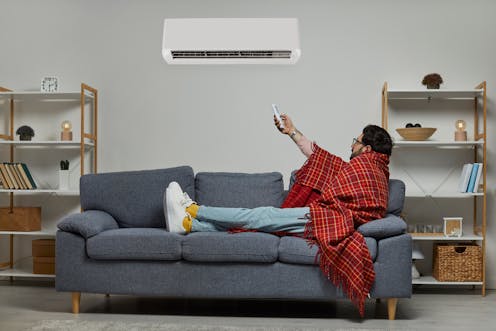
Researchers and policymakers are advocating all-electric housing to reduce energy bills and emissions. Using energy-efficient reverse-cycle air conditioners is a core element of the shift from gas.
However, not everyone is happy with the change. “I just don’t feel warm,” said some people we interviewed after they switched to reverse-cycle air conditioning.
Others are very happy with the comfort, hundreds of dollars in savings and low lifetime carbon emissions.
How can different people have such varied experiences with the same technology? Our computer modelling of air flows in the home offers an answer: the quality of the building’s insulation makes a big difference to how people feel with reverse-cycle heating.
What’s different about this heating?
Reverse-cycle air conditioners are different from traditional gas or electric heaters. They produce warm, not hot, air, and the unit is usually mounted high on a wall. This is a suitable position for cooling but not so effective for heating.
When cooling, output air cools the hot air near the ceiling and the air movement provides a complementary cool breeze.
In heating mode, the warm outlet air cools down as it flows along surfaces such as the ceiling, external walls, windows and floor and mixes with cool air. It is then drawn back to the air conditioner where it is reheated.
If the building is poorly insulated and has single-glazed windows, the surface temperatures in the home are low and heat losses and temperature drops are high. The cooled air flowing close to the floor creates a “wind chill” effect – it feels like a cold draught.
Also, our warm bodies radiate heat to the cold surfaces of the walls and windows. This means we tend to feel even colder when we are near them.
In contrast, the surfaces of insulated walls, ceilings, floors and windows stay warmer and allow much less heat loss. When the heated air touches them, it stays relatively warm as it flows back to the air conditioner to be reheated. The air circulating in the room is warmer, which reduces the “wind chill” effect.
Because the surfaces of insulated walls and windows are much warmer, our bodies also radiate much less heat to them, so we feel warmer.
Read more: Cooking (and heating) without gas: what are the impacts of shifting to all-electric homes?
Our modelling shows these effects
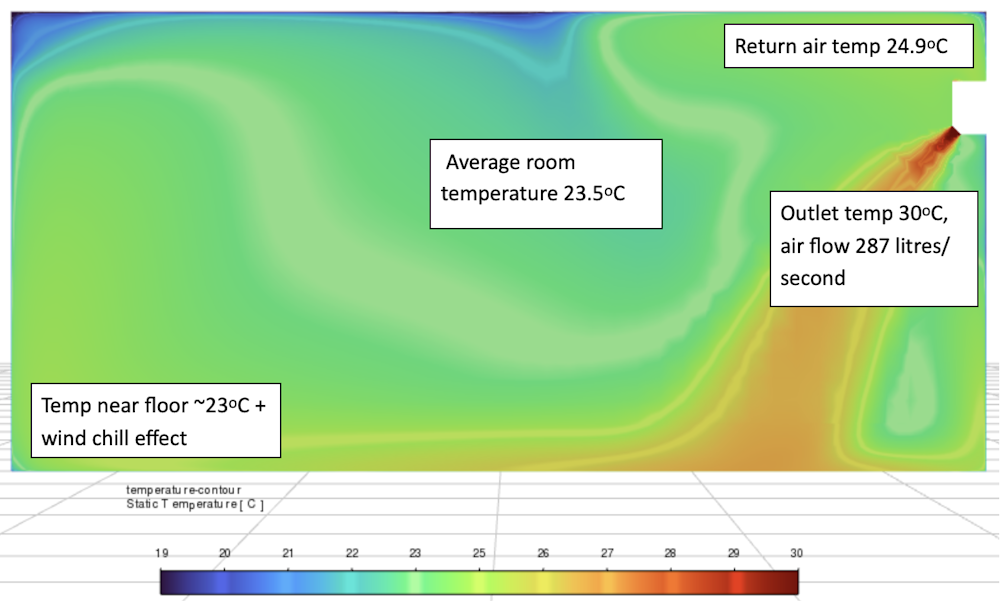
We modelled the heating energy and temperature distributions in a living room of a 1960s home. It had large areas of glazing on two side walls, an internal end wall and a reverse-cycle air conditioner mounted high on the external end wall.
Case 1 was uninsulated with single glazing. Case 2 had insulated walls, ceiling and floor and double glazing.
The temperature distributions are shown below.
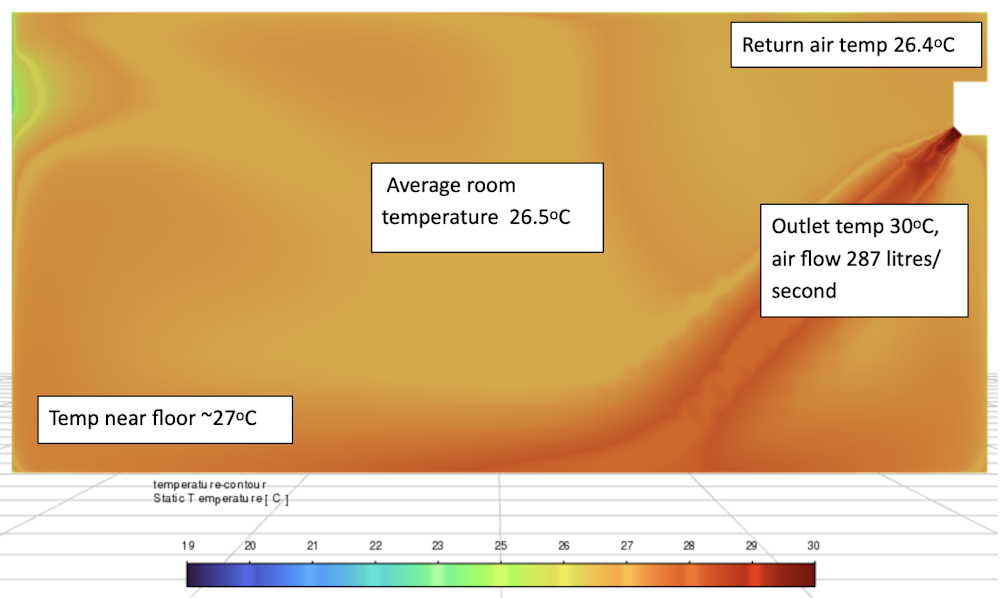 Case 2: temperature distribution in insulated room with double glazing.
Authors
Case 2: temperature distribution in insulated room with double glazing.
Authors
Read more: Want an easy $400 a year? Ditch the gas heater in your home for an electric split system
For both scenarios, the outdoor temperature was 10℃. The air conditioner delivered 287 litres of heated air per second at a constant 30℃. This meant average room air temperatures were higher than if the thermostat was set at a typical 20–22℃ with heat output varying.
This simplification showed how different the temperatures were in the two cases for the same amount of heat supply.
In case 1, as the heated output air contacted the cold, uninsulated surfaces, its temperature dropped so the average room temperature was 23.5℃. Air returning to the air conditioner was 24.7℃, 5.3℃ lower than the outlet air.
Case 2 had a higher average room temperature of 26.5℃ with a return air temperature of 26.4℃. The surfaces of the walls, ceiling and floor were warmer, which increased comfort by reducing radiant heat loss from occupants. Since the return air was warmer, about 30% less energy was used to reheat it to the 30℃ outlet temperature.
What does this mean for home heating?
These modelling results seem to explain people’s experiences of discomfort. The policy and technology implications are significant.
If reverse-cycle air conditioning is to deliver improved comfort, it should be combined with upgrading the building’s thermal performance. Programs that subsidise reverse-cycle air conditioners and heat pumps should be linked to retrofitting adequate insulation and draught sealing.
Occupants will not only be more comfortable, but the air conditioner can be smaller and cheaper. Carbon emissions and energy costs will be lower too.
Further research is needed to explore a wider range of situations. There can be different combinations of insulation, varying areas of glazing and window coverings, and other appliance-related options such as floor-mounted reverse-cycle air conditioners and ceiling fans.
If we want people to embrace heat pumps and reverse-cycle air conditioners as the new normal, we must ensure they provide the comfortable temperatures people want and need. Push-back due to feelings of discomfort may undermine progress towards a zero-emission future.
We need to understand the interactions between heating and cooling technologies and real-world buildings much better. We also need to make sure policy does not lock in certain technologies without fully understanding their impacts.
Authors: Alan Pears, Senior Industry Fellow, RMIT University

















