

Modern Australian
The Times

Australia is leaving thousands of international graduates in visa limbo, and it’s about to get worse

  • Written by Brendan Coates, Program Director, Economic Policy, Grattan Institute

Many international students come to Australia with the hope of staying permanently.

But our latest report, Graduates in limbo: International student visa pathways after graduation, shows that the rights Australia grants international students to stay and work here after they graduate are too generous, offering many false hope.

Australia offers graduating students much longer temporary visas than our main competitors for international students, such as Canada, the UK and the US.

But many temporary graduate visa holders struggle to pursue their chosen careers in Australia, with

  • only half securing full-time employment
  • most working in low-skilled jobs
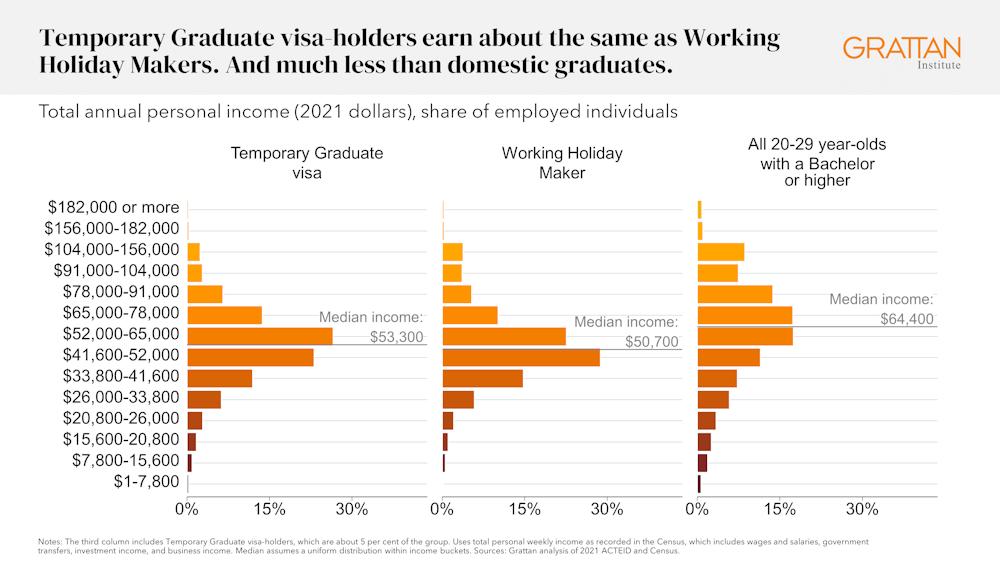
  • and half earning less than A$53,300 a year, compared to just one-third of all graduates.

Outcomes are often not matching the effort

More than half of these visa holders work in jobs that don’t even require a tertiary qualification. In fact, the incomes of temporary graduate visa holders look more like those of working holiday makers, most of whom come to Australia to travel.
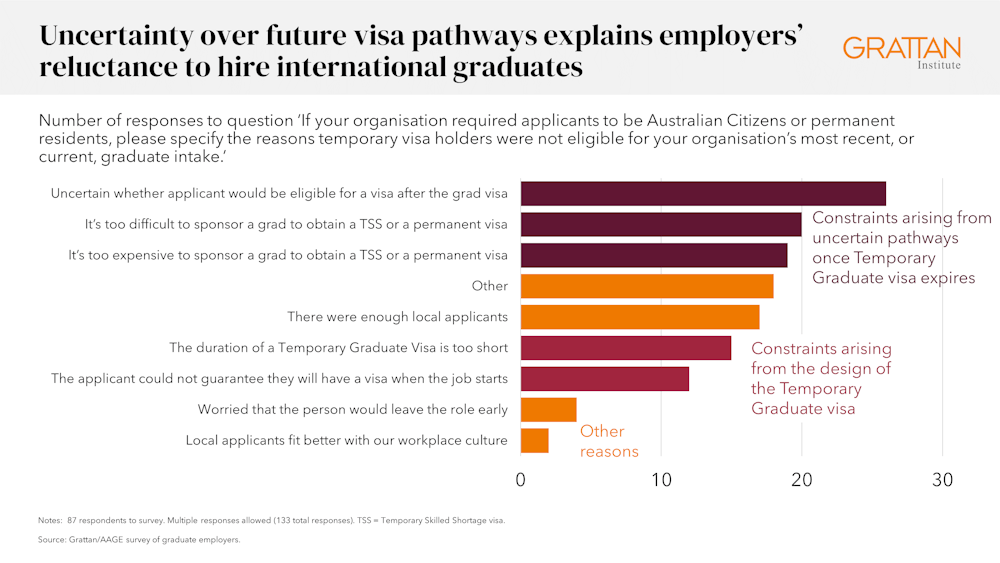
A new Grattan Institute survey of employers shows many are reluctant to hire international graduates, especially because of uncertainty about whether they can stay and work in Australia once their temporary graduate visa expires. Other evidence suggests that poor English language skills, the poor education some students receive and discrimination are also important factors. Fewer international graduates now get permanent visas A growing number of international graduates are stuck in visa limbo in Australia, with less than one-third of temporary graduate visa holders now transitioning to permanent residency when their visa expires, down from two-thirds in 2014. One in three return to further study here once their visa expires, mostly in cheaper vocational courses, to prolong their stay in Australia. Encouraging so many international graduates to stay and struggle in Australia is in no one’s interests. It damages the reputation of our international higher education sector and erodes public trust in our migration program. It hurts the long-term prospects of those graduates who do stay permanently. It adds to population pressures and housing prices. And it’s unfair to those graduates who invest years in Australia with little prospect of securing permanent residency. And recent policy changes will only make this problem worse. The Albanese government’s decision at last year’s Jobs and Skills Summit to extend the length of temporary visas for international graduates is a big reason why we should expect their numbers to nearly double to about 370,000 by 2030. Some students studying in the regions can now stay and work in Australia on a temporary visa for up to eight years after they graduate. Unless the number of permanent visas on offer each year rises, which seems unlikely, many more graduates will be left in limbo in the future. And that’s despite the government pledging to reduce the number of migrants in Australia in “permanently temporary limbo”. The government needs to reverse course, and quickly. Here’s what it should do. Stop offering false hope First, Australia should offer shorter post-study work visas to international graduates: just long enough to identify which graduates would make good prospects for permanent residency. Visa extensions currently on offer for graduates with degrees in nominated areas of shortage, and for those living in the regions, should be scrapped. Read more: Australian universities have dropped in the latest round of global rankings – should we be worried? Instead, graduates should be eligible for an extension to their visa only if they earn at least $70,000 a year – a good sign that they’ll eventually secure a permanent skilled visa. Grattan Institute modelling shows that these reforms could result in the number of international graduates on temporary visas in Australia growing only modestly, to 260,000 by 2030. That’s 110,000 fewer than if current policies remain in place. Fix visa pathways for talented graduates Second, Australia should fix the pathways for talented graduates after they finish their temporary graduate visa. The current system rewards persistence, encouraging students to make education and career decisions to secure permanent residency rather than making decisions that benefit their careers in the long-term. We need to make it easier for employers to sponsor migrants if they earn a high wage, rather than the current system of restricting sponsorship to an outdated list of nominated occupations. And we should select permanent skilled migrants who come here without a sponsor, based on our assessment of the characteristics that point to them succeeding in Australia long-term. Do more to help international graduates find good jobs And last, Australia should do more to help international graduates to thrive here. The government should launch a campaign designed to change employer attitudes about new graduates, and public sector graduate programs should accept international graduates. Read more: Australia wants international students to stay and work after graduation. They find it difficult for 4 reasons The federal government should publish detailed league tables of the employment outcomes of international graduates, including their earnings, to shame universities into supporting international graduates to build careers in Australia. The price of policy inaction is clear: Australia will host an ever-larger pool of international graduates living in limbo. Authors: Brendan Coates, Program Director, Economic Policy, Grattan Institute

Read more https://theconversation.com/australia-is-leaving-thousands-of-international-graduates-in-visa-limbo-and-its-about-to-get-worse-214471

Road Signs: Understanding Their Role in Clear and Effective Signage

Effective signage and display hardware can help businesses communicate information, promote products and organise customer or visitor movement. Road...

Bottle Label Printing: Key Factors to Consider Before Your Next Packaging Run

Effective packaging begins with understanding the product, bottle material, artwork and production requirements when planning bottle label printing. H...

Planning a Long-Distance Move With Interstate Movers Melbourne

Moving between states involves more planning than a typical local relocation. Along with packing and transporting household belongings, you need to...

Understanding the Role of an I/O Controller in Industrial Automation

Modern industrial systems depend on accurate communication between sensors, machines and control systems. An I/O controller can help manage this commu...

How the Right Mining Hose Supports Demanding Operations

Mining environments place considerable demands on equipment used for material transfer, water management and processing. Hoses operating in these co...

Simple Ideas for Making Social Gatherings More Memorable

We have all been to those parties where everyone just stands around the kitchen island, staring at their phones, waiting for someone else to make a mo...

Outdoor Wall Lights: Improving Exterior Lighting Around Your Home

Lighting can influence how a room looks, feels and functions, so the right fitting should be selected according to both appearance and practical req...

Commercial Office Cleaning: Combining Routine Office Cleaning With Melbourne Service

Keeping a workplace clean requires a service that can accommodate everyday tasks as well as the particular needs of the business. Professional comme...

Caravan Sales in Queensland: How to Find the Right Caravan for Sale QLD

Caravan ownership is about more than having somewhere to sleep while travelling. For many Queenslanders, it is one of the best ways to explore regio...

What Sir Walter Buffalo Turf Actually Costs in 2026 (And Why Quotes Vary So Much)

Two quotes landed on a Hills District homeowner's kitchen table last spring for the exact same 80-square-metre backyard. One said $12 a metre. The o...

Nearly 1,300 NSW Hospital Beds Are Occupied By People Who Are Ready To Go Home

1,276 people in NSW hospitals have been medically cleared for discharge but remain in hospital because they're still waiting for NDIS or aged care sup...

National Survey Launched to Measure Operational Impacts of Federal NDIS Policy Reforms

The effects of recent NDIS reforms are beginning to move beyond policy papers and into day to day service delivery. A new national survey is asking ...

Beyond the Nappy Cake: Baby Shower Gifts That Get Used

What new Australian parents unwrap, keep, and quietly thank you for months later. Six weeks after my daughter was born, I did an audit of the baby sh...

Parent-Advocates Are Reshaping Frontline Disability Service Delivery

Parents have always been part of the disability sector. They advocate, coordinate services, challenge decisions and often become the person holding ev...

Vista Cruises Enters "Two-Flagship Era" as Vista Aurora Completes Inaugural Voyage

Vista Aurora Sets Sail along the Yangtze. (Photo courtesy of the company)YICHANG, China — August 5, 2026 — Vista Aurora, a high-end interprovinc...

A Digital Preparation Checklist For International Medical Conferences

An international medical conference compresses many responsibilities into a few days. A delegate may need to present research, move between venues, ...

The Growing Popularity of Lab Grown Diamonds in Sydney and Hong Kong

The diamond industry has changed significantly in recent years as more buyers seek ethical, affordable, and sustainable alternatives to mined diamon...

Modern AI SEO Agency vs Traditional SEO: What’s the Difference

Search engine optimisation has changed dramatically over the past few years. Search engines have become smarter, user behaviour has evolved, and bus...
















