

Humpback whales hold lore for Traditional Custodians. But laws don't protect species for their cultural significance
- Written by Jack Pascoe, Research fellow, The University of Melbourne
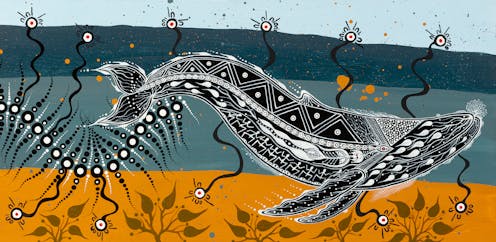
Aboriginal and Torres Strait Islander readers are advised this article contains names of deceased people.
For saltwater people of Australia’s east and west coasts, humpback whales hold important lore in the form of stories.
For the Yuin people of the east coast, this story is one of a binding promise between whales (Gurawal) and people, as our old mentor and Elder, Uncle Max Harrison taught us.
The ancestors of the whales lived on Country with our old people. One day, Gurawal went to the Elders and asked to be allowed to live in Gadu, the ocean. The Elders agreed on the condition that Gurawal would hold the lore of the ocean, returning it to the land when required, just as the people would hold the lore of the land.
When Gadu rose up and covered significant parts of Country – when Bass Strait flooded and Tasmania became an island – Yuin people were confused and fearful. But, as Gadu engulfed the plains and swept up toward the mountains, Gurawul came to their aid, blowing bubbles to show a clear path. In this way, Gurawul led the people to safety on the higher grounds of Country, keeping the promise that had been made to the Elders.
This species and its story are of special significance to Yuin people. It’s similar to how dingoes are held in high regard for many mobs who consider them to be spiritual relatives. That’s why those mobs have called for an end to the routine killing of dingoes.
But to date, the ability to list species of cultural significance is not possible under Australian law. It’s time for that to change.
Why should we recognise culturally significant species?
Last month, Australia marked Threatened Species Day by adding 48 more species to the list threatened with extinction. The government has pointed to these listings as a commitment to ensuring there are no more extinctions.
It’s important to acknowledge the clear threats to our native species and plan for their protection and survival. Extinctions make a poorer world for us and for future generations.
However, as three Indigenous ecologists, we argue this approach of affording species greater protection only when they become threatened, falls short of our cultural obligation to care for Country when applied to species of cultural significance.
As Traditional Custodians we have a complex relationship with Country which extends to kinship with plants, animals and ecological communities.
This binds us to follow lore through reciprocal care. Furthermore, additional responsibilities for some species require greater recognition of their significance. Waiting for these species to decline in order to show them care represents a failure to uphold lore.
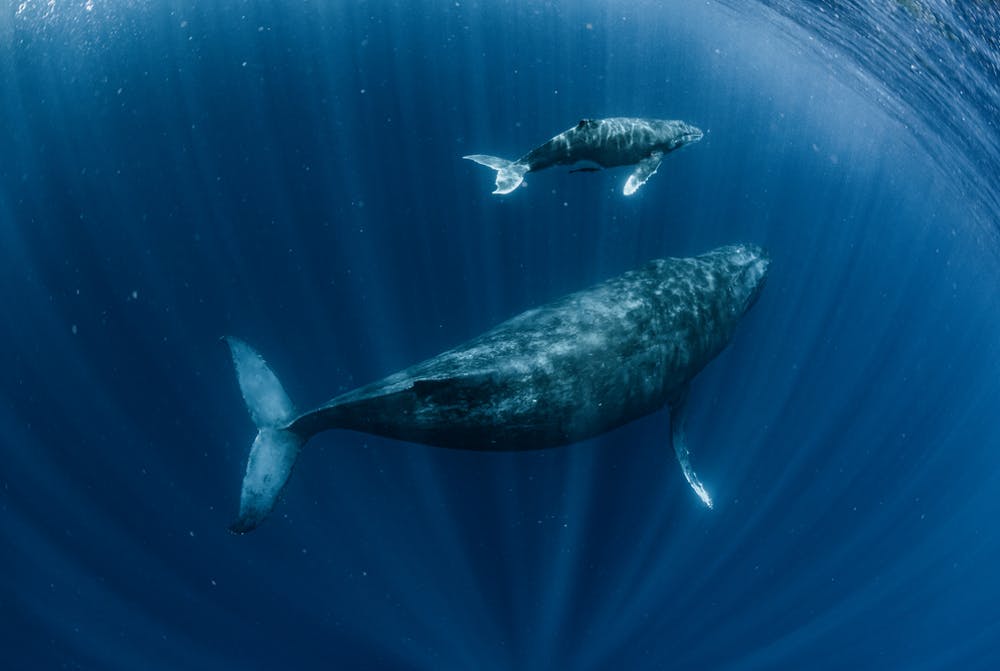
Humpback numbers are recovering after industrial whaling of the species ended in 1963. As a result, they have been taken off the list of threatened species. But that doesn’t mean they aren’t at risk.
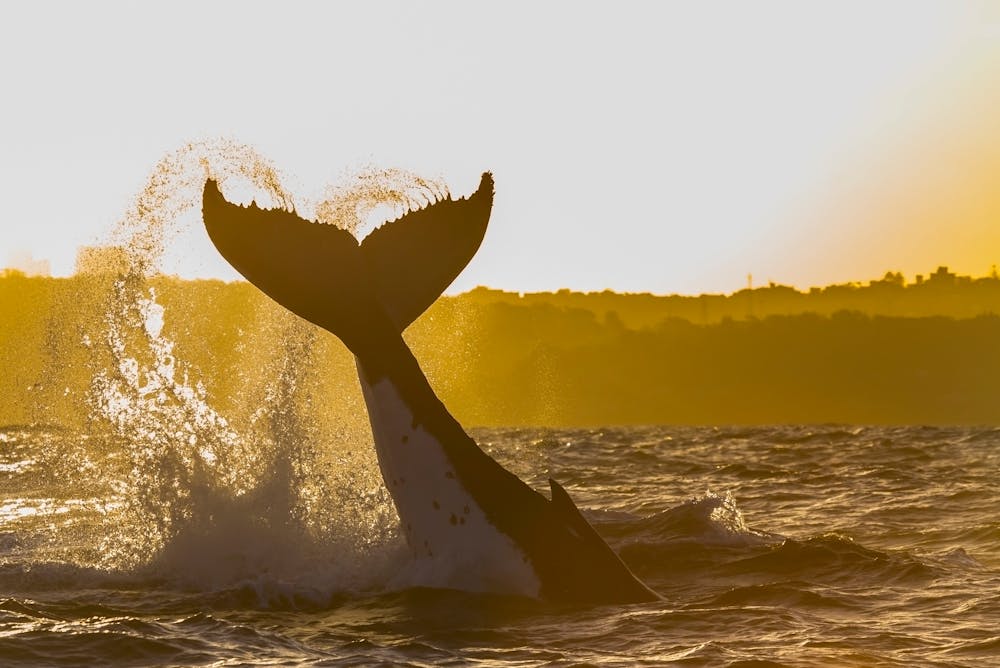 Humpback whales have migrated along Australia’s coastlines for millennia.
Shutterstock
Humpback whales have migrated along Australia’s coastlines for millennia.
Shutterstock
For instance, ghost nets and ship strikes can hurt or kill whales. And when gas companies use seismic blasting to find gas reservoirs under the sea bed, the soundwaves can disrupt how whales communicate or migrate. This can mean whales are unable to follow their ancient songlines or migratory paths, teach their young and share their songs.
For the Yuin people, like many saltwater peoples, whales are Elders of the sea and their loss to human misconduct cannot be tolerated. The loss of an Elder of the sea reduces the collective memory of Gurawul and their ability to hold the lore of the ocean.
If we allocate funding and research based only on whether a species is threatened or not, we risk losing the tangible and intangible elements of cultural heritage and the First Nations knowledge of a species.
Right now, Australia’s government is reforming our biodiversity laws – widely seen as not fit for purpose. First Nations heritage protection laws are also likely to be updated.
Read more: 'The boss of Country', not wild dogs to kill: living with dingoes can unite communities
That means we have a singular chance to embed species of cultural significance into law. We cannot let this opportunity slip past.
Our research calls for the ability to recognise culturally significant entities in law, which could include species, ecosystems, seascapes and landscapes.
If Traditional Custodians can formally list entities of cultural significance, we could improve their care and ensure ongoing connection with them for future generations.
 For saltwater people like the Yuin, the importance of the ocean and its inhabitants was laid down in lore.
Shutterstock
For saltwater people like the Yuin, the importance of the ocean and its inhabitants was laid down in lore.
Shutterstock
Laws are the start
Changes to legislation alone will not guarantee greater consideration of Indigenous Knowledge and the value of species.
For instance, Canada’s Species of Risk act has a mandated requirement to consult Indigenous peoples. But less than half of its recovery and management plans include Indigenous Knowledge and values. So while tailored legislation sets a clear mandate, it’s just the first step.
Another step is to realign policy and practice to make possible traditional management of culturally significant species. This could achieve much, even without a change to the laws.
For this to work, the management of culturally significant entities must be guided by Traditional Custodians.
Will we Australians – known lovers of the ocean – take up the challenge of caring for the entities that live in Gadu Country, under the guidance of Traditional Custodians?
Gurawul kept his promise. Will we?
Read more: What should happen to native forests when logging ends? Ask Victoria's First Peoples
Authors: Jack Pascoe, Research fellow, The University of Melbourne

















