

Holes in baby dinosaur bones show how football-sized hatchlings grew to 3-tonne teens
- Written by: Roger S. Seymour, Professor Emeritus of Physiology, University of Adelaide
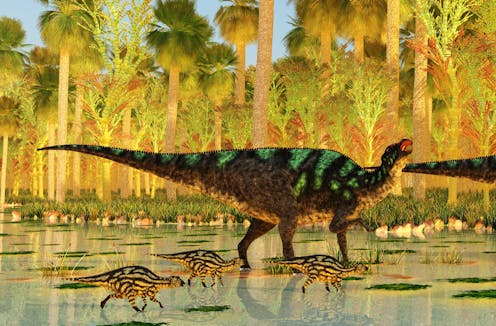
Despite their public image as torpid, lumbering creatures, many dinosaurs were evidently warm-blooded, highly active animals, capable of prolonged and strenuous aerobic exercise.
In new research, my colleagues and I determined how much energy minibus-sized dinosaurs called Maiasaura used while growing to adulthood.
Our results, published in the journal Paleobiology, show Maiasaura was capable of taking in huge amounts of energy and nutrients and using them for rapid growth and levels of activity comparable to those of modern mammals.
How bones heal and grow
Living an active lifestyle can leave traces in the skeleton. Locomotion and weight-bearing activity cause stresses and strains that result in microfractures in the bones. If these tiny cracks build up, the outcome can be a catastrophic fracture.
Fortunately, the leg bones of dinosaurs – like those of birds, mammals and varanid lizards such as the Komodo dragon – repair themselves in a process known as bone remodelling.
This occurs by blood capillaries growing through old bone, which is dissolved and replaced by new bone. Under the microscope, the new bone can be seen as column-like structures called “secondary osteons”.
Read more: How smart were our ancestors? Turns out the answer isn't in brain size, but blood flow
Many palaeontologists have looked for and found these secondary osteons in dinosaur bones as evidence for the bone remodelling that is characteristic of warm-blooded animals.
However, little attention has been given to the bones of juvenile dinosaurs, in which primary bone is being laid down in a process called bone modelling.
The main impediment to this research is the shortage of collections of bones from a single dinosaur species at different stages of growth.
‘Good mother reptile’
Possibly the best growth series of dinosaur bones in the world comes from the fossil beds of the Two Medicine Formation in the US state of Montana.
Fossils from this formation have yielded much information about the eggs, hatchlings and early lives of a dinosaur named Maiasaura (meaning “good mother reptile”).
This herbivorous hadrosaur apparently tended her eggs and raised her offspring for more than a year after hatching.

Young Maiasaura grew astonishingly fast, reaching 200-400 kilograms by their second year, and over 3,000kg by their teens.
In comparison, cold-blooded saltwater crocodiles today weigh only about 6kg at the age of two, and reach adulthood at between ten and 16 years old, when females weigh about 34kg and males about 115kg.
Such high growth rates in Maiasaura involved rapid lengthening and thickening of their long bones, and the process doubtlessly required much oxygen and nutrients from the blood.
The shafts of long bones of the leg, such as the femur (thigh bone) and tibia (shin bone), are supplied with blood by the principal nutrient artery, which enters the bone through a hole (called a foramen) that is visible on the surface.
How to measure blood flow from bones
A decade ago, I wondered whether the size of the foramen could be an indirect measurement of the rate of blood flow to a bone.
This turned out to be true, and since then the “foramen technique” has been used on fossils to estimate blood flow rate and hence how much energy and nutrients were used in the bones of adult dinosaurs.
To apply the foramen technique to the fast-growing juvenile Maiasaura, I teamed up with Heath Caldwell, a student at Montana State University, who searched for the tiny foramina among the fossil collection at the Museum of the Rockies in Bozeman, Montana.
Holly Woodward of Oklahoma State University had previously determined the ages of the animals when they died. Qiaohui Hu at Adelaide University used the best techniques for measuring foramen size and relating it to nutrient artery size.
Rapid growth doesn’t come cheap
Our work produced clear results. Blood flow rates calculated from foramen size were similar in one-year-old dinosaurs weighing between 189kg and 455kg and in six- to 11-year-old adults weighing between 1,680kg and 3,200kg.
In other words, a one-year-old had about four times as much blood flowing to each gram of its shinbone as a full-grown adult did. The flow rate per gram in the femur of a two kilogram hatchling Maiasaura was 15 times higher than that of the adults.
Read more: Hot fuss: is warm-blooded dinosaur theory right or wrong?
These differences reveal how much more energy and nutrients it took to build bones in the early rapid growth stages of a Maiasaura’s life than it did to maintain the bones in adulthood.
The size of the foramen in adults was also comparable to those in mammals alive today, and much larger than in most modern reptiles. These findings support the view that dinosaurs were not cold-blooded and sluggish, but warm-blooded, very active, fast-growing animals that dominated the Mesozoic landscape.
Authors: Roger S. Seymour, Professor Emeritus of Physiology, University of Adelaide


















