Modern Australian
The Times

Australia's emissions must decline more steeply to reach climate commitment: OECD

  • Written by Michelle Grattan, Professorial Fellow, University of Canberra
Australia's emissions must decline more steeply to reach climate commitment: OECD

Australia’s emissions need to decline “on a much steeper trajectory” if it is to meet its declared commitment of a 43% reduction by 2030 and net zero by 2050, the Organisation of Economic Co-operation and Development says.

In its report on Australia, released as part of its Going For Growth update on Tuesday, the OECD recommends Australia develop

a national, integrated long-term emissions reduction strategy with clear goals and corresponding policy settings to achieve climate targets.

The OECD also suggests broadening the scope of Australia’s so-called Safeguard Mechanism, which at present regulates the emissions of Australia’s 215 biggest polluting facilities.

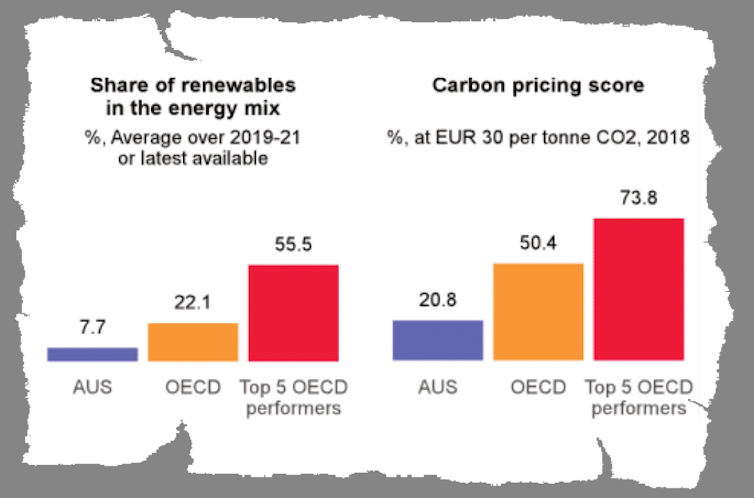
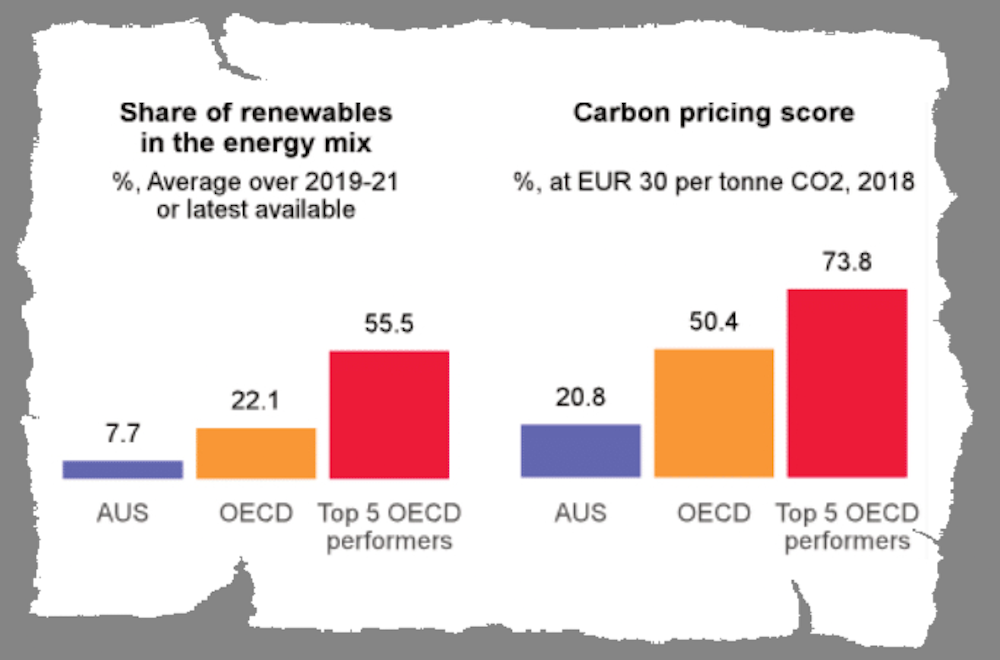
It awards Australia a score on carbon pricing well below the OECD average and even further below that of the top OECD performers.

It says the share of renewables in Australia’s energy supply averaged only 7.7% between 2019 and 2021, compared to an average of 22.1% for OECD members, and 55.5% for the top performers.

OECD, Going for Growth 2023 The OECD is a forum of 38 mainly high-income countries, including Australia, that describe themselves as committed to democracy and market economies. The report is critical of Australia’s performance on a number of other fronts, including income support for the unemployed, job market flexibility and the recognition of trade qualifications. It says Australia’s JobSeeker unemployment benefit remains among the lowest in the OECD and below the relative poverty line when compared to the wages available from work. The Albanese government has increased the rate of JobSeeker in the May budget. The report recommends the government consider “further increasing” it. Declining productivity, declining competitiveness The OECD finds signs of “reduced competitive intensity” in product markets, as well as falling labour mobility. “Productivity growth has also slowed down.” It says about one in five workers needs a licence to do their work, raising economic costs, and calls for automatic mutual recognition of licenses across states. Access to fast broadband is low compared to other developed countries, and the take-up of digital technologies by businesses can be improved, the report says. The OECD also draws attention the “large” gaps in economic and wellbeing measures between Indigenous and other Australians. It recommends the government “embed the Productivity Commission Indigenous Evaluation Strategy in the policy design and evaluation process of all Australian government agencies”. Workforce transformation needed for 2050 target Meanwhile, a report prepared by Jobs and Skills Australia entitled The Clean Energy Generation: workforce needs for a net zero economy says the government’s 2050 net-zero emissions target will require a transformation in the workforce that is “substantial but not unprecedented”. “Like the post-war industrial transformation and the digital transformation of the late twentieth century, a new generation of workers will be required, both from existing energy sectors and through new pathways into clean energy. New jobs, skills, qualifications, training pathways, technologies and industries will emerge over the next 30 years,” the report says. “Australia will need to consider the full range of levers across the education, training, migration, procurement, and workplace relations systems to ensure a sustainable and equitable path towards net zero.” Treasurer’s response to OECD Treasurer Jim Chalmers said the Albanese government was acting on the areas identified in the OECD report. Its policies were “focused on maximising the opportunities of the energy transformation, embracing digitalisation and new technology and investing in our people and their skills so that we can build a more productive, prosperous and dynamic economy”. “We’re securing faster progress towards decarbonisation through our safeguard mechanism, over $40 billion of investment in the energy transformation, our sustainable finance strategy, and establishing a new Net Zero authority to train workers and prepare communities for new opportunities here,” Chalmers said. Authors: Michelle Grattan, Professorial Fellow, University of Canberra

Read more https://theconversation.com/australias-emissions-must-decline-more-steeply-to-reach-climate-commitment-oecd-214851

Plantation Shutters vs Curtains: Which Is Better for Your New Home?

Moving into a new home is an exciting opportunity to personalise your space and make it your own. While many homeowners focus on furniture, flooring...

Celebration of Life vs Traditional Funeral: What's the Difference?

When saying goodbye to someone you love, there is no single way to honour their life. Every family has different traditions, beliefs, and preference...

Building Approval for Roofing Projects: What Homeowners Need to Know

Roofing projects are an important part of maintaining and protecting your home. Whether you're repairing storm damage, replacing an ageing roof, or ...

Chatswood Tutoring And Its Role In Academic Achievement

Academic success often requires more than classroom attendance alone. Students face increasing expectations as they progress through school, particu...

Why Laser Hair Removal Treatments Continue Growing In Popularity

Managing unwanted hair can become time-consuming and frustrating for many people, especially when shaving, waxing, and other temporary methods requi...

Choosing the Right Devices for a Flexible Workplace

For IT leaders managing large fleets, the device layer is where workforce productivity and security policy meet. The shift towards flexible and hybrid...

How Business Advisory Services Help Companies Achieve Sustainable Growth

Every business owner aims to build a profitable and sustainable organisation. While dedication, innovation, and hard work are important, achieving l...

Why Body Contouring Has Become A Popular Cosmetic Treatment

Many people maintain healthy lifestyles through regular exercise and balanced eating habits but still struggle with stubborn areas of fat that are d...

How to Choose the Right POS Hardware for Your Business in Australia

A lot of Australian business owners spend weeks researching POS software but buy hardware almost as an afterthought. That's a mistake. The wrong har...

Why Material Handling Hose Is Critical for Industrial Efficiency

A high-performance material handling hose is an essential component in industries that transport abrasive, dry, or bulk materials on a daily basis...

How to Choose the Right Lawyer in Melbourne for Your Situation

Choosing legal support can feel difficult, especially when the stakes are personal or business-related. The right lawyer in Melbourne should underst...

Hoteliers Look to Clever Value Adds to Increase Revenue

The Australian hospitality industry is still in recovery mode after a notoriously rough patch in recent years. While there has been a post-COVID tra...

Moving to Queensland? Here’s How to Prep Your Car for the Big Move North

There’s no sign of the northern migration slowing down, with thousands of southerners fleeing from chaotic lifestyles and cooler climates for a brig...

Diesel Shortage to Impact Trades and Contractors

Strait of Hormuz blockage affecting all major parts of trades and construction Trades and construction across residential, commercial and industria...

Why Holiday Home Owners Turn to Rental Management Agents

The Allure — and the Reality — of Renting Out Your Property Owning a holiday home is a dream for many Australians. Whether it's a beachside sha...

Why Finding Reliable Doctors In Bundoora Is Important For Long-Term Health

Access to quality healthcare plays an important role in maintaining overall wellbeing and managing health concerns early. Trusted Doctors in Bundoor...

Understanding the Different Types of Car Services: Minor vs Major

When it comes to car maintenance, one of the most important things every vehicle owner should understand is the difference between a minor and a maj...

How Superannuation and TPD Insurance Work Together

Superannuation is an essential part of financial planning in Australia. It is designed to provide individuals with income during retirement, helping...