

From glowing cats to wombats, fluorescent mammals are much more common than you'd think
- Written by Kenny Travouillon, Curator of Mammals, Western Australian Museum
Recently, several mammals have been reported to “glow” under ultraviolet (UV) light, including our beloved platypus. But no one knew how common it was among mammals until now.
Our research, published in Royal Society Open Science today, found this glow – known as fluorescence – is extremely common. Almost every mammal we studied showed some form of fluorescence.
We also examined the glow to determine if it was really fluorescence and not some other phenomenon. Then, we tested if the fluorescence we observed in museum specimens was natural and not caused by preservation methods.
We also searched for links between the type and degree of fluorescence and the lifestyle of each species, to gain insights on whether there are any benefits to glowing under UV if you’re a mammal.
Nightclub lights
Nightclub visitors will be familiar with white clothes, or perhaps their gin and tonic, glowing blue under UV light. This is a great example of fluorescence – when the energy from UV light, which is a form of electromagnetic radiation invisible to humans, is absorbed by certain chemicals.
These chemicals then emit visible light, which is lower-energy electromagnetic radiation. In the case of gin and tonic, this is due to the presence of the quinine molecule in the tonic water.
In the case of animals, this can be due to proteins or pigments in their scales, skin or fur. Fluorescence is quite common among animals. It has been reported for birds, reptiles, amphibians, fish, corals, molluscs and most famously scorpions and other arthropods.
However, it has been described less frequently in mammals, although recent studies have provided several examples. We already knew that bones and teeth glow with fluorescence, as do white human hair and nails. Some rodents have a pink glow under UV light and platypuses glow blue-green.
Read more: Explainer: what is the electromagnetic spectrum?
How often do mammals glow?
Our team came together because we were curious about fluorescence in mammals. We wanted to know if the glow reported recently for various species was really fluorescence, and how widespread this phenomenon was. We obtained preserved and frozen specimens from museums and wildlife parks to study.
We started with the platypus to see if we could replicate the previously reported fluorescence. We photographed preserved and frozen platypus specimens under UV light and observed a fluorescent (although rather faint) glow.
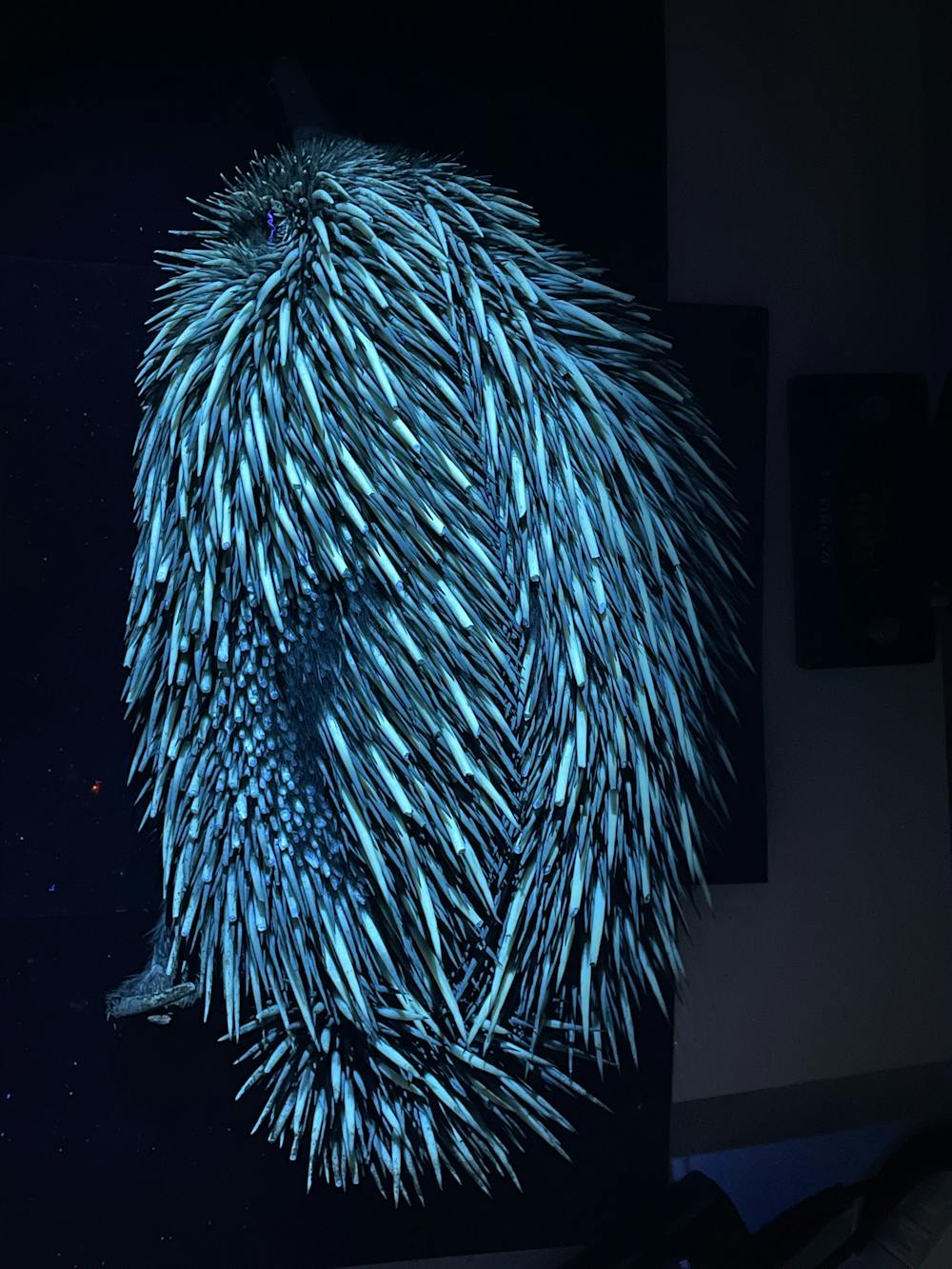 Echidna spikes are fluorescent as well.
Kenny Travouillon, Author provided (no reuse)
Echidna spikes are fluorescent as well.
Kenny Travouillon, Author provided (no reuse)
To make sure it was fluorescence and not some other effect that looked like it, we used a technique called fluorescence spectroscopy.
This involved shining various sources of light at the samples and recording the specific “fingerprints” of the resulting glow, known as an emission spectrum. This way, we could confirm what we saw was indeed fluorescence.
We repeated this process for other mammals and found clear evidence of fluorescence in the white fur, spines and even skin and nails of koalas, Tasmanian devils, short-beaked echidnas, southern hairy-nosed wombats, quendas (bandicoots), greater bilbies and even cats.
Both fresh-frozen and chemically treated museum specimens were fluorescent. This meant it wasn’t preservation chemicals such as borax or arsenic causing the fluorescence. So, we concluded this was a real biological phenomenon.
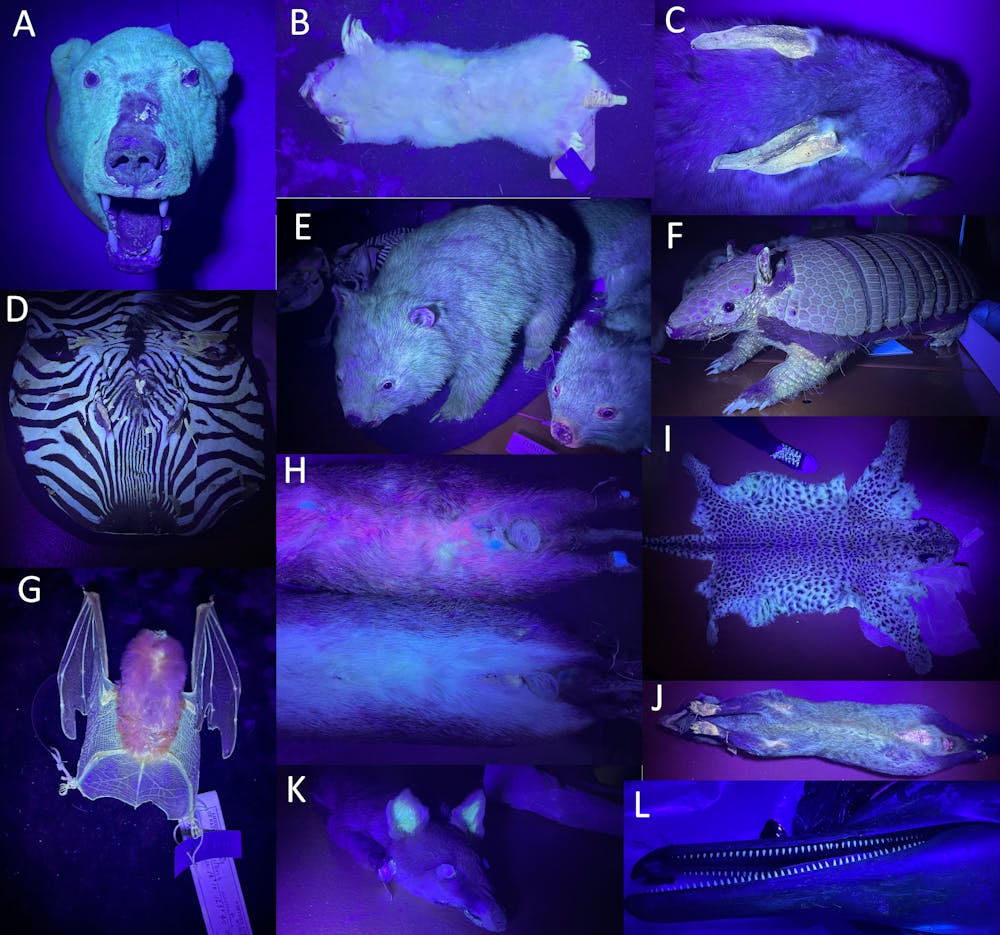 A selection of glowing mammal specimens in the WA Museum collection: A) polar bear, B) southern marsupial mole, C) greater bilby, D) mountain zebra, E) bare-nosed wombat, F) six-banded armadillo, G) orange leaf-nosed bat, H) quenda, I) leopard, J) Asian palm civet, K) red fox, L) dwarf spinner dolphin.
Kenny Travouillon, Author provided (no reuse)
A selection of glowing mammal specimens in the WA Museum collection: A) polar bear, B) southern marsupial mole, C) greater bilby, D) mountain zebra, E) bare-nosed wombat, F) six-banded armadillo, G) orange leaf-nosed bat, H) quenda, I) leopard, J) Asian palm civet, K) red fox, L) dwarf spinner dolphin.
Kenny Travouillon, Author provided (no reuse)
Mammals in dazzling lights
Using specimens from the Western Australian Museum’s collection, we took the experiment to the next stage. We recorded every species of mammal that was fluorescent when we exposed the specimens to UV light.
As a result, we found 125 fluorescent species of mammal, representing all known orders. Fluorescence is clearly common and widely distributed among mammals.
In particular, we noticed that white and light-coloured fur is fluorescent, with dark pigmentation preventing fluorescence. For example, a zebra’s white stripes fluoresced while the dark stripes didn’t.
Read more: Zebra's stripes are a no fly zone for flies
We then used our dataset to test if fluorescence might be more common in nocturnal species. To do this, we correlated the total area of fluorescence with ecological traits such as nocturnality, diet and locomotion.
Nocturnal mammals were indeed more fluorescent, while aquatic species were less fluorescent than those that burrowed, lived in trees, or on land.
Based on our results, we think fluorescence is very common in mammals. In fact, it is likely the default status of hair unless it is heavily pigmented. This doesn’t mean fluorescence has a biological function – it may just be an artefact of the structural properties of unpigmented hair.
However, we suggest florescence may be important for brightening pale-coloured parts of animals that are used as visual signals. This could improve their visibility, especially in poor light – just like the fluorescent optical brighteners that are added to white paper and clothing.
Authors: Kenny Travouillon, Curator of Mammals, Western Australian Museum


















