

It's not just Victoria's iconic mountain ash trees at risk – it's every species in their community
- Written by David Lindenmayer, Professor, The Fenner School of Environment and Society, Australian National University
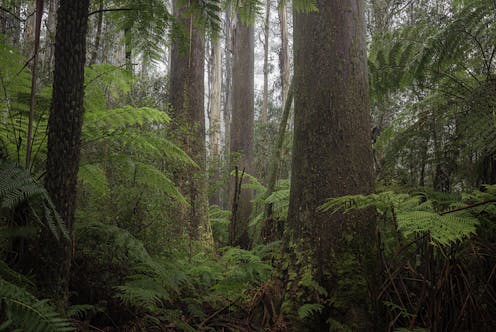
When we think of extinction, we think of individual species. But nature doesn’t operate like that. Entire communities and even whole ecosystems are now so compromised they could be lost entirely. Australia now has about 100 ecological communities at risk.
One of those is the iconic Mountain Ash (Eucalyptus regnans) community in Victoria’s Central Highlands. Many of us know and love these regal trees, the tallest flowering plant in the world. But decades of logging, repeated wildfires, and fragmentation of these forests means they and the species which rely on them like Leadbeater’s possum and gliders now face existential threats.
In our new research, we point to the need to list the entire community as threatened.
How can ecological communities go extinct?
Australia is an enormous contributor to global biodiversity loss. A recent study found 97 species in Australia have now gone extinct since British colonisation in 1788, with roughly 10% of all native mammal species gone forever. The numbers would be higher if invertebrate losses were included.
Worldwide, roughly a million species are now at risk of extinction. Looming loss at this scale threatens entire ecological communities – or even whole ecosystems.
Under Australia’s biodiversity laws, ecological communities can be listed as threatened, endangered or critically endangered. About 100 ecological communities – defined as assemblages of species in a particular habitat – are currently at risk. But even this figure is likely to be a massive underestimate.
Many ecological communities are not on this list even though they probably should be. The reason for that is a lack of good data.
To find out whether a community is threatened requires a thorough assessment of many species and key ecological processes using high-quality long-term data.
These kinds of data aren’t available for many communities. But we have 40 years of detailed data for the Central Highlands Mountain Ash forests. So to find out whether they are truly threatened, we undertook a detailed assessment.
Why are these forests at risk of collapse?
These forests cover 140,000 hectares near Victorian towns like Marysville, Warburton and Healesville. They’re rich in biodiversity, including several threatened mammals and plants.
We focused on the Central Highlands because this area is home to the largest remaining forests of Mountain Ash – 44% of all remaining forest.
Much elsewhere has been lost. In South Gippsland, plantations, dairy and potato farms have replaced Mountain Ash forests, with only small fragments left.
Tasmania’s Mountain Ash forests are important, albeit less extensive than those in Victoria’s Central Highlands.
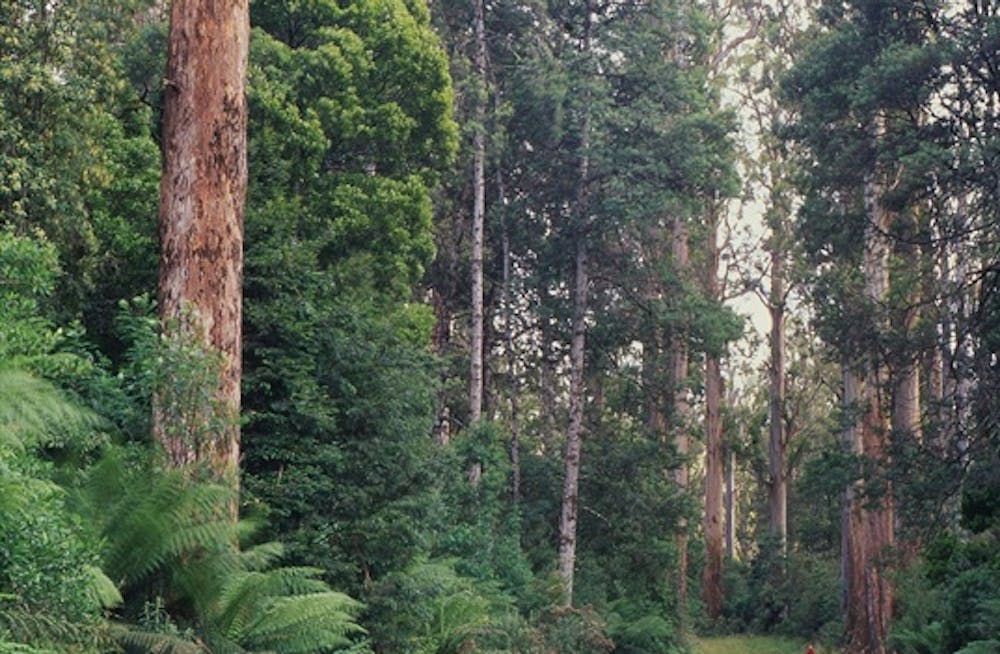
Our conclusion? Sadly, the Central Highlands Mountain Ash community is now eligible for listing as either endangered or critically endangered.
These forests are now largely regrowth. Many have been fragmented, making it harder for wildlife to cross between patches. Biodiversity is still declining, including threatened species, while changing fire regimes are placing intensive pressure on the remaining forests.
What happened here? These forests have been subject to decades of intensive clearfell logging, as well extensive cutting dating back to the late 1920s.
These pressures have made old growth a vanishing rarity, accounting for just over 1% of the remaining 137,000 hectares of Mountain Ash forest in the Central Highlands. The rest of the forest is often highly degraded.
The loss of almost all old growth has been devastating for species like Leadbeater’s possum, the southern greater glider and the yellow-bellied glider over the past 25 years. These animals must have nesting hollows to survive, and these only form when large old trees lose limbs - a process that can take well over 100 years.
And because the Mountain Ash community is dominated by younger trees, it is now at risk of reburning. Younger trees are highly fire-prone – even those regenerating from the Black Saturday fires of 2009. This has left the entire ecological community vulnerable to future fires.
Our analysis found nearly 70% of these forest communities are already either severely disturbed by fire and logging or exist within 70 metres of severely disturbed areas.
What would happen if Mountain Ash communities collapse?
These pressures have pushed these forests to the edge. They could readily collapse and be replaced by an entirely different community, dominated by wattles and prone to more fire, more often.
The collapse of the Mountain Ash community would have catastrophic implications for the five million people who live in Melbourne. The city’s famously good drinking water relies almost entirely on run-off from Mountain Ash forest to the east.
You might wonder – won’t the ending of industrial logging in January help? It might – if we undertake a massive restoration effort. Many tracts of forest are simply not regenerating after logging – up to 30%.
Restoring tree cover, species diversity and making the ecosystem functional again will take a great deal of work.
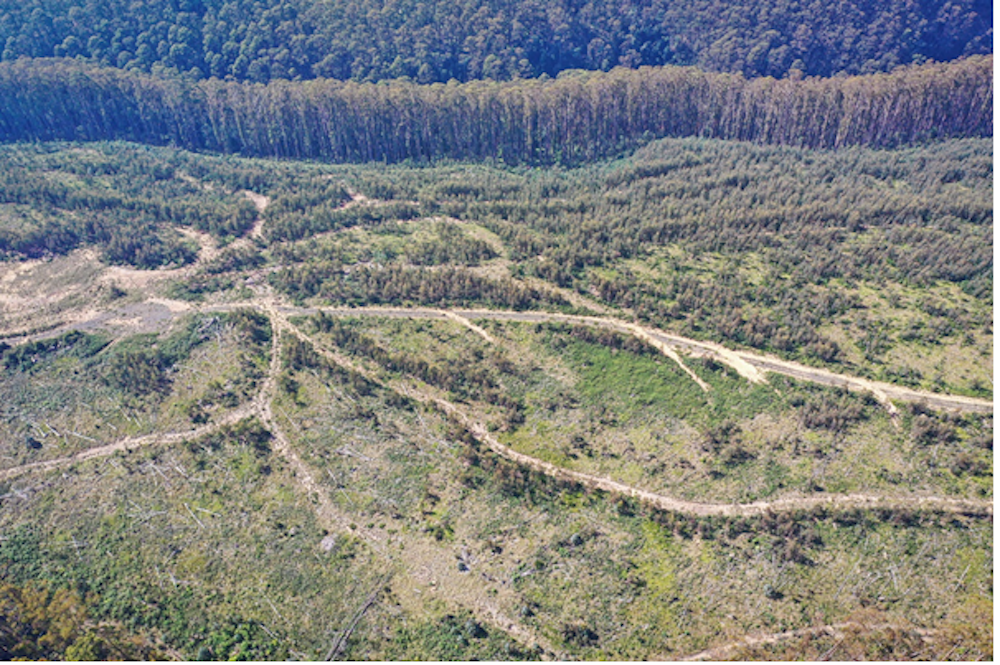 Nature will bounce back, won’t it? Not always, as the failure of mountain ash to regenerate after logging or fire demonstrates.
Chris Taylor/Lachlan McBurney, CC BY-NC-ND
Nature will bounce back, won’t it? Not always, as the failure of mountain ash to regenerate after logging or fire demonstrates.
Chris Taylor/Lachlan McBurney, CC BY-NC-ND
What can we do?
The case is compelling for listing Victoria’s Mountain Ash community as threatened.
Huge efforts will be required to stop the populations of animals such as the southern greater glider from plunging. Recently, we have been testing new nesting box designs to help populations recover. These boxes are meant to be a stop-gap substitute as nesting hollows to replace natural cavities.
We’ll also have to do our best to keep out high-intensity wildfire from as many areas of Mountain Ash forest as possible, so the young trees have a chance to mature and develop hollows.
This kind of restoration is compatible with efforts by conservationists to declare a Great Forest National Park to protect Mountain Ash communities.
It’s well established that protecting areas does work. For example, an estimated 25% of the world’s bird species are alive today because they have been protected in reserves.
Listing an ecological community as threatened isn’t a one-way street to extinction. We can – and have – reversed the damage for other communities and species. We need do it for Mountain Ash forests, and it must be done now.
Authors: David Lindenmayer, Professor, The Fenner School of Environment and Society, Australian National University

















