

'No' campaign is dominating the Voice debate among Chinese Australians on WeChat: new research
- Written by: Fan Yang, Research fellow at Melbourne Law School, the University of Melbourne and the ARC Centre of Excellence for Automated Decision-Making and Society., The University of Melbourne
Some 1.4 million Australians are of Chinese ancestry, or about 5.5% of the population. Given the size of the community, it will be an important voting bloc in the upcoming referendum on a Voice to Parliament for First Nations people.
But while the government and the “yes” and “no” campaigns are translating some information into Chinese, it appears very little is gaining traction in the Chinese Australian online community.
According to our research, the Voice referendum has garnered limited attention on WeChat, the popular Chinese messaging app, compared to discussions on other issues, such as immigration, the economy and property prices.
As we draw closer to the referendum, we’ve also seen right-wing political rhetoric and misinformation come to dominate what little online discussion there has been.
Our research found the “no” campaign was resonating much more than “yes” on WeChat, particularly among conservative voices within the community. Among the 339 comments we collected and analysed, the vast majority (about 98.5%) leaned towards voting “no”, while just five comments unequivocally expressed support for the “yes” side.
Read more: Friday essay: Australia may ban WeChat – but for many Chinese Australians, it's their 'lifeline'
Translated media reports
Our study used a tool called WeCapture to collect and archive public posts and comments on WeChat related to the referendum.
Between February and September, we collected more than 110 public posts, two short videos and 339 public comments in total. None of the posts had more than 20,000 views – showing how little the debate has resonated with Chinese Australians.
We were only able to analyse public WeChat accounts, as opposed to private discussions between individuals or in groups. As a result, commercial media accounts run by Chinese migrants, such as sydtoday, meltoday, AFNDaily, and melvlife, played a pivotal role in shaping these discussions.
Many of these posts were translated news reports on the Voice from the English-language media. These posts covered a broad range of topics, including explanations on the scope of the proposed Voice, analysis of Australian public sentiment about the Voice and reports on “yes” and “no” campaign rallies.
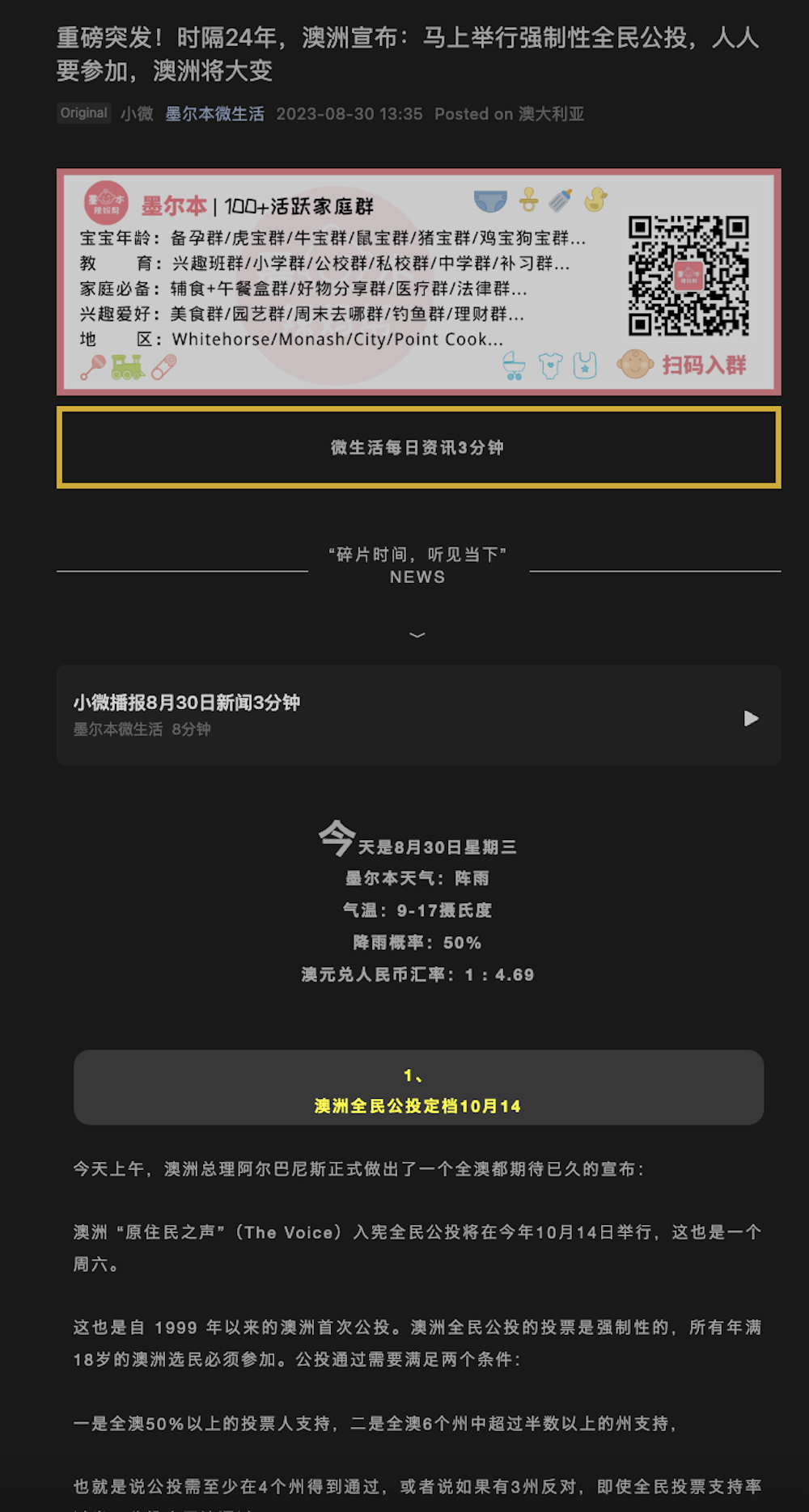
We found these media accounts sometimes editorialised the translated English sources to align with readers’ expectations and the accounts’ business imperatives. For instance, in the screengrab of a WeChat post below, the headline reads:
Breaking news! After 24 years, Australia has announced: an immediate mandatory nationwide referendum will be held. Everyone must participate. Australia is about to undergo significant changes.
This translation conveys a sense of emergency and ambiguity to entice WeChat users to click on the link.
Posts from the official groups
Other posts came from the Australian Electoral Commission (AEC), the Victorian Labor Party, the Yes Campaign Alliance and other content producers, also translated into Mandarin. These appeared on influential WeChat media accounts such as sydtoday and Mel_life.
The AEC posted a series of sponsored articles to explain the Voice and the voting procedure (as seen in the post below). The AEC posts were much more formal and official sounding than most public posts on WeChat.
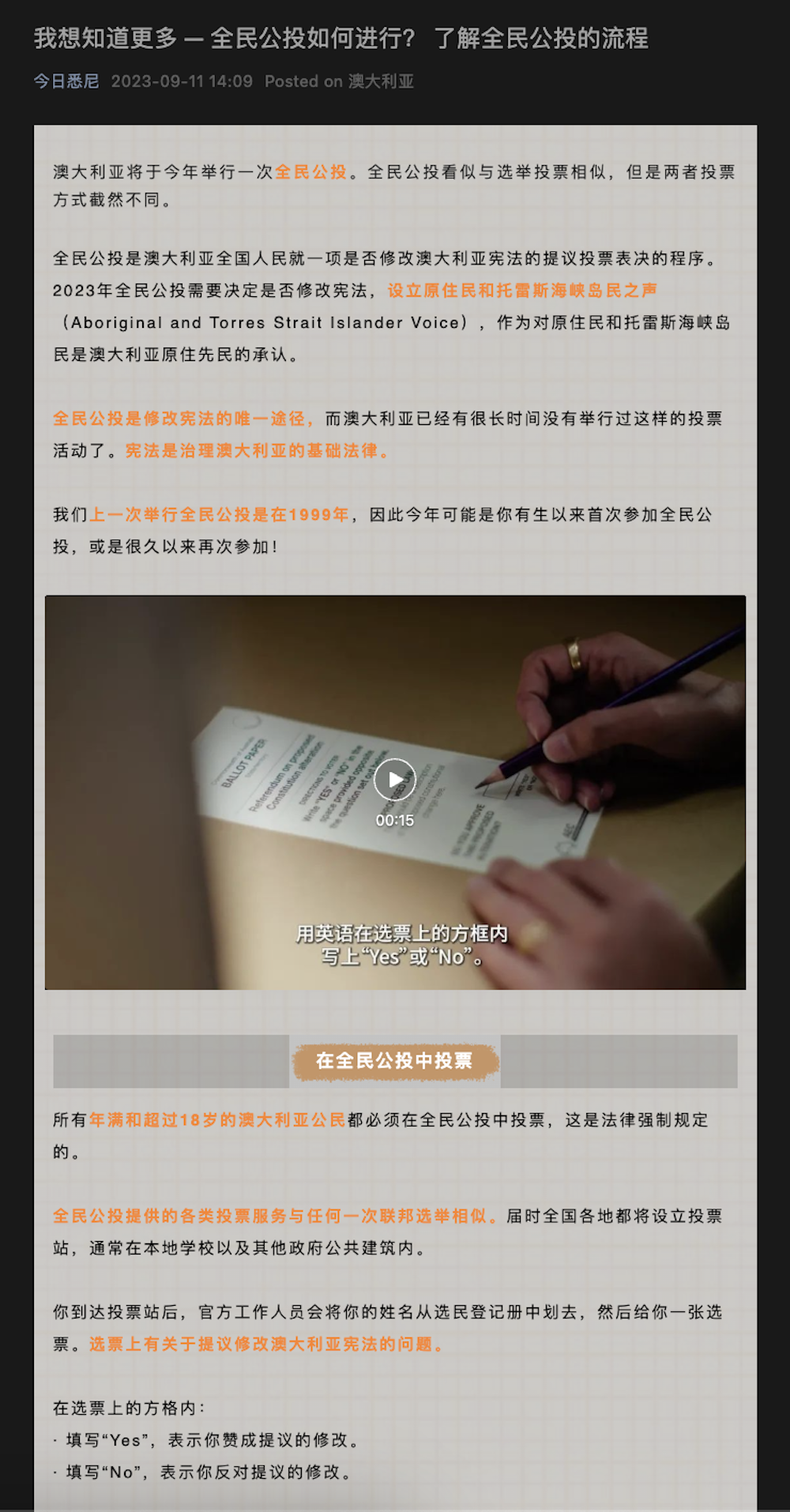 A sponsored article from the AEC, entitled: ‘I’d like to know more - How does the referendum work? Know about the process!’
The “yes” campaign has also embedded image banners within WeChat posts, such as the one below, authorised by Dean Parkin, director of the Yes Campaign Alliance.
And in a short video posted the Victorian Labor Party, Carina Garland, the MP for Chisholm, conducted an interview with Attorney-General Mark Dreyfus to explain the Voice referendum and its significance. The video, which features Chinese subtitles and is specifically targeting Chinese Australians, only received 20 likes and was shared just 25 times. It also got no comments from WeChat users.
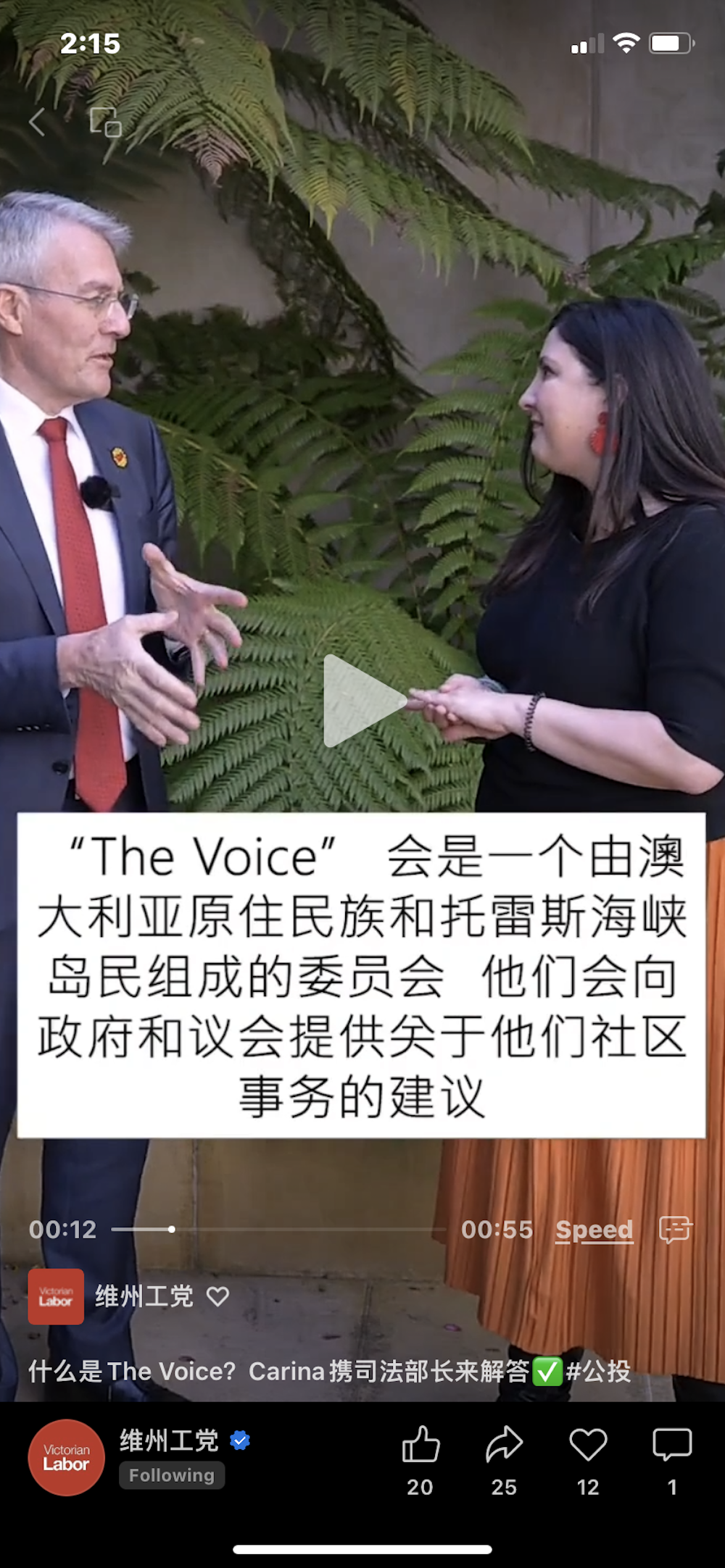 A screenshot of Carina Garland and Mark Dreyfus’s interview.
Posts from ‘no’ campaigners
In our research, we found WeChat users who were leaning towards a “no” vote had many concerns, including:
fears the Voice could somehow disempower the Chinese Australian community
the perception taxes could increase due to Labor’s “leftist politics”
skepticism towards the Albanese government
fears the Voice could lead to “racial divide” and “apartheid” in Australia
and the prevalence of conspiracy theories associated with white supremacy ideologies.
One account named YamiChew has published a series of “no” campaign videos. The profile says the owner of the account transitioned from a professional career in Beijing to an immigrant life in Melbourne.
The account underwent a notable transformation at the end of September, from posting videos of the family dog to advocating for the “no” campaign. Compared to most WeChat posts about the referendum, YamiChew’s first video gained significant traction on the platform, with over 10,000 reposts, 1,800 likes and more than 300 comments within 24 hours of its release.
The video listed four reasons to vote “no”, which included claims that have been dismissed elsewhere as misinformation, such as concerns over the Voice’s impact on Australia’s “constitutional integrity”, fears of “racial inequality” if the referendum succeeded, and claims it would lead to “Indigenous priviledge”.
Why countering misinformation matters
Migrants from diverse socio-cultural backgrounds possess varying levels of literacy regarding Indigenous affairs.
As a result, Australian public institutions need to craft messages that are not only linguistically accessible, but also adapted to the information consumption habits of migrant communities.
The government also needs to take steps to address the amount of misinformation in the Chinese-language media and social media.
The government’s bill to curb the online spread of false and misleading information, for instance, does not include non-English-language platforms in its scope.
On WeChat, misinformation that is not directly linked to Beijing’s political interests tends to fall outside the scope of platform regulators.
This means it’s up to public institutions to counter misleading information. They can do this by working with local communities to provide credible information on all matters of public interest, not just during the referendum campaign.
Read more: Australia's media has been too white for too long. This is how to bring more diversity to newsrooms
The author would like to acknowledge Robbie Fordyce from Monash University and Luke Heemsbergen from Deakin University for their participation in the research project.
Authors: Fan Yang, Research fellow at Melbourne Law School, the University of Melbourne and the ARC Centre of Excellence for Automated Decision-Making and Society., The University of Melbourne


















