

There are 750 unidentified human remains in Australia. Could your DNA help solve one of these cold cases?
- Written by Jodie Ward, Associate Professor, Centre for Forensic Science, University of Technology Sydney
Yesterday it was announced the Australian Federal Police (AFP) National DNA Program for Unidentified and Missing Persons used advanced DNA technology to assist South Australia Police resolve a 40-year-old missing persons case.

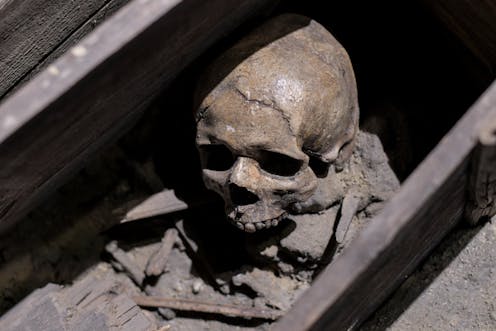
In January 1983, skeletal remains were found in roadside scrub on Kangaroo Island. Forensic testing over the years revealed he was male, middle-aged, of European ancestry, blue-eyed, 162–173cm tall and wore full dentures.
But it wasn’t until June 2023 that advances in forensic genomics and genealogy gave William Hardie his name back.
The AFP DNA program used similar technology to direct-to-consumer DNA testing companies like AncestryDNA and 23andMe. These companies market themselves as a DNA-based way to explore your ancestral origins by simply sending in a saliva sample. But how is this technology used to solve cold cases?
Read more: If you've given your DNA to a DNA database, US police may now have access to it
We share pieces of DNA with our relatives
All humans are more than 99% genetically identical. The genetic differences in the remaining 1% of the genome are what hints at our ancestors, as well as coding for other distinctive traits (for example, facial features and height).
Most consumer DNA testing companies use microarrays to survey this non-identical DNA. Microarrays target a small fraction of the genome – up to a million genetic variants called single nucleotide polymorphisms or SNPs.
The reason we can match our DNA to relatives is because we inherit it from each of our biological parents. On average, half of our DNA (including the identical and non-identical parts) is shared with our parents and siblings – first degree relatives.
Going further, we share roughly a quarter of our DNA with second degree relatives, and an eighth with third degree relatives. As the genetic distance increases, we generally share fewer and smaller pieces of DNA.
Even so, it’s possible to detect the few small pieces of DNA we share with our ancestors (and their descendants) going back many generations.
 The pieces of DNA shared with relatives generally get fewer and smaller each generation they are removed from you in the family tree.
Louise Coakley, Author provided (no reuse)
The pieces of DNA shared with relatives generally get fewer and smaller each generation they are removed from you in the family tree.
Louise Coakley, Author provided (no reuse)
Read more: How do we identify human remains?
A challenge for forensic samples
But there are unique challenges for forensic scientists trying to identify human remains using ancestral DNA. In long-term missing persons cases, often the only remains found are skeletal.
In this scenario, DNA has to be extracted from bones or teeth. However, the DNA contained in these hard tissues will degrade with time and exposure to adverse environmental conditions (for example, long periods in soil and seawater).
As a result, the quantity and quality of extracted DNA is often insufficient for microarray analysis. Whole genome sequencing – which can recover all 3.2 billion letters that make up the genetic code – is proving more successful for such samples, but it’s not yet available in Australian forensic laboratories.
To overcome these challenges, the AFP DNA program recently validated a forensic DNA kit for use in their accredited laboratory. The kit employs targeted sequencing to focus on about 10,000 SNPs.
While this new method doesn’t analyse as much DNA as microarrays or whole genome sequencing, it is enough to link genetic relatives up to the fifth degree (for example, second cousins or great-great-great grandparents), or sometimes further.
Combing through public databases and records
Once a SNP profile is obtained – and after all other avenues of inquiry have been exhausted – the AFP DNA program will upload it to the GEDmatch PRO and FamilyTreeDNA databases for comparison to the profiles of citizens who have volunteered their DNA to be used in this way.
If suitable genetic matches are found, a genetic genealogist will use public information to build out their family trees until they discover (typically deceased) ancestors in common. From there, they will research relevant family lines to find closer (ideally living) relatives of the unknown individual.
They may also work with police who can use investigative techniques, non-public information and targeted DNA testing to fill in some branches of the tree and rule out others. The aim is to find a present-day family with a missing or unaccounted-for relative.
This process is known as forensic investigative genetic genealogy. It has revolutionised John and Jane Doe investigations and other humanitarian efforts in the United States. However, its use in Australia is still growing. It is also just one of many forensic identification tools and often used as a last resort.
750 unidentified and 2,500 missing persons
Currently, there are around 2,500 long-term missing persons and 750 unidentified human remains in Australia.
AFP DNA program specialists are supporting state and territory police to identify these nameless individuals, link them to missing people and reunite them with families who’ve missed them for years.
So far, the AFP DNA program has been instrumental in resolving 46 cases. This includes identifying the remains of 15 missing Australians, including Mario Della Torre, Owen Ryder, Tanya Glover and Francis Foley.
How can you help if you have a missing relative?
First, you should report them missing to the police if you haven’t already. Provide all known information relevant to the forensic investigation (including physical appearance, medical history and dentist’s details).
Second, you can provide a reference DNA sample. This simple procedure involves you swabbing the inside of your cheek and can be done at your local police station when making a missing persons report.
Your DNA profile will be uploaded to Australia’s national DNA database so it can be compared to DNA profiles from unknown deceased persons across Australia with your consent.
This is critical for decades-old missing persons cases where few close genetic relatives remain.
You can help if you’ve taken a consumer DNA test
You may be distantly related to one of the unknown Australians without even knowing it.
Anyone who has done a consumer DNA test can potentially help identify missing people. To do so, you need to download your DNA data file, upload it to GEDmatch and choose to opt in or out of “law enforcement matching”.
If you opt in, you consent to your DNA being included in searches by police worldwide for the purpose of identifying human remains and solving violent crimes like homicides.
If you opt out, your DNA can still be used by the AFP DNA program to resolve unidentified and missing persons cases, but it won’t be used for criminal cases.
Without the leads from distant genetic relatives who had previously opted in to this type of DNA matching, it wouldn’t have been possible to connect human remains found on Kangaroo Island in 1983 to the family of William Hardie, who’ve missed him for over 40 years.
Read more: Is your genome really your own? The public and forensic value of DNA
Authors: Jodie Ward, Associate Professor, Centre for Forensic Science, University of Technology Sydney

















