

how the South American jacaranda became a symbol of Australian spring
- Written by Susan K Martin, Emeritus Professor in English, La Trobe University
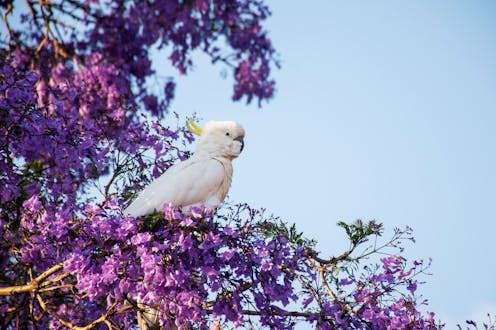
Jacaranda season is beginning across Australia as an explosion of vivid blue spreads in a wave from north to south. We think of jacarandas as a signature tree of various Australian cities. Sydney, Melbourne, Adelaide and Perth all feature avenues of them.
Grafton in New South Wales hosts an annual jacaranda festival. Herberton in Queensland is noted for its seasonal show.
There are significant plantings in many botanic, public and university gardens across Australia. Jacaranda mimosifolia (the most common species in Australia) doesn’t generally flower in Darwin, and Hobart is a little cold for it.
So showy and ubiquitous, jacarandas can be mistaken for natives, but they originate in South America. The imperial plant-exchange networks of the 19th century introduced them to Australia.
But how did these purple trees find their stronghold in our suburbs?
Propagating the trees
Botanist Alan Cunningham sent the first jacaranda specimens from Rio to Britain’s Kew gardens around 1818.
Possibly, jacaranda trees arrived from Kew in colonial Australia. Alternately, Cunningham may have disseminated the tree in his later postings in Australia or through plant and seed exchanges.

Jacarandas are a widespread imperial introduction and are now a feature of many temperate former colonies. The jacaranda was exported by the British from Kew, by other colonial powers (Portugal for example) and directly from South America to various colonies.
Jacarandas grow from seed quite readily, but the often preferred mode of plant propagation in the 19th century was through cuttings because of sometimes unreliable seed and volume of results.
 The jacaranda plantation at Angorichina Hostel in South Australia’s Flinders Ranges.
State Library South Australia
The jacaranda plantation at Angorichina Hostel in South Australia’s Flinders Ranges.
State Library South Australia
Cuttings are less feasible for the jacaranda, so the tree was admired but rare in Australia until either nurseryman Michael Guilfoyle or gardener George Mortimer succeeded in propagating the tree in 1868.
Once the trees could be easily propagated, jacarandas became more widely available and they began their spread through Australian suburbs.
Read more: Why there's a lot more to love about jacarandas than just their purple flowers
A colonial import
Brisbane claims the earliest jacaranda tree in Australia, planted in 1864, but the Sydney Botanic Garden jacaranda is dated at “around” 1850, and jacarandas were listed for sale in Sydney in 1861.
These early park and garden plantings were eye-catching – but the real impact and popularity of jacarandas is a result of later street plantings.
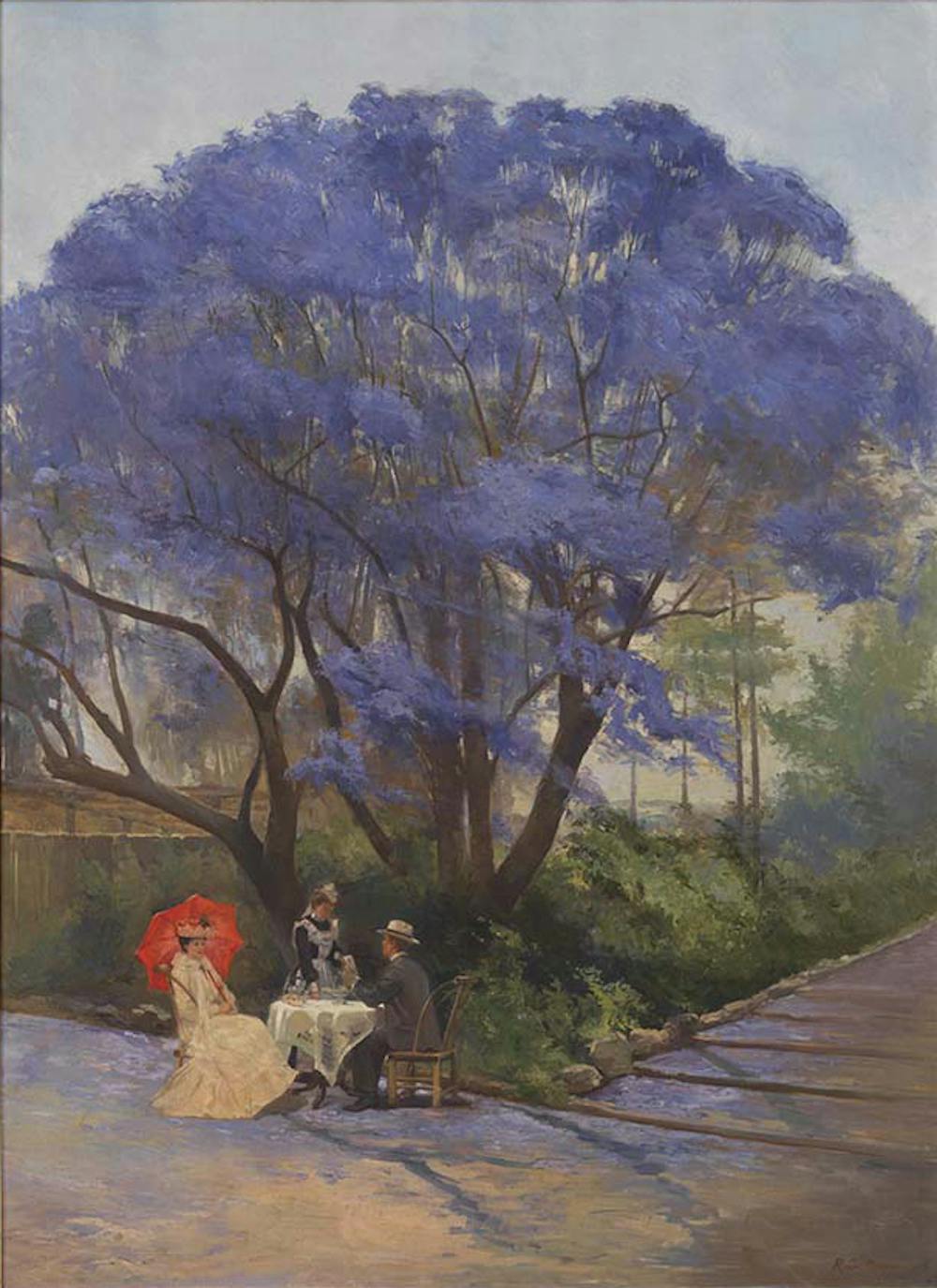 R. Godfrey Rivers, Under the jacaranda ,1903. Oil on canvas, 143.4 x 107.2cm. Purchased 1903.
Collection: QAGOMA
R. Godfrey Rivers, Under the jacaranda ,1903. Oil on canvas, 143.4 x 107.2cm. Purchased 1903.
Collection: QAGOMA
Jacaranda avenues, in Australia and around the world, usually indicate wealthier suburbs like Dunkeld in Johannesberg and Kilimani in Nairobi.
In Australia, these extravagant displays appear in older, genteel suburbs like Subiaco and Applecross in Perth; Kirribilli, Paddington and Lavender Bay in Sydney; Parkville and the Edinburgh Gardens in North Fitzroy in Melbourne; Mitcham, Frewville and Westbourne Park in Adelaide; and St Lucia in Brisbane.
The trend toward urban street avenue plantings expanded internationally in the mid 19th century. It was particularly popular in growing colonial towns and cities. It followed trends in imperial centres, but new colonial cities offered scope for concerted planning of avenues in new streets.
 Ethel Carrick, A Jacaranda avenue, (c. 1943)
National Gallery of Victoria
Ethel Carrick, A Jacaranda avenue, (c. 1943)
National Gallery of Victoria
Early Australian streets were often host to a mix of native plants and exotic imported trees. Joseph Maiden, director of the Sydney Botanic Gardens from 1896, drove the move from mixed street plantings towards avenues of single-species trees in the early 20th century.
Maiden selected trees suitable to their proposed area, but he was also driven by contemporary aesthetic ideas of uniformity and display.
By the end of the 19th century, deciduous trees were becoming more popular as tree plantings for their variety and, in southern areas, for the openness to winter sunshine.
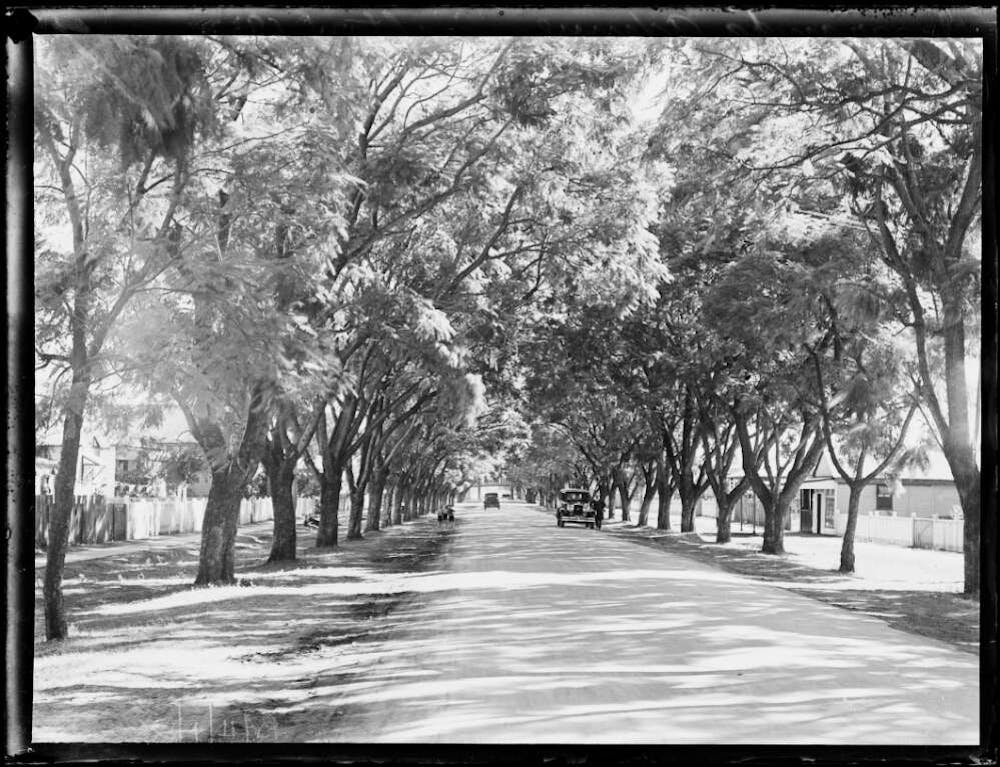 Jacaranda Avenue, Grafton, New South Wales, 1932.
National Library of Australia
Jacaranda Avenue, Grafton, New South Wales, 1932.
National Library of Australia
It takes around ten years for jacaranda trees to become established. Newly planted jacarandas take between two and 14 years to produce their first flowers, so there was foresight in planning to achieve the streets we have today.
In Melbourne, jacarandas were popular in post-first world war plantings. They were displaced by a move to native trees after the second world war. Despite localised popularity in certain suburbs, the jacaranda does not make the list of top 50 tree plantings for Melbourne.
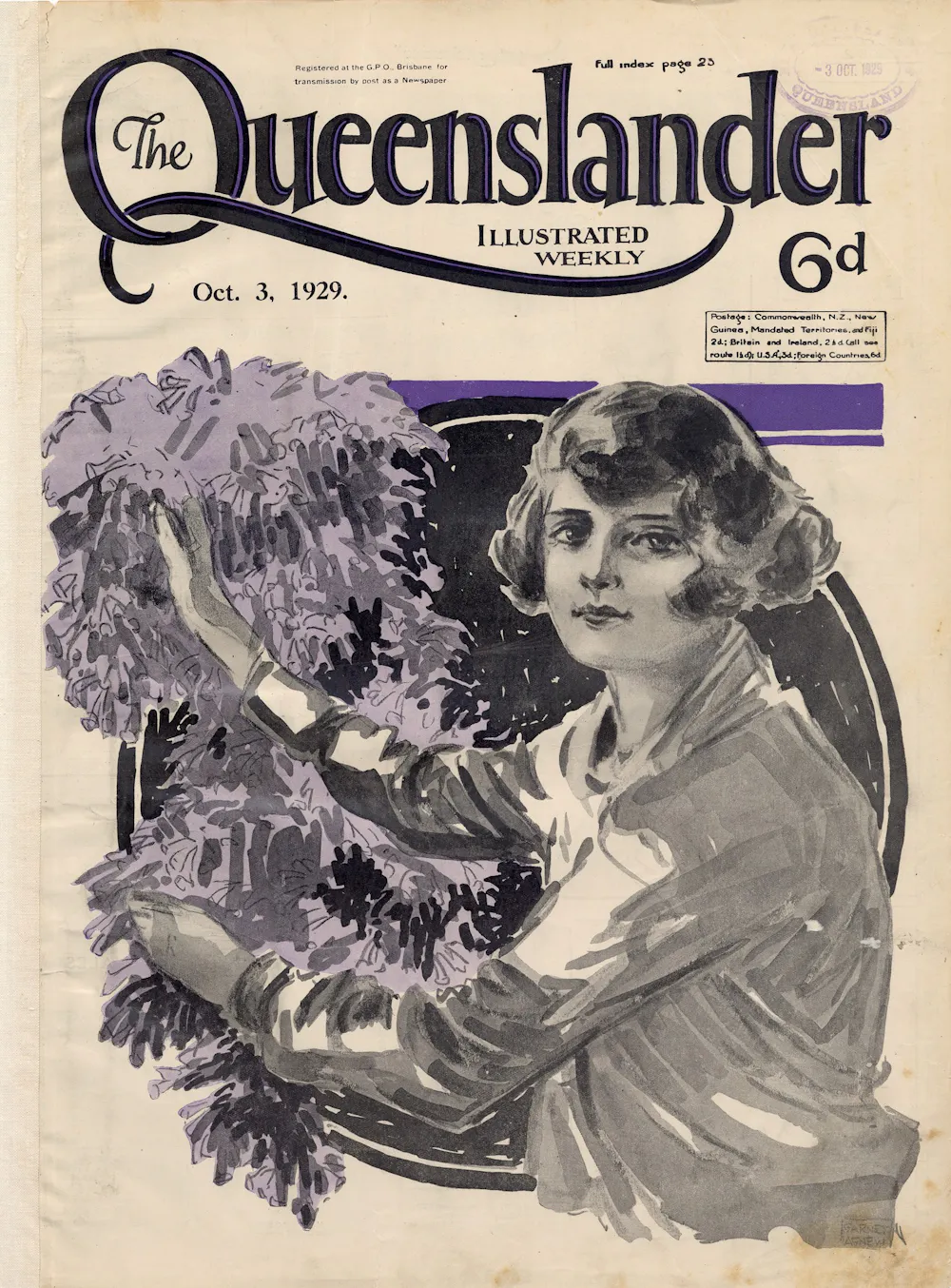 Illustrated front cover from The Queenslander, October 3 1929.
State Library of Queensland
Illustrated front cover from The Queenslander, October 3 1929.
State Library of Queensland
In Queensland, 19th-century street tree planting was particularly ad hoc – the Eagle Street fig trees are an example – and offset by enthusiastic forest clearance. It wasn’t until the early 20th century street beautification became more organised and jacaranda avenues were planted in areas like New Farm in Brisbane.
The popular plantings on the St Lucia campus of the University of Queensland occurred later, in the 1930s.
A flower for luck
In Australia, as elsewhere, there can be too much of a good thing. Jacarandas are an invasive species in parts of Australia (they seed readily in the warm dry climates to which they have been introduced).
Parts of South Africa have limited or banned the planting of jacarandas because of their water demands and invasive tendencies. Ironically, eucalypts have a similar status in South Africa.
 The first blooms of the jacaranda tree at the University of Sydney mark the time to study.
Shutterstock
The first blooms of the jacaranda tree at the University of Sydney mark the time to study.
Shutterstock
Writer Carey Baraka argues that, however beloved and iconic now, significant plantings of jacarandas in Kenya indicate areas of past and present white population and colonial domination.
Despite these drawbacks, spectacular jacaranda plantings remain popular where they have been introduced. There are even myths about them that cross international boundaries.
In the southern hemisphere – in Pretoria or Sydney – they bloom on university campuses during examination time: the first blooms mark the time to study; the fall of blooms suggests it is too late; and the fall of a blossom on a student bestows good luck.
Read more: Jacarandas in parts of South Africa are flowering earlier: why it’s a warning sign
Authors: Susan K Martin, Emeritus Professor in English, La Trobe University

















