

Celebrated novelist Arundhati Roy faces prosecution in India – for a speech she gave in 2010
- Written by Priya Chacko, Senior Lecturer in International Politics, University of Adelaide
Booker Prize-winning writer Arundhati Roy, author of The God of Small Things, has been charged, along with retired law professor Sheikh Showkat Hussain, for allegedly seditious comments supporting the separation of Kashmir from India.
They were speaking at a 2010 Delhi conference, the same year right-wing activist Sushil Pandit filed the complaint on which these latest charges draw.
Nearly 13 years later, on October 10, Delhi’s lieutenant governor V.K. Saxena, with the approval of Narendra Modi’s government, sanctioned the prosecution. Roy and Hussain are accused of making statements promoting social enmity, prejudicing national integration and inciting offences against the state and public tranquillity.
It’s the latest in a series of prosecutions and arrests using India’s Unlawful Activities (Prevention) Act, which was amended in 2019 to allow the government to designate individuals as terrorists, without following any formal judicial process.
Roy and Hussain are not being prosecuted under sedition law, though. (In May 2022, the Indian Supreme Court ordered a hold on prosecuting such cases, while the Indian government reviews the colonial-era sedition law.)
As India hurtles toward the 2024 national election, liberal-left civil society and independent media have become prime targets of the Modi government.
Read more: Novelist Arundhati Roy and her mission to inspire in the Ministry of Utmost Happiness
A ‘dangerous time’ for minorities
A strident critic of Modi’s ruling Bharatiya Janata Party, Roy used her September acceptance speech for the European Essay Prize to further condemn his government.
She criticised its normalisation of Hindu supremacism in public life and institutions, its crony capitalism, and India’s burgeoning economic inequality. She noted:
elections are a season of murder, lynching and dog-whistling – the most dangerous time for India’s minorities, Muslims and Christians in particular.
The ‘Maoist conspiracy’ case
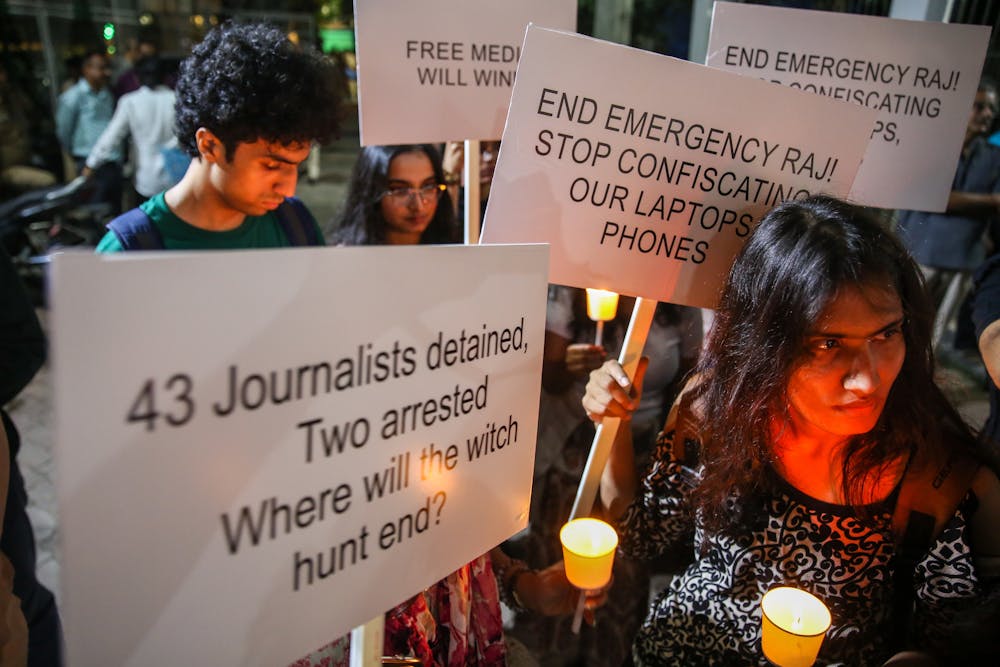
On October 2, India’s National Investigative Authority conducted coordinated raids against human rights activists in the states of Telangana and Andhra Pradesh, related to the “Maoist conspiracy” case in the village of Munchingiputtu.
TV journalist Pangi Nagannna had been arrested by Munchingiputtu police in November 2020 for allegedly acting as a Maoist “courier”.
He was charged under the Unlawful Activities (Prevention) Act (and various sections of the Indian Penal Code), along with 63 others. He then reportedly named several activists associated with organisations linked to the outlawed Communist Party of India (Maoist) – thus revealing a conspiracy to aid a Maoist insurgency.
These raids involve the confiscation of electronic devices vital to activists’ work. They are designed to intimidate and suppress advocacy.
Read more: India elections: who are Narendra Modi's main rivals – and can they beat him?
Newsclick raids
On October 3, Prabir Purkayastha and Amit Chakravarty, of the news organisation Newsclick, were subjected to police raids. So were 50 other journalists and contributors – including historians, activists and satirists.
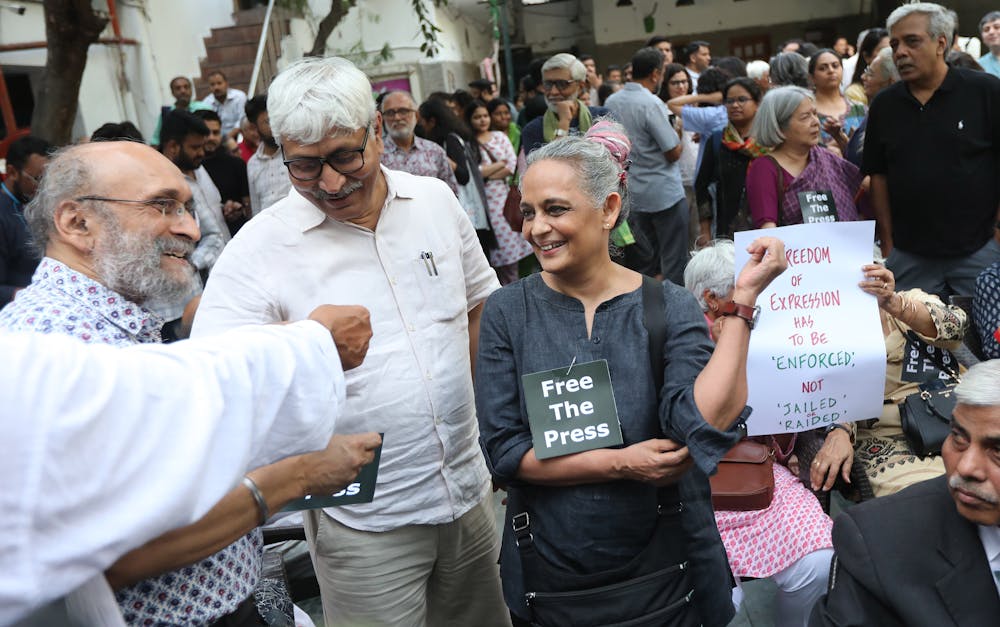 Indian senior journalist and columnist Paranjoy Guha Thakurta, detained by Delhi police in the Newsclick raids, with Arundhati Roy.
Harish Tyagi/AAP
Indian senior journalist and columnist Paranjoy Guha Thakurta, detained by Delhi police in the Newsclick raids, with Arundhati Roy.
Harish Tyagi/AAP
Purkayastha and Chakravarty were charged under the the Unlawful Activities (Prevention) Act, as well as with criminal conspiracy and promoting social enmity.
The basis appeared to be a two-month-old New York Times report that alleged, with weak evidence, that Newsclick had received funds from an American, Neville Roy Singham, to “sprinkle” its coverage with “Chinese government talking points”.
Since 2010, 16 journalists have been charged under the Unlawful Activities (Prevention) Act. Most of these arrests have been in the Modi era.
Read more: Divided Indian diaspora in Australia tops concerns for Narendra Modi visit
An alleged conspiracy and a ‘puppet’
In August, Bharatiya Janata Party politicians and ministers Nishikant Dubey, Anuraj Thakur and Rajeev Chandrasekhar used the New York Times report to allege a conspiracy between the opposition Congress Party and Rahul Gandhi, Newsclick and the Chinese government, to “break India” and prevent “India’s rise”.
The Bharatiya Janata Party has also claimed Rahul Gandhi is a puppet of billionaire investor George Soros.
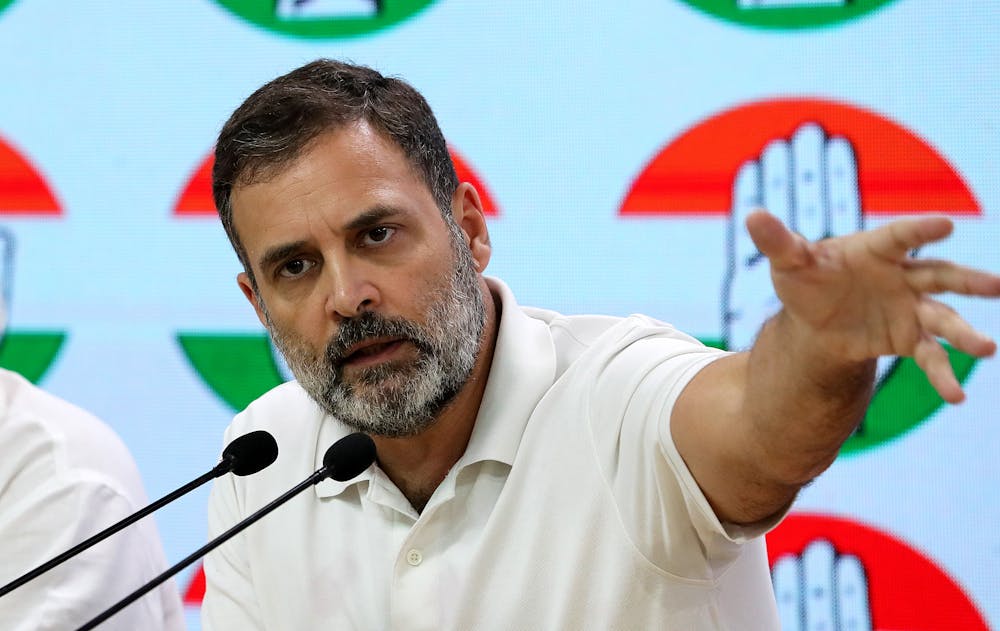 Indian National Congress Party senior leader Rahul Gandhi.
Harish Tyagi/AAP
Indian National Congress Party senior leader Rahul Gandhi.
Harish Tyagi/AAP
In March, Gandhi had been convicted over his comments that “all thieves have Modi as [their] common surname”, which were deemed insulting to the prime minister. He was sentenced to two years’ jail, meaning he lost his parliamentary seat. An appeal to the Supreme Court saw his conviction suspended on August 4 (the day before the New York Times report), allowing him to return to parliament and contest next year’s national elections.
Read more: Why Modi's India has become a dangerous place for Muslims
Dissent shrinking under ‘flawed democracy’
As Roy has long pointed out, India has always been a flawed democracy with overly centralised governance structures that breed discontent, a constitution with elements favouring the Hindu majority, and laws that stifle free speech.
However, the space for dissent has dramatically shrunk in the past decade under Modi’s authoritarian populist leadership.
The government’s new information technology rules require social media companies to use AI moderation to identify and remove fake, false or misleading news related to the government. In 2020, the government issued more than 9,800 take-down orders.
The subjects of these orders have included a BBC documentary that was critical of Modi, criticism of the government’s COVID policies, and support of farmer protests against India’s agricultural policies.
The Indian government’s social media take-down orders included a BBC documentary critival of Modi.The government has used tax investigations, accusations of terrorism and criminal defamation cases against its critics and opponents.
Courts often dismiss cases (like Rahul Gandhi’s) based on laws that criminalise peaceful expression. But their record is patchy, and the drawn-out legal process imposes heavy financial and personal penalties on the accused. This leads many to withdraw comments – with chilling effects on free speech.
Hailed as the world’s largest democracy, India risks becoming the world’s largest autocracy, with consequences for the whole world.
Authors: Priya Chacko, Senior Lecturer in International Politics, University of Adelaide

















