

In Killers of the Flower Moon, true crime reveals the paradoxes of the past
- Written by Paul Giles, Professor of English, Institute for Humanities and Social Sciences, ACU, Australian Catholic University
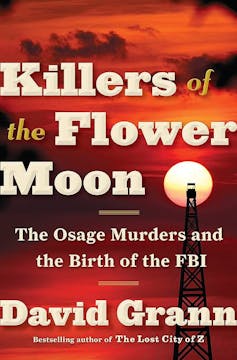
Martin Scorsese’s latest film Killers of the Flower Moon is based on a 2017 book of the same name by David Grann that chronicled a true story of Osage Indians being systematically murdered in the 1920s.
Fifty years earlier, the Osage had been driven from their ancestral lands in Kansas to a reservation in Oklahoma deemed by the Department of Indian Affairs to be “rocky, sterile, and unfit for cultivation”. It was then found to contain huge reserves of oil.
This oil brought enormous riches to the Osage people, who legally enjoyed “headrights” to land that could not be bought, only inherited. But it also led to a gruesome tale of white entrepreneurs marrying into the Osage clan to murder their relatives and make off with the family wealth.
New Journalism
Grann currently works as a staff writer for the New Yorker. His bestselling book was based around the principles of New Journalism, which developed as a popular literary genre during the 1960s in the hands of writers such as Truman Capote, Tom Wolfe and Joan Didion.
The most successful longer works in this format, such as Capote’s In Cold Blood (1966) and Norman Mailer’s The Executioner’s Song (1979), dramatise factual events to explore the complexities of American life. They typically eschew the more closeted dimensions of experimental fiction to engage openly with the public world.
Wolfe, who did a PhD in American Studies at Yale prior to his career as a writer, wrote several literary manifestos pointing explicitly to 19th-century realists, such as Dickens and Balzac, to support his claim that a capacity for “reporting” was more valuable to a creative writer than abstract “theory”.
Though Grann’s writing does not quite have the verve of Wolfe or Mailer, Killers of the Flower Moon gains much of its power from a similar sense of authenticity. His fastidiousness about historical records compels the reader to recognise the narrative’s factual rather than fictional basis.
The third and final section of the book, titled “The Reporter”, boasts an epigraph from William Faulkner’s novel Absalom, Absalom! (1936). And like Quentin Compson – Faulkner’s narrator – Grann portrays himself sorting through historical archives and oral testimonies of surviving witnesses in an attempt to reconstitute the past.
Killers of the Flower Moon is a captivating detective story, with all the usual twists and turns, but in this case the apparently unbelievable twists turn out to be true.
The mythology of West
Killers of the Flower Moon not only describes institutional racism and violence against Native American tribes, but the growth of law enforcement agencies in the United States between the two world wars.
One of Grann’s key themes is how J. Edgar Hoover used the Osage murder investigations to highlight the limitations of local police forces, so as to justify the establishment of the FBI on more centralised, scientific principles. The book’s subtitle – “Oil, Money, Murder, and the Birth of the FBI” – underlines its interest in the origins of Hoover’s agency, which was officially founded in 1935.
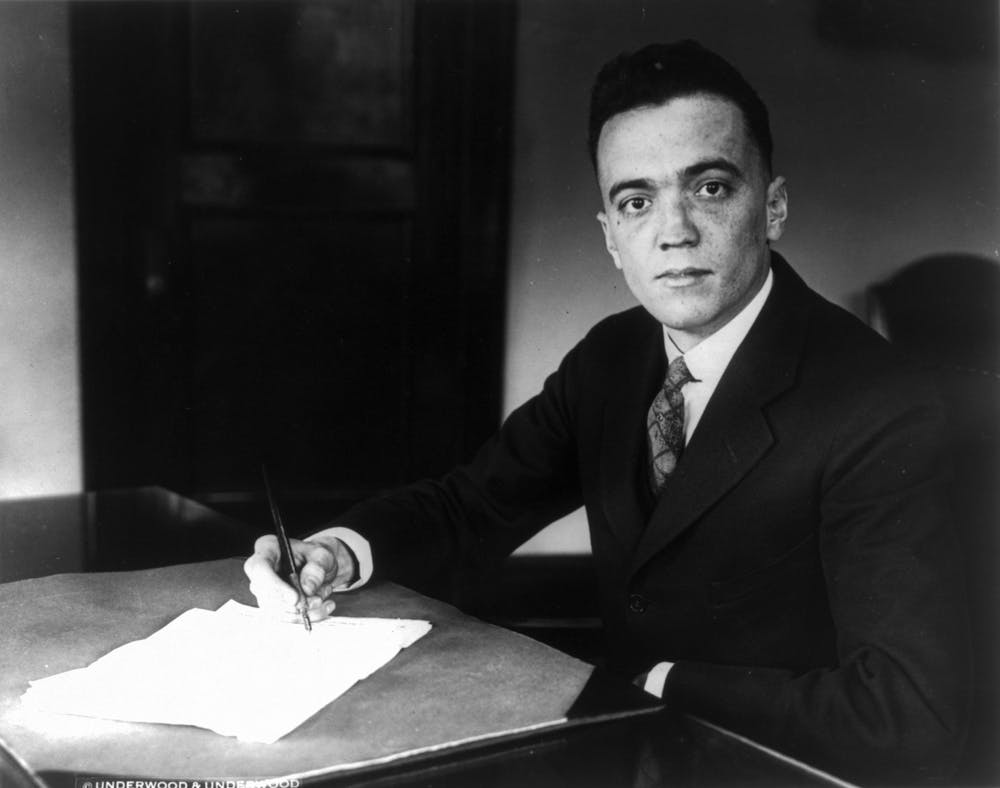 J. Edgar Hoover in 1932.
Library of Congress. Public domain, via Wikimedia Commons.
J. Edgar Hoover in 1932.
Library of Congress. Public domain, via Wikimedia Commons.
During the investigation, the Bureau of Investigation – the precursor to the FBI – regarded a rancher named William Hale as the “lone mastermind” of the killings. Grann’s conclusion, working from an impressive variety of sources, is that the focus on Hale was misplaced and the murder of Osage people during the 1920s and early 1930s was actually much more widespread.
He quotes an Osage tribe member as saying the white community considered murdering an Indian as merely akin to “cruelty to animals”. Indeed, one of the convicted criminals in 1924 justified his nefarious deeds on the grounds that “white people in Oklahoma thought no more of killing an Indian than they did in 1724”.
Grann’s wider perspective allows him to generalise his theme of racism. He suggests that such illegal forms of brutality were always embedded at the heart of the mythology of the American West. He quotes a Tulsa Tribune report on the trial of Hage and his accomplice John Ramsay, which described them simply as “two old-time cowboys”.
Read more: David Grann's The Wager: a drama of murder, insurrection, escape and an empire at sea
An unsettling aspect of Grann’s book is its suggestion that the entire American system of commercial wealth and appropriation of territory was implicitly based on such gangsterism. Hale justified his activities by saying they were just a “business proposition”. Calling himself “the Reverend”, he presented himself in the venerable tradition of American pioneers who helped to forge God’s chosen nation out of the wilderness.
The chameleonic character of Hale accords with the theme of ambiguity, which is a central concern of Killers of the Flower Moon. Grann acknowledges the procedural inequity of implicating Herb Bert, a long-deceased guardian of one of the Osage women, simply on circumstantial evidence: “I was conscious of the unfairness of accusing a man of hideous crimes when he could not answer questions or defend himself.”
Grann admits finally that, in his role as investigative journalist, he “had lost the illusion that I would find some Rosetta stone that would unlock the secrets of the past.” In this sense, the ambivalence surrounding Hale – the question of whether he was a staunch pioneer, a clinical murderer, or both – is recapitulated in the book’s formal ambivalence, whereby Grann portrays the truth as impossible to pin down.
 This narrative complexity has interesting repercussions for the debates around the question of “truth-telling” in the fraught conditions of contemporary Australia. Grann’s point is that truth-telling is always an intertextual rather than a positive concept. Records can be corrected and hidden facts brought to light, but no final truth is ultimately available.
Grann’s book is valuable not just for the history it recounts and the obscure murder mysteries from the past that it illuminates, but for what it suggests about racial politics in contemporary America – and, by extension, Australia. He shows how the upstanding citizens of Oklahoma were perturbed by the newfound prosperity of the Osage Indians, a wealth they had come to assume was the birthright of their white community, and he describes how these ethnic frictions have continued into the present day.
In a recent interview, Grann remarked that his favourite genre of fiction is the detective novel. One of the heroes in Killers of the Flower Moon is Tom White, a fearless investigator from Texas, who is sent by J. Edgar Hoover into Oklahoma to organise undercover operations and expose the conspiracies in this tight-knit community.
White subsequently left Hoover’s organisation to work in Kansas as a prison governor on a higher salary, but in the late 1950s he attempted to commercialise the fleeting fame he had gained from the widely publicised murder investigations. He asked Osage novelist Fred Grove to assist him in writing a historical account. White’s memoir was rejected by publishers, but many years later it did morph into a fictionalised version by Grove entitled The Years of Fear (2002).
This narrative complexity has interesting repercussions for the debates around the question of “truth-telling” in the fraught conditions of contemporary Australia. Grann’s point is that truth-telling is always an intertextual rather than a positive concept. Records can be corrected and hidden facts brought to light, but no final truth is ultimately available.
Grann’s book is valuable not just for the history it recounts and the obscure murder mysteries from the past that it illuminates, but for what it suggests about racial politics in contemporary America – and, by extension, Australia. He shows how the upstanding citizens of Oklahoma were perturbed by the newfound prosperity of the Osage Indians, a wealth they had come to assume was the birthright of their white community, and he describes how these ethnic frictions have continued into the present day.
In a recent interview, Grann remarked that his favourite genre of fiction is the detective novel. One of the heroes in Killers of the Flower Moon is Tom White, a fearless investigator from Texas, who is sent by J. Edgar Hoover into Oklahoma to organise undercover operations and expose the conspiracies in this tight-knit community.
White subsequently left Hoover’s organisation to work in Kansas as a prison governor on a higher salary, but in the late 1950s he attempted to commercialise the fleeting fame he had gained from the widely publicised murder investigations. He asked Osage novelist Fred Grove to assist him in writing a historical account. White’s memoir was rejected by publishers, but many years later it did morph into a fictionalised version by Grove entitled The Years of Fear (2002).
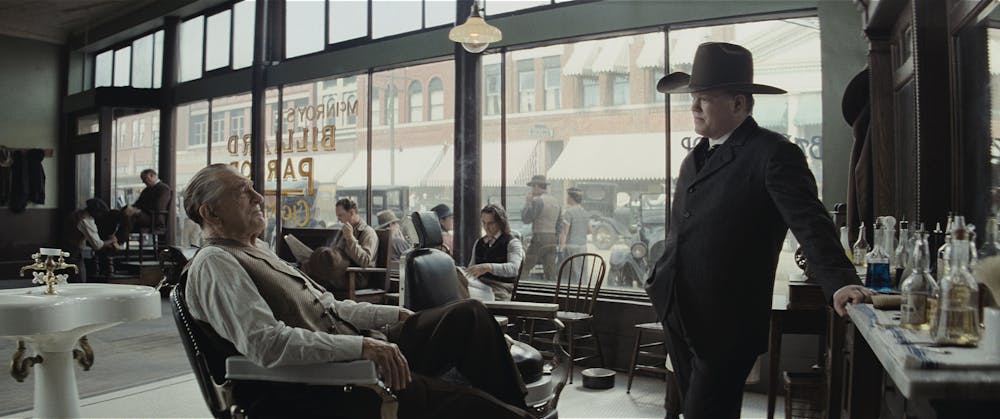 Robert De Niro and Jesse Plemons in Killers of the Flower Moon.
Apple TV+
Read more:
Oklahoma is – and always has been – Native land
New light
Tom White plays a minor part in Scorsese’s film. The director remarked in a recent interview with Deadline that he was more interested in exploring the story’s “mystery” than reproducing “a police procedural”.
Reports of the movie’s premiere at the Cannes Film Festival in May suggest it pays less attention to the bureaucratic reforms that led to the establishment of the FBI than Grann’s book. Scorsese focuses instead on the characters of William Hale, played by Robert de Niro, and Hale’s nephew Ernest Burkhart, played by Leonardo DiCaprio, who was the husband of an Osage woman named Mollie. He casts the two men as charismatic villains with one foot in the old Wild West.
Scorsese is a truly great director who has previously represented enclosed ethnic communities (mainly Italian Americans), as well as the expansive mythologies of capitalist America. He has explored capitalism’s dangerous proximity to criminal activity in films such as The Aviator (2004), starring DiCaprio as Howard Hughes. Scorsese would thus appear to be just the kind of cinematic artist to take on this complex subject and avoid reductive stereotypes or one-dimensional perspectives.
Robert De Niro and Jesse Plemons in Killers of the Flower Moon.
Apple TV+
Read more:
Oklahoma is – and always has been – Native land
New light
Tom White plays a minor part in Scorsese’s film. The director remarked in a recent interview with Deadline that he was more interested in exploring the story’s “mystery” than reproducing “a police procedural”.
Reports of the movie’s premiere at the Cannes Film Festival in May suggest it pays less attention to the bureaucratic reforms that led to the establishment of the FBI than Grann’s book. Scorsese focuses instead on the characters of William Hale, played by Robert de Niro, and Hale’s nephew Ernest Burkhart, played by Leonardo DiCaprio, who was the husband of an Osage woman named Mollie. He casts the two men as charismatic villains with one foot in the old Wild West.
Scorsese is a truly great director who has previously represented enclosed ethnic communities (mainly Italian Americans), as well as the expansive mythologies of capitalist America. He has explored capitalism’s dangerous proximity to criminal activity in films such as The Aviator (2004), starring DiCaprio as Howard Hughes. Scorsese would thus appear to be just the kind of cinematic artist to take on this complex subject and avoid reductive stereotypes or one-dimensional perspectives.
 David Grann.
Goodreads
Grann’s book sets its criminal activity in a wide social context. Its fascination lies in the scrupulous detail it brings to the story. Its depth of archival research shines new light on a distressing but not entirely anomalous episode in the recent American past.
Grann gestures explicitly towards some of the grand narratives of American literature, citing Don DeLillo on conspiracy theories and Faulkner on the opacities and bitterness of the Old South. But his particular expertise lies in more traditional journalistic virtues: punctiliousness, fine detail, and a precise sense of time and place. His version of events, while slow and meticulous at times, reconstructs an important event that probably seems even more significant now than it did 100 years ago.
The rise of interest in Indigenous rights across the globe, along with increasing scepticism about the racial assumptions of settler colonial authority, has changed the framework in which the Osage story can be understood. In an intelligently self-reflexive manner, Killers of the Flower Moon also interrogates the paradoxes of the past, the multiple ways in which it relates to the present, and vice versa.
Authors: Paul Giles, Professor of English, Institute for Humanities and Social Sciences, ACU, Australian Catholic University
David Grann.
Goodreads
Grann’s book sets its criminal activity in a wide social context. Its fascination lies in the scrupulous detail it brings to the story. Its depth of archival research shines new light on a distressing but not entirely anomalous episode in the recent American past.
Grann gestures explicitly towards some of the grand narratives of American literature, citing Don DeLillo on conspiracy theories and Faulkner on the opacities and bitterness of the Old South. But his particular expertise lies in more traditional journalistic virtues: punctiliousness, fine detail, and a precise sense of time and place. His version of events, while slow and meticulous at times, reconstructs an important event that probably seems even more significant now than it did 100 years ago.
The rise of interest in Indigenous rights across the globe, along with increasing scepticism about the racial assumptions of settler colonial authority, has changed the framework in which the Osage story can be understood. In an intelligently self-reflexive manner, Killers of the Flower Moon also interrogates the paradoxes of the past, the multiple ways in which it relates to the present, and vice versa.
Authors: Paul Giles, Professor of English, Institute for Humanities and Social Sciences, ACU, Australian Catholic University 

















