

Could 'marine cloud brightening' reduce coral bleaching on the Great Barrier Reef?
- Written by Daniel Patrick Harrison, Senior Lecturer, Southern Cross University
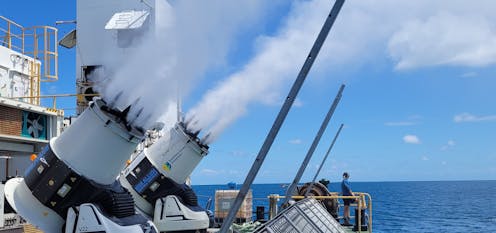
It might sound like science fiction, but “marine cloud brightening” is being seriously considered as a way to shield parts of the ocean from extreme heat.
We’re using water cannons to spray seawater into the sky. This causes brighter, whiter clouds to form. These low marine clouds reflect sunlight away from the ocean’s surface, protecting the marine life below from the worst of climate change.
Australia’s Reef Restoration and Adaptation Program – a collaboration between several universities, CSIRO and the Australian Institute of Marine Science – is exploring whether cloud brightening could reduce coral bleaching. As an oceanographer and engineer I lead the program’s research into cooling and shading techniques.
We started exploring cloud brightening after the mass bleaching event in 2016. First, we needed to develop and test the underlying technologies in the lab. Then we began pilot testing in the central Great Barrier Reef near Townsville during January 2020. After several iterations we have now moved beyond “proof of concept” to investigating the response of the clouds themselves.
The Cloud Brightening Field Trip of 2021 (Southern Cross University)A bright idea
British cloud physicist John Latham originally proposed cloud brightening in 1990 as a way to control global warming by altering Earth’s energy balance. He calculated that brightening clouds across the most susceptible regions of the world’s oceans could counteract the global warming caused by a doubling of preindustrial atmospheric carbon dioxide. That’s a level likely to be reached by the year 2060.
Recently, scientists have begun to consider regional rather than global application of cloud brightening. Could brightening clouds directly over the Great Barrier Reef for a few months reduce coral bleaching during a marine heat wave?
Modelling studies are encouraging and suggest it could delay the expected decline in coral cover. This could buy valuable time for the reef while the world transitions away from fossil fuels.
Lowering the heat stress on the ecosystem would produce other benefits when combined with other reef interventions – such as improved control of invasive crown of thorns starfish and planting of corals with increased heat tolerance.
But these studies also show there’s a limit to what can be achieved. Long-term benefits are only possible if the cloud brightening activity occurs alongside aggressive emissions reductions.
Cloud brightening does have risks as well as benefits, but the prospect of intermittent regional use is very different to large-scale “solar geo-engineering” proposals for shading and cooling the whole planet.
We expect the regional effect will be short-lived and reversible, which is reassuring. The technology must be operated continuously to modify clouds and could be stopped at any time. The sea salt particles sprayed in the process typically only persist in the atmosphere for one to several days.

How do you brighten a cloud?
A warm cloud (as opposed to an ice cloud) is a collection of small water droplets floating in the air.
A cloud of many small droplets is brighter than one with fewer large droplets – even if both clouds contain the same amount of water overall.
Every droplet begins with the condensation of water vapour around a nucleus, which can be almost any kind of tiny particle suspended in air.
Typically, in the lower atmosphere over land there are thousands to tens of thousands of these tiny particles suspended in every cubic centimetre of air. We call these airborne particles “aerosols”.
Aerosols may be natural such as dust, sea salt, pollen, ash and sulphates. Or they may come from human activity such as burning fossil fuels or vegetation, manufacturing, vehicle exhaust and aerosol spray cans.
In very clean maritime air, the aerosols available to form clouds are mainly sulphates and sea salt crystals. And they are few and far between, only a few hundred per cubic centimetre.
When a cloud forms under these conditions, water vapour is forced to condense around fewer nuclei, creating larger droplets and fewer of them. Large droplets reflect less light for the same volume of cloud water.
To brighten such clouds, we can spray large quantities of microscopic seawater droplets into the air. This process of atomising seawater mimics the generation of sea salt aerosols by wind and waves in the ocean. If these are incorporated into a cloud and create extra droplets, the cloud will be brightened.
Sea salt also provides additional shade by direct scattering of light.
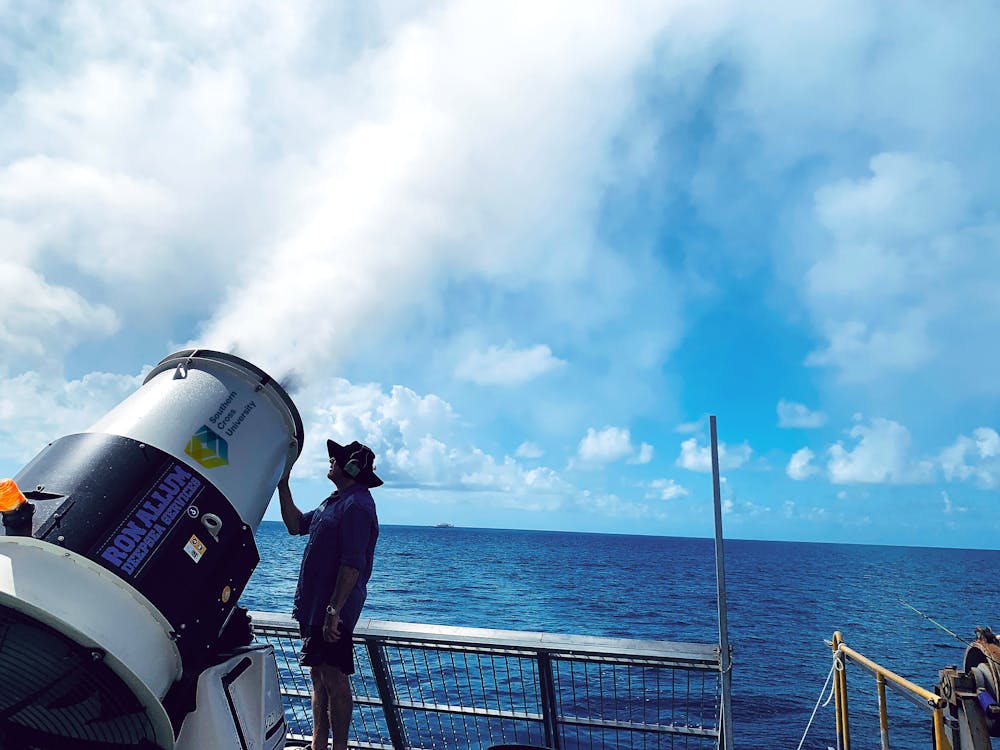 The latest cloud brightening generator (V model) in action.
Southern Cross University
The latest cloud brightening generator (V model) in action.
Southern Cross University
Testing the theory
Although scientists have researched cloud brightening for more than 30 years, no one had ever directly tested the theory. In Australia, we have now developed technology to a point where we are starting to measure the response of the clouds.
We are beginning such tests with the support and permission of Traditional Owners, who have sustainably managed their Sea Country for tens of thousands of years.
Our research program involves more than 15 research institutions and has multiple levels of governance and oversight.
Read more: Out of danger because the UN said so? Hardly – the Barrier Reef is still in hot water
Not so far-fetched
Most people probably don’t realise we are already inadvertently brightening the clouds. The Intergovernmental Panel on Climate Change estimates humanity’s unintentional release of aerosols offsets around 30% of the warming effect due to greenhouse gases.
Sulphates in ship exhaust are such a potent source of aerosols for droplet formation, the passage of ships leaves cloud trails called ship tracks.
When the International Maritime Organisation introduced new rules limiting the sulphur content of marine fuels, the number and extent of ship tracks drastically reduced, especially in the Northern Hemisphere. A recent study even suggests the devastating heat wave that swept the Northern Hemisphere earlier this year was worsened by the absence of ship tracks.
The world-first research we are conducting in Australia aims to determine if we could harness the clouds in an effective, environmentally responsible and socially acceptable manner for the future conservation of one of our most precious ecosystems.
Authors: Daniel Patrick Harrison, Senior Lecturer, Southern Cross University

















