

Where did the cars go? How heavier, costlier SUVs and utes took over Australia's roads
- Written by Peter Martin, Visiting Fellow, Crawford School of Public Policy, Australian National University
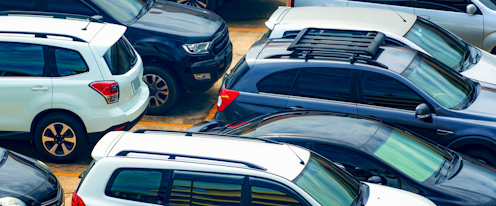
If we’re upset about the price of petrol, why do we drive the vehicles we do?
SUVs (so-called sport utility vehicles) use more fuel per kilometre than standard cars – according to the International Energy Agency, up to 25% more.
They weigh more than standard cars – about 100 kilograms more.
And they emit more carbon than standard cars. In Australia, medium-size SUVs emit 14% more carbon per kilometre travelled than medium-size cars. Large SUVs emit 30% more than large cars.
Yet we’re buying them at a rate that would have been unimaginable even a decade ago.
SUVs outsell passenger cars 3 to 1
As recently as 2012, more than half the new vehicles sold in Australia were “passenger cars” – the standard low-slung cars of the type we were used to. About one-quarter were SUVs.
Back further, in the early 1990s, three-quarters of the new vehicles we bought were passenger cars, and only 8% SUVs.
Yet after an explosion in SUV sales, today every second vehicle bought is a SUV. In September, SUVs accounted for 58% of new vehicle sales. Passenger cars accounted for just 17%. This means SUVs outsell passenger cars three to one.
Like country music, SUVs are hard to define, but you know one when you see one.
They are distinguished by being high and squarish – the words used in the official definition are “wagon body style and elevated ride height”, and generally big. They are usually four-wheel drives or all-wheel drives.
Standard passenger cars (be they hatches, sedans or wagons) sit closer to the ground, are usually lighter, and are less likely to kill or seriously injure pedestrians and cyclists, according to US insurers.
So common have the new larger SUVs become that Standards Australia is considering increasing the length of a standard parking bay by 20cm. It wants comments by November.
Also taking market share from smaller standard cars are what we in Australia call utes, which are standard vehicles (they used to be Falcons and Commodores) with a built-in tray attached at the rear.
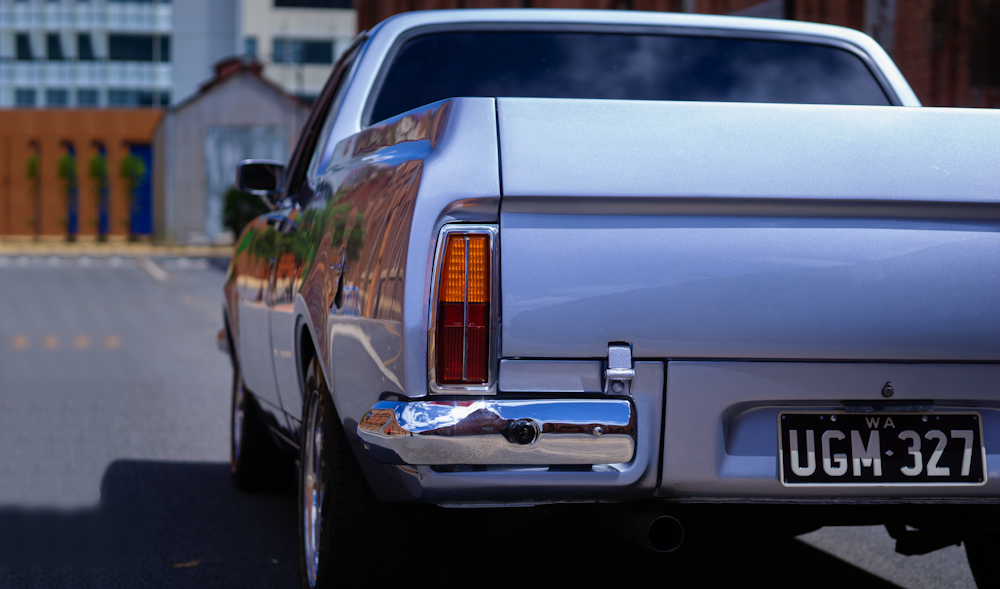
Utes are categorised as commercial vehicles, even though these days they tend to have four doors rather than two. They are also just as likely to be used for moving families as equipment, even if bought with small business tax concessions.
Australia’s National Transport Commission is so concerned about the rise in sales of both SUVs and utes, it warns they are “tempering Australia’s improvement in transport emissions”.
Vehicles defined as commercial, the bulk of them utes, accounted for one in five vehicles sold a decade ago. Now they are one in four, outselling passenger cars.
Tax only explains so much
Cars get special treatment in Australia’s tax system.
If an employer provides them and their private use is “minor, infrequent and irregular”, or if they are utes “not designed for the principal purpose of carrying passengers”, they can can escape the fringe benefits tax.
And from time to time small businesses get offered instant asset writeoffs, which means that all or part of the cost of the car can be written off against tax.
But apart from perhaps helping to explain the increasing preference for utes, these concessions seem insufficient to explain the demise of the standard passenger car and the rise of the expensive (and more expensive to fuel) alternatives.
Australia’s Bureau of Infrastructure and Transport Research Economics identifies the obvious: headroom, legroom and storage space, as well as the ability to drive on bad roads as well as good.
Read more: I've always wondered: are SUVs and 4WDs safer than other cars?
Danger is a perverse selling point
But, in an information paper, the bureau goes on to note that SUVs “appear to be more likely to kill pedestrians than cars”.
They also appear more likely to kill the occupants of standard cars than standard cars when those cars crash, largely because they are higher – a phenomenon the insurance industry refers to as “incompatibility”.
Australia’s Bureau of Infrastructure and Transport Research Economics refers to this as the “other side of the coin”.
But I think that for buyers of SUVs, it might be the same side of the coin. That is, I think it might be becoming a perverse and macabre argument for buying SUVs.
If SUVs are becoming dominant and they put other road users at risk, it makes sense not to be one of those other road users.
I am not suggesting that danger from SUVs is the only reason for the flood of buyers switching to SUVs. But I am suggesting it has helped contribute to a snowballing in demand for SUVs, along with fashion, and changed views about what’s normal.
I’m not sure what can be done at this stage. Higher petrol prices ought to have helped, but they don’t seem to have.
SUV purchases have increased, even as petrol prices have climbed. Extra taxes have been proposed to help curb road deaths, but they mightn’t help either. SUVs are already expensive.
Tighter standards would help
One thing we ought to do straight away is to shift the burden of decision-making from buyers to makers.
The federal government is about to roll out long-overdue fuel efficiency standards, of the kind already common in the rest of the world.
Ideally, those standards would require the entire fleet of vehicles sold by each manufacturer to meet a gradually-tightening average efficiency standard.
Putting more electric vehicles into each fleet would help. But so would increasing the efficiency of its conventionally-powered SUVs – which would mean reducing their weight, and with it, their danger to other people on the road.
The design of the scheme is up for grabs, and the Grattan Institute’s Marion Terrill has made a submission.
She says regardless of the switch to electric cars, Australians are going to be buying petrol and diesel vehicles for some time. That’s why it’s so important those cars become as fuel efficient (and, she could add, as safe) as they can be.
Read more: Why NZ should lower motorway speed limits for SUVs and other high-emission vehicles
Authors: Peter Martin, Visiting Fellow, Crawford School of Public Policy, Australian National University

















