

More than 200 scientists from 19 countries want to tell us the Southern Ocean is in trouble
- Written by Andrew J Constable, Adviser, Antarctica and Marine Systems, Science & Policy, University of Tasmania
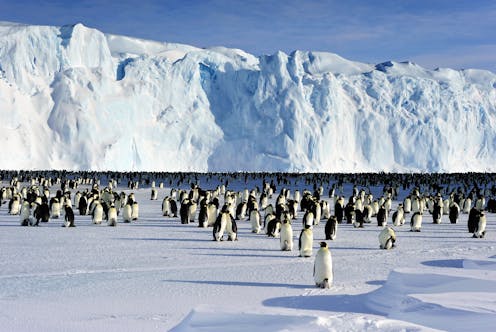
While the Southern Ocean around Antarctica has been warming for decades, the annual extent of winter sea ice seemed relatively stable – compared to the Arctic. In some areas Antarctic sea ice was even increasing.
That was until 2016, when everything changed. The annual extent of winter sea ice stopped increasing. Now we have had two years of record lows.
In 2018 the international scientific community agreed to produce the first marine ecosystem assessment for the Southern Ocean. We modelled the assessment process on a working group of the Intergovernmental Panel on Climate Change (IPCC). So the resulting “summary for policymakers” being released today is like an IPCC report for the Southern Ocean.
This report can now be used to guide decision-making for the protection and conservation of this vital region and the diversity of life it contains.
Read more: Fractured foundations: how Antarctica's 'landfast' ice is dwindling and why that's bad news
Why should we care about sea ice?
Sea ice is to life in the Southern Ocean as soil is to a forest. It is the foundation for Antarctic marine ecosystems.
Less sea ice is a danger to all wildlife – from krill to emperor penguins and whales.
The sea ice zone provides essential food and safe-keeping to young Antarctic krill and small fish, and seeds the expansive growth of phytoplankton in spring, nourishing the entire food web. It is a platform upon which penguins breed, seals rest, and around which whales feed.
The international bodies that manage Antarctica and the Southern Ocean under the Antarctic Treaty System urgently need better information on marine ecosystems. Our report helps fill this gap by systematically identifying options for managers to maximise the resilience of Southern Ocean ecosystems in a changing world.
An open and collaborative process
We sought input from a wide range of people across the entire Southern Ocean science community.
We sought to answer questions about the state of the whole Southern Ocean system - with an eye on the past, present and future.
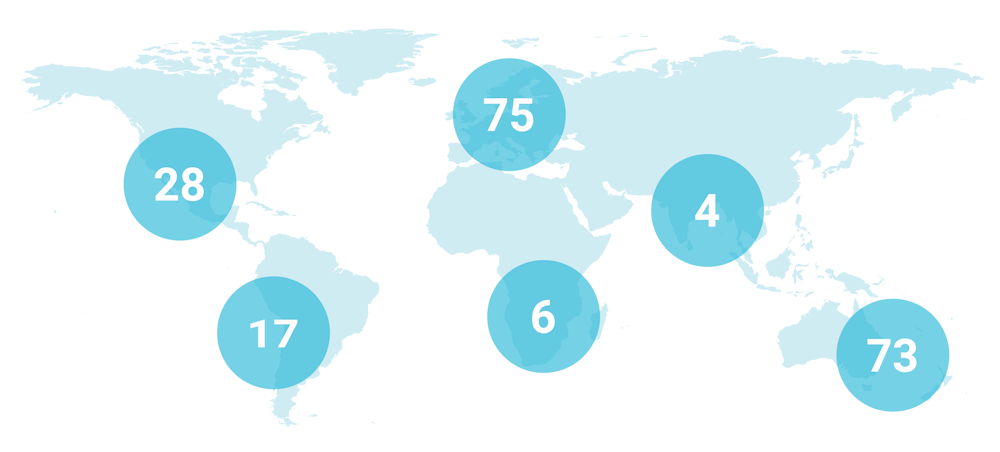
Our team comprised 205 authors from 19 countries. They authored 24 peer-reviewed papers. We then distilled the findings from these papers into our summmary for policymakers.
We deliberately modelled the multi-disciplinary assessment process on a working group of the IPCC to distill the science into an easy-to-read and concise narrative for politicians and the general public alike. It provides a community assessment of levels of certainty around what we know.
We hope this “sea change” summary sets a new benchmark for translating marine research into policy responses.
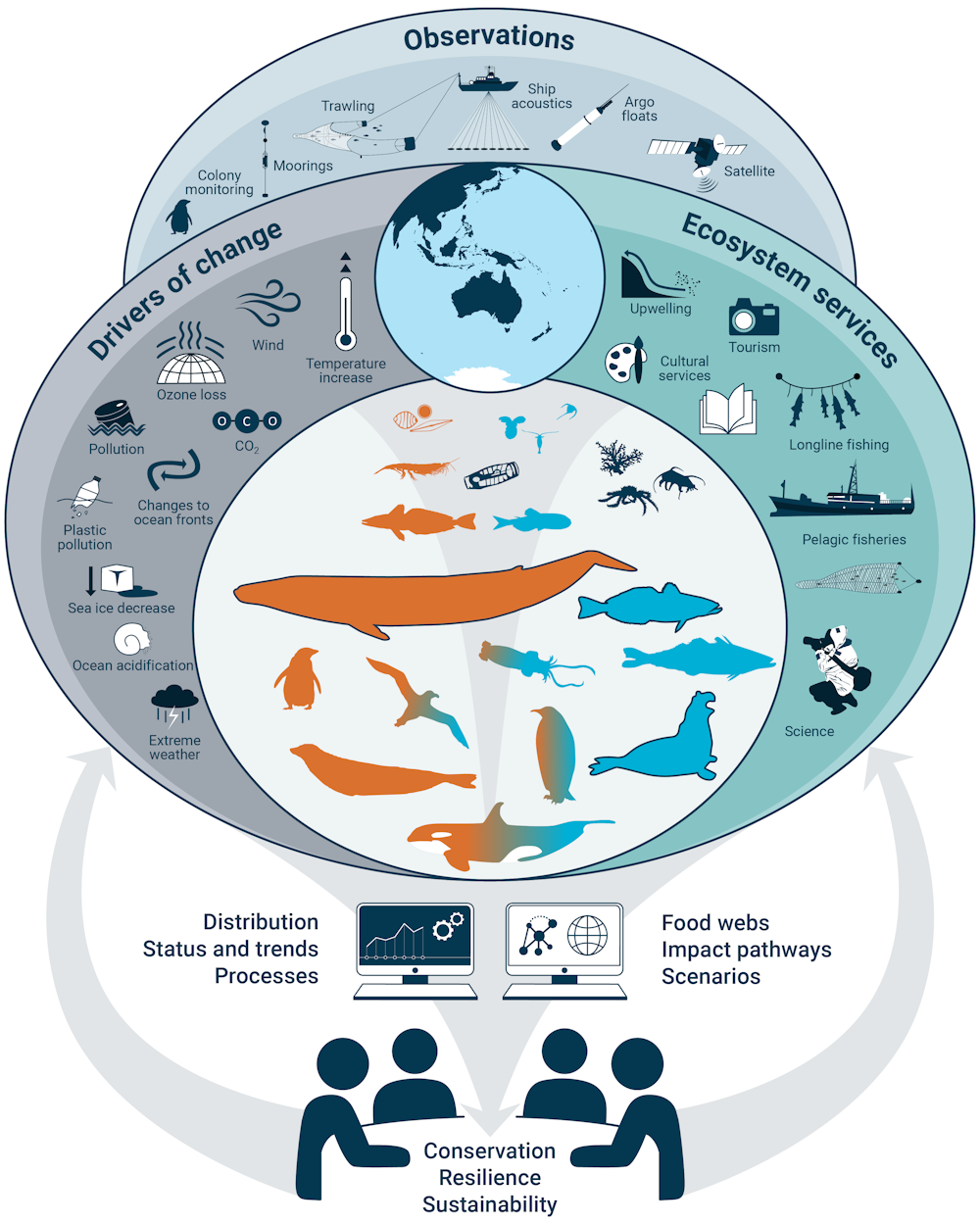 Our system-level assessment addressed the multiple drivers of ecosystem change in the Southern Ocean.
Constable, A.J. et al (2023) Marine Ecosystem Assessment for the Southern Ocean., CC BY-NC
Our system-level assessment addressed the multiple drivers of ecosystem change in the Southern Ocean.
Constable, A.J. et al (2023) Marine Ecosystem Assessment for the Southern Ocean., CC BY-NC
So what’s in the report?
Southern Ocean habitats, from the ice at the surface to the bottom of the deep sea, are changing. The warming of the ocean, decline in sea ice, melting of glaciers, collapse of ice shelves, changes in acidity, and direct human activities such as fishing, are all impacting different parts of the ocean and their inhabitants.
These organisms, from microscopic plants to whales, face a changing and challenging future. Important foundation species such as Antarctic krill are likely to decline with consequences for the whole ecosystem.
The assessment stresses climate change is the most significant driver of species and ecosystem change in the Southern Ocean and coastal Antarctica. It calls for urgent action to curb global heating and ocean acidification.
It reveals an urgent need for international investment in sustained, year-round and ocean-wide scientific assessment and observations of the health of the ocean.
We also need to develop better integrated models of how individual changes in species along with human impacts will translate to system-level change in the different food webs, communities and species.
Read more: Antarctica's heart of ice has skipped a beat. Time to take our medicine
What’s next?
Our report will be tabled at this week’s international meeting of the Commission for the Conservation of Antarctic Marine Living Resources in Hobart.
The commission is the international body responsible for the conservation of marine ecosystems in the Southern Ocean, with membership of 26 nations and the European Union.
It is but one of the bodies our new report can assist. Currently assessments of change in habitats, species and food webs in the Southern Ocean are compiled separately for at least ten different international organisations or processes.
The Southern Ocean is a crucial life-support system, not just for Antarctica but for the entire planet. So many other bodies will need the information we produced for decision-making in this critical decade for action on climate, including the IPCC itself.
Beyond the science, the assessment team has delivered important lessons about how coordinated, collaborative and consultative approaches can deliver ecosystem information into policymaking. Our first assessment has taken five years, but this is just the beginning. Now we’re up and running, we can continue to support evidence-based conservation of Southern Ocean ecosystems into the future.
Authors: Andrew J Constable, Adviser, Antarctica and Marine Systems, Science & Policy, University of Tasmania

















