

The Chinese government claims LGBTQ+ people are protected from discrimination. Our interviews with 26 activists tell another story
- Written by Ausma Bernot, Postdoctoral Research Fellow, Australian Graduate School of Policing and Security, Charles Sturt University
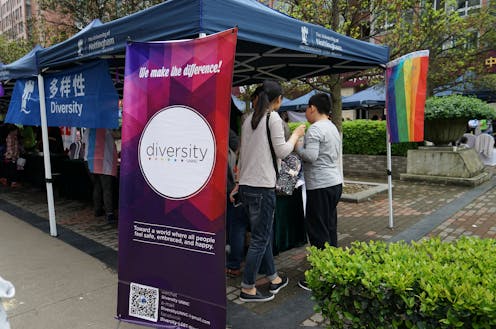
In China, LGBTQ+ activists and groups are consistently targeted by authorities and tech platforms. This is done digitally through computer algorithms, and physically by law enforcement and state security personnel trying to constrain their work.
For these people, living under the Chinese Communist Party (CCP) and government means being severely limited in any activities their organisations undertake.
For our latest research, we spoke with 26 LGBTQ+ activists from 12 different provinces in China, to investigate what life is like on the ground for them.
The Chinese government claims LGBTQ+ people do not face discrimination in their country – but our research shows this isn’t true.
The realities of Chinese LGBTQ+ activism
China’s LGBTQ+ communities are still awaiting legal recognition of their relationships in the form of marriage or de facto relationships. And as in many countries, trans people are the most marginalised on the rainbow spectrum.
The level of social acceptance of LGBTQ+ people is discouraging. One 2015 survey of 28,454 people, conducted by the United Nations Development Fund, found only 5% of LGBTQ+ people in China chose to disclose their sexual and/or gender identity at school, in the workplace or in religious communities.
The evidence suggests LGBTQ+ activists in China have had a particularly tough time since President Xi Jinping took office in 2013. The effects of targeting have spiralled in the past few years, reflected in the abrupt closure of the Shanghai Pride in 2020, and the 2021 shutdown of LGBT Rights Advocacy China – an organisation that held law-based campaigns.
However, arguably the toughest blow was delivered this year when the Beijing LGBT Center closed its doors after 15 years of service.

About half of the organisations we talked to for our research have since been closed.
The line between legal and acceptable
For our research, we used encrypted communication platforms to interview activists from 12 different provinces, various types of organisations, and all parts of the LGBTQ+ spectrum.
Our findings reveal these activists have long had to negotiate an invisible line between what is legal and what is acceptable.
For one thing, Chinese social media is tightly controlled. Social media companies are mandated to proactively support online censorship. WeChat, the most popular social media app in China, also actively engages in censorship.
Using the app is a double-edged sword for activists. They have to play around with words and content in a bid to dodge censorship, playing the cat-and-mouse game. In some cases, even using LGBTQ+ “double-speak”, or code words well known within the community, isn’t enough for content to be published (or remain published).
In July 2021, a number of LGBTQ+ activist groups woke up to find their WeChat social media accounts deactivated. Although they hadn’t breached any laws with their content, the date was very close to a key political event, which likely invoked pre-emptive repression.
Waves of censorship tied to key political events are known as the “dissident calendar”. These repression strategies most often coincide with the five-year anniversaries of the Tiananmen Square massacre, the founding of the People’s Republic of China, and high-level government meetings.
One queer woman activist spoke to us about the incident:
I tried to find some people [working for WeChat] to ask what exactly happened. It’s very difficult to find any proof […] after some investigation, our conclusion was that it might have been the company’s action based on their own fear of getting into trouble. They wanted to prove to the authorities that they were loyal.
Other Chinese-owned social media apps such as Weibo and Douban must monitor “sensitive terms” and cooperate with government authorities. This can lead to account “bombing”, where access to an account is frozen or blocked by the government – and shadow banning, where the content is only visible to the person who posted it.
Read more: What is shadowbanning? How do I know if it has happened to me, and what can I do about it?
Using the law as a weapon
We also found an onslaught of regulatory practices (such as laws and policies) constraining most activities in which LGBTQ+ groups and organisations would typically engage, whether that be fundraising and partnering with donor organisations, or raising social awareness.
For example, the 2017 Charity Law allows registered charitable organisations to fundraise. However, it requires social groups and social service organisations to obtain registration certificates issued by the local civil affairs department.
As our interviewees noted, registering an LGBTQ+ organisation is extremely difficult as most activists are bluntly rejected. In other words, the law indirectly outlaws fundraising for LGBTQ+ activities. Authorities can use the law to validate an existing governance agenda in which they consistently monitor and even harass LGBTQ+ activists.
One genderqueer activist shared their experience with us:
The police called our landlord, telling them that we were an illegal organisation and […] not to rent the place to us anymore. […] The police called the owner of the property […], then our organisation closed down and ceased all activities.
The current state of birthrates in China hasn’t helped. Birthrates continue to fall, despite the relaxation of the one-child policy in 2015, which then became a two-child policy, and then a three-child policy in 2021.
One queer woman activist commented on the secondary pressure coming from declining birthrates:
China right now is going insane […] they are trying to put women back in [the] home, so that they produce more babies for the GDP. Some of my friends who are Party members are getting calls from the Communist Party saying, ‘are you having plans to have kids? Don’t make up excuses to not have kids’.
While regular police strategies include monitoring and intimidation, some use more extreme measures. In one case, an activist found their passport banned from overseas travel after arriving at the airport in preparation to fly internationally.
Survival as resistance
Queer activists in China have actively challenged the conditions of control and repression imposed upon them.
They told us their first priority was ensuring the longevity of their organisations. They did this by deprioritising outward-facing activities such as social awareness campaigns, and directing that focus to community activities.
Many still maintain social media accounts, but must increasingly put in effort to dodge shadow bans and avoid having their posts taken down.
Chinese authorities have weaponised regulatory practices against LGBTQ+ communities and activists, while maintaining decorum on the political world stage. We should expose these forms of oppression to help ensure they don’t become permanent fixtures in Chinese society.
Read more: There are 60,000 Chinese-made surveillance systems in Australia – how concerned should we be?
Authors: Ausma Bernot, Postdoctoral Research Fellow, Australian Graduate School of Policing and Security, Charles Sturt University

















