

Young crown-of-thorns starfish can survive heatwaves. That's yet more bad news for the Great Barrier Reef
- Written by: Matt Clements, PhD Student, University of Sydney
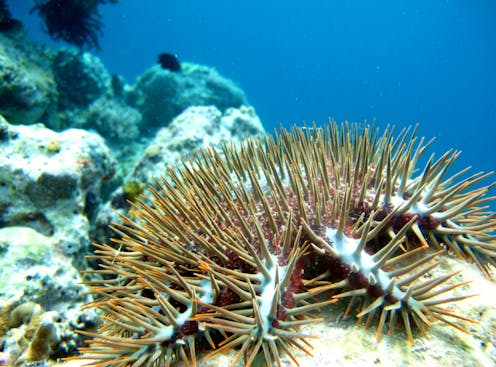
You might not realise it, but the infamous crown-of-thorns starfish is native to coral reefs throughout the Indo-Pacific – including the Great Barrier Reef. When they’re fully grown, these large, thorn-covered starfish dine on hard coral polyps.
That’s fine when their populations are small. They can play an important role in keeping reefs healthy by eating fast-growing branching corals and clearing space for slower-growing coral species.
But when their populations surge, they can decimate coral reefs – and strip habitat for the myriad species relying on them.
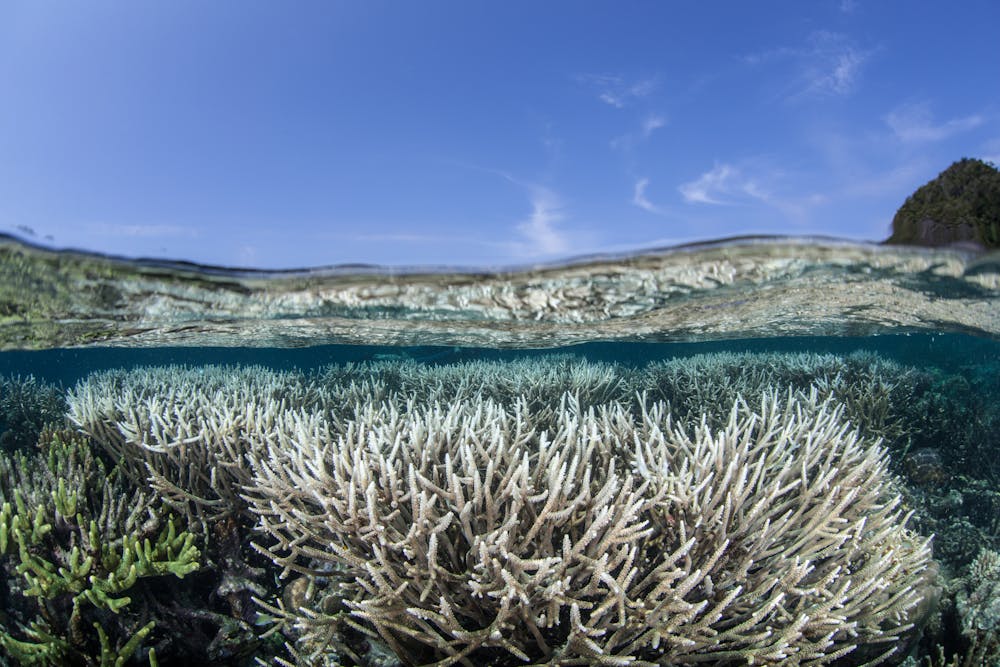
Our coral reefs are already suffering from marine heatwaves, pollution and overfishing. Crown-of-thorns outbreaks can push reefs over the edge.
But can these starfish survive the marine heatwaves now striking the oceans more and more regularly? To find out, we worked out what temperatures the starfish could handle.
Our results suggest baby crown-of-thorns starfish are, unfortunately, very tolerant of warmer water. It’s more bad news for our sick reefs.
Keystone predators of the reef
At up to 80 centimetres across, crown-of-thorns starfish are one of the largest invertebrates on coral reefs. They are named after their toxic spines.
Their large central body houses a particularly large stomach. To eat, they force their stomachs out of their mouths to cover the coral underneath their body. Once wrapped around the coral, enzymes released from the stomach liquefies the coral’s soft tissues and absorbs the nutrients – leaving only the skeleton behind.
These starfish have evolved to become keystone predators. That is, relative to their population, they have a disproportionately large ability to control how abundant other species are.
During an outbreak, their swarms can eat up to 95% of hard corals on some reefs. When this happens, not only are coral species hard hit, but the animals dependent on them as well.
When the conditions are right, these starfish can go from a very low abundance of one per hectare to upwards of a thousand in a short period of time.
Read more: Is the Great Barrier Reef reviving – or dying? Here's what's happening beyond the headlines
They are remarkably good at reproducing. The females can spawn hundreds of millions of eggs and the males can put out 10 trillion sperm into the water during the breeding season.
Not only that, but the larvae can adjust their bodies depending on the availability of food. When food is low, the arms of the larvae grow longer. These arms have bands of little hairs used to capture food. The longer these bands are, the more food they can capture.
Despite their ability to breed like rabbits, crown-of-thorns populations go through boom and bust. Why? We don’t fully know, even after decades of intensive research and enormous expenditure. Leading theories include a boom following nutrient run-off from rivers and the removal of predatory fish. Other important predators such as the giant triton shell (which eats adults) and the red decorator crab (which eats juveniles).
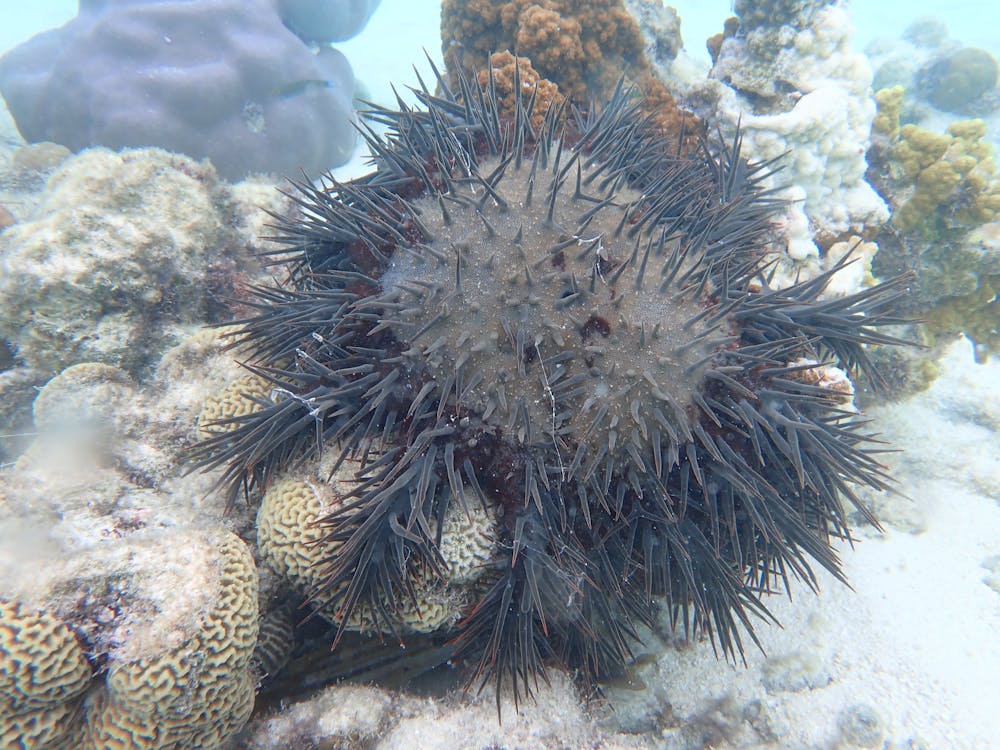 These starfish cover coral with their stomachs to eat it.
Shawna Foo, CC BY-ND
These starfish cover coral with their stomachs to eat it.
Shawna Foo, CC BY-ND
Read more: There's a hidden source of excess nutrients suffocating the Great Barrier Reef. We found it
What we did and what we found
Virtually all research on crown-of-thorns starfish has focused on larval or adult stages, with little to no attention to juveniles, which are difficult to study.
The juveniles start their life on the reef as algae eaters. Our previous research has shown they don’t have to grow up fast. They can remain herbivores for many years when there’s not enough coral to eat and feast on the algae growing on the skeletons of coral killed by heatwaves.
These Peter Pan-like juveniles can build up hidden in the reef over many years. But how do they cope with heat?
Our experiments revealed young starfish can survive tremendous heatwaves, well above the temperatures needed to bleach or kill coral. Coral can bleach or die when water gets 1–3°C warmer, depending on how long the heat lasts. But the starfish had much greater tolerance – almost three times the heat needed to bleach coral.
All of them survived in coral bleaching conditions – four consecutive weeks of temperatures 1°C above the average maximum temperatures for the sea surface in summer, as well as eight consecutive weeks (enough for mass death of corals) and even 12 weeks – extreme conditions well past what coral can survive.
Over the course of the experiment, the juveniles could handle waters up to 34–36°C.
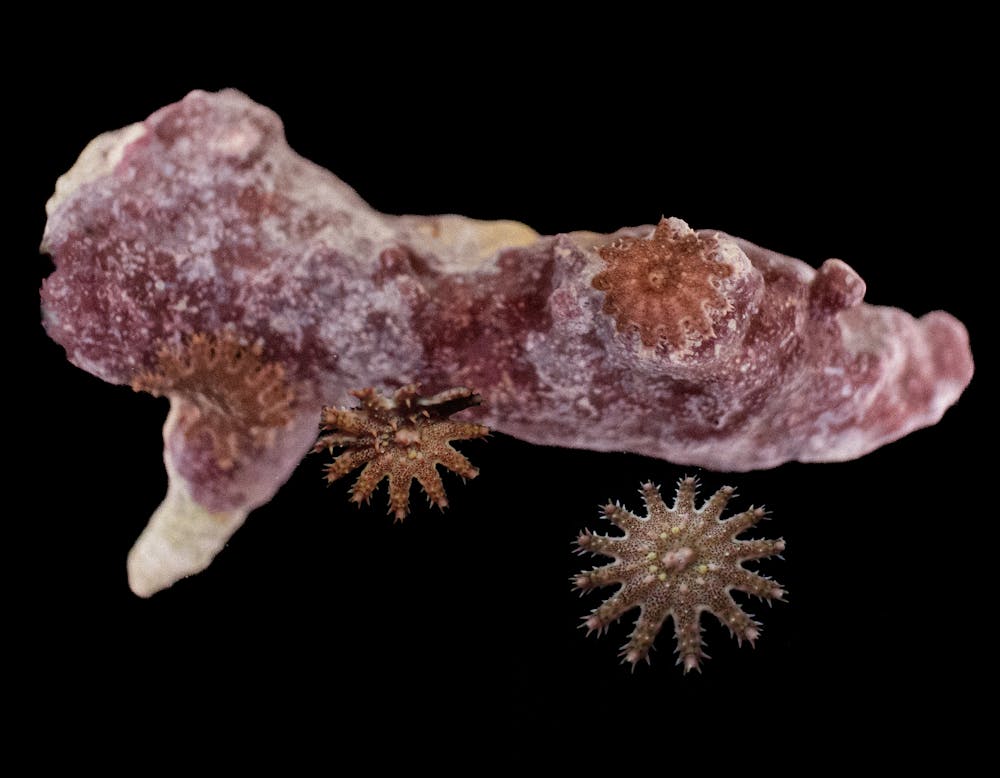 These starfish eat algae when young and coral when they’re fully grown.
Monique Webb and Matthew Clements, CC BY-ND
These starfish eat algae when young and coral when they’re fully grown.
Monique Webb and Matthew Clements, CC BY-ND
More bad news for coral reefs
This is not good news for our reefs. Warming waters may actually make life easier for a major predator of coral.
Even if the coral-eating adults decline as their coral prey dies back, their young can wait patiently for the right moment to develop into predators able to devour corals just as they begin to recover.
This discovery may help explain why adult crown-of-thorns starfish outbreaks can occur so suddenly.
For years, we’ve suspected the acceleration of outbreaks was linked to predator removal or a build-up of nutrients in the water.
Now we have evidence that coral bleaching and death could actually aid the juvenile crown-of-thorns starfish – and that the heat tolerance of juveniles could add even more pressure to struggling reefs.
Ultimately, the only real solution is to rapidly reduce greenhouse gas emissions.
Read more: Could 'marine cloud brightening' reduce coral bleaching on the Great Barrier Reef?
Authors: Matt Clements, PhD Student, University of Sydney


















