The climate impact of plastic pollution is negligible – the production of new plastics is the real problem
- Written by Karin Kvale, Senior Scientist, Carbon Cycle Modeller, GNS Science
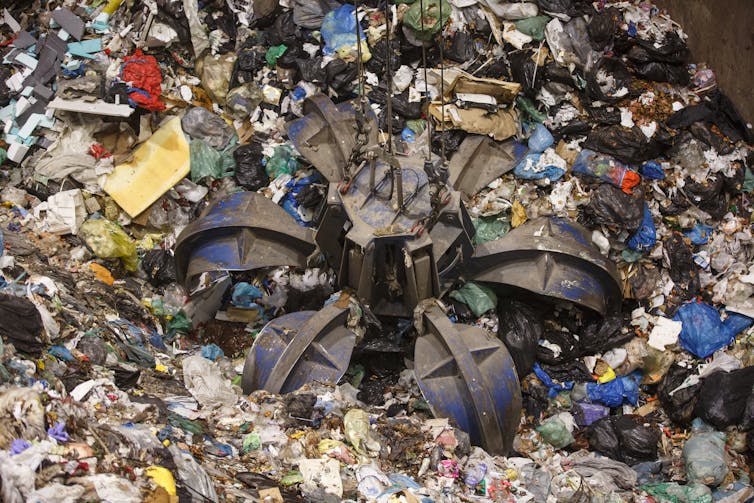
The dual pressures of climate change and plastic pollution are frequently conflated in the media, in peer-reviewed research and other environmental reporting.
This is understandable. Plastics are largely derived from fossil fuels and the burning of fossil fuels is the major driver of human-caused climate change.
The window for cutting emissions to keep warming at internationally agreed levels is closing rapidly and it seems logical to conclude that any “extra” fossil carbon from plastic contamination will be a problem for the climate.
Our research examines this question using an Earth system model. We found carbon leaching out of existing plastic pollution has a negligible impact. The bigger concern is the production of new plastics, which already accounts for 4.5% of total global emissions and is expected to rise.
Organic carbon leaching from plastic pollution
In nature, plants make organic carbon (carbon-hydrogen compounds) from inorganic carbon (carbon compounds not bonded with hydrogen) through photosynthesis. Most plastics are made from fossil fuels, which are organic carbon compounds. This organic carbon leaches into the environment from plastics as they degrade.
Concerns have been raised that this could disrupt global carbon cycling by acting as an alternative carbon source for bacteria, which consume organic carbon.
A key assumption in these concerns is that organic carbon fluxes and reservoirs are a major influence on global carbon cycling (and atmospheric carbon dioxide) over human timescales.
It is true that dissolved organic carbon is a major carbon reservoir. In the ocean, it is about the same amount as the carbon dioxide (CO₂) held in the pre-industrial atmosphere. But there are key differences between atmospheric CO₂ and ocean organic carbon storage. One is the climate impact.
Atmospheric CO₂ warms the climate directly, whereas dissolved organic carbon stored in the ocean is mostly inert. This dissolved organic carbon reservoir built up over many thousands of years.
When phytoplankton make organic carbon (or when plastics leach organic carbon), most of it is rapidly used within hours to days by bacteria and converted into dissolved inorganic carbon. The tiny fraction of organic carbon left behind after bacterial processing is the inert portion that slowly builds up into a natural reservoir.
Once we recognise that plastics carbon is better considered as a source of dissolved inorganic carbon, we can appreciate its minor potential for influence. The inorganic carbon reservoir of the ocean is 63 times bigger than its organic carbon store.
Plastics carbon has little impact on atmospheric CO₂
We used an Earth system model to simulate what would happen if we added dissolved inorganic carbon to the surface ocean for 100 years. We applied it at a rate equivalent to the amount of carbon projected to leach into the ocean by the year 2040 (29 million metric tonnes per year).
This scenario likely overestimates the amount of plastics pollution. Current pollution rates are well below this level and an international treaty to limit plastic pollution is under negotiation.
Read more: Four reasons to be hopeful about the planned global plastics treaty
We repeated the model simulation of adding plastics carbon both with strong climate warming (to see if plastics carbon might produce unexpected climate feedbacks that increase warming) and without (to see if it could alter the climate by itself). In both cases, plastics carbon only increased atmospheric CO₂ concentrations by 1 parts per million (ppm) over a century.
This is a very small increase, considering that current burning of fossil fuels is raising atmospheric CO₂ by more than 2ppm each year.
Direct emissions from burning plastic
We also examined the impact of plastics incineration. We used a scenario in which all plastic projected to be produced in the year 2050 (1.1 billion metric tonnes) would be burned and directly converted into atmospheric CO₂ for 100 years.
In this scenario, we found atmospheric CO₂ increased a little over 21ppm by the year 2100. This increase is equivalent to the impact of fewer than nine years of current fossil fuel emissions.
Relative to the current continued widespread burning of fossil fuels for energy, carbon emitted from plastic waste will not have significant direct impacts on atmospheric CO₂ levels, no matter what form it takes in the environment.
However, plastics production, as opposed to leaching or incineration, currently represents about 4.5% of total global emissions. As fossil fuel consumption is reduced in other sectors, emissions from plastics production are expected to increase in proportional footprint and absolute amount.
A legally binding plastics pollution treaty, currently under development as part of the UN’s environment programme, is an excellent opportunity to recognise the growing contribution of plastics production to climate change and to seek regulatory measures to address these emissions.
Limiting the use of incineration is another climate-friendly measure that would make a small but positive contribution to the goals of the Paris Agreement.
Of course, environmental plastics pollution has many negative impacts beyond climate effects. Our work does not diminish the importance of cleaning up plastic pollution and implementing stringent measures to prevent it. But the justification for doing so is not primarily grounded in an effort to cut emissions.
Authors: Karin Kvale, Senior Scientist, Carbon Cycle Modeller, GNS Science