

how First Nations leadership is key to getting remote communities online
- Written by Daniel Featherstone, Senior Research Fellow, RMIT University
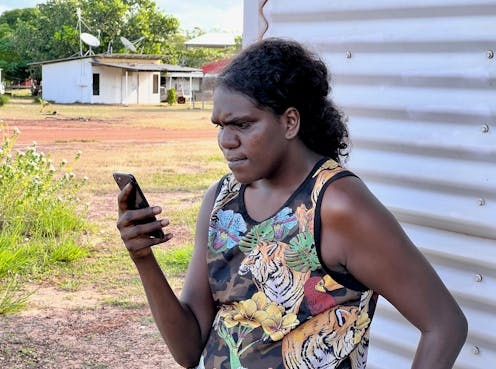
There are more than 1,500 remote First Nations communities and homelands around Australia, and about 670 of them have no mobile phone coverage. In research with 495 people from ten remote communities, we found 45.9% were “highly excluded” from increasingly important digital services and tools.
Digital inclusion for First Nations people is part of the National Agreement on Closing the Gap. The agreement calls for Aboriginal and Torres Strait Islander people to have “access to information and services enabling participation in informed decision-making regarding their own lives”, and “equal levels of digital inclusion as other Australians by 2026”.
There is still some way to go, as our research shows. As one person in a remote community described their situation, “the internet here in Galiwin’ku past 10am is hopeless. [It] further marginalises people already living in an isolated community.”
A new report by the First Nations Digital Inclusion Advisory Group, released today, proposes a series of practical strategies to the Australian government to reduce the digital divide for First Nations Australians, particularly those living in remote communities and homelands.
Digital inclusion and the digital gap
We are part of a team that studies digital inclusion – the ability to access, afford, and effectively use digital technologies – across Australia. Each year, we publish the Australian Digital Inclusion Index which gives scores out of 100 for inclusion in different regions and groups of people around the country.
In our Mapping the Digital Gap project, we are researching digital inclusion among First Nations people in remote communities.
There is a significant gap in digital inclusion for First Nations people compared with other Australians, which widens substantially with remoteness.
Nationally, we found a “digital gap” of 7.5 points between First Nations people and others in Australia. In remote Australia the gap is 24.4 points, and in very remote communities and homelands it is 25.3 points.
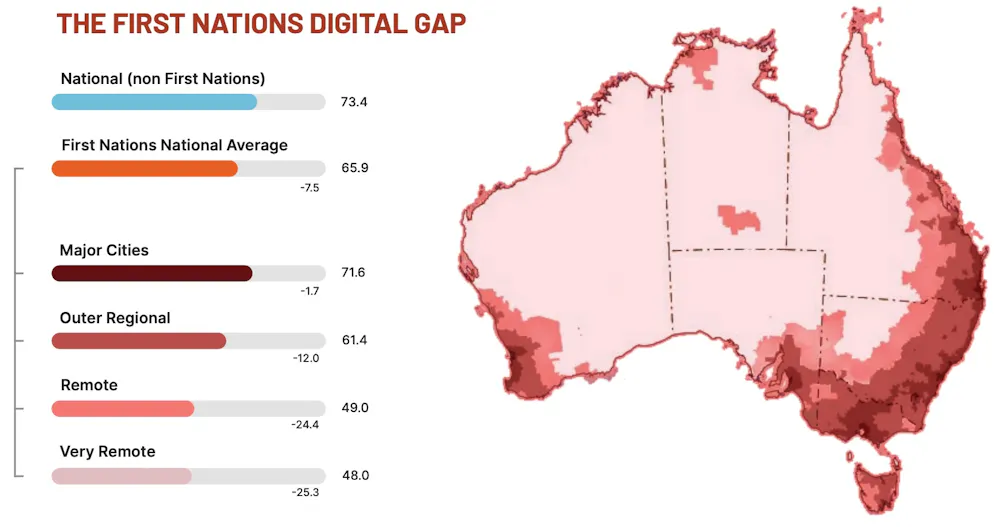
The biggest contribution to this gap comes from access to communications services. There are some 1,545 remote First Nations communities and homelands across Australia, and 670 have no mobile coverage. Many of the others need much better access to affordable and reliable connections.
First Nations people primarily use prepaid mobile services for voice and data, so expanded access to mobile and wifi services are a critical first step.
Of the 495 remote First Nations people who participated in our study, 45.9% were rated as “highly excluded” based on their inclusion index scores, compared with 9.4% of people across Australia.
First Nations leadership on closing the digital gap
The First Nations Digital Inclusion Advisory Group was established by Minister for Communications Michelle Rowland in January 2023 to provide First Nations leadership on policy and programs to address closing the digital gap.
The advisory group consists of five highly experienced First Nations people, supported by a seven-person expert panel and a secretariat within the Commonwealth Department of Infrastructure. The group is chaired by veteran media professional and Noongar woman Dot West, with researcher Lyndon Ormond-Parker, an Alyawarr man and coauthor of this article, as deputy chair.
The advisory group’s initial report was released by West, Rowland, and Minister for Indigenous Australians Linda Burney. This report follows the release of the federal government’s First Nations Digital Inclusion Plan in July.
In the introduction to the report, West outlines the importance of Closing the Gap Target 17:
Digital inclusion is a critical enabler for a vast array of other benefits, including health, education and social connectedness, as well as making sure First Nations people have access to the information they need to make decisions for themselves and their families.
She describes the need for a collaborative approach to achieve this ambitious target.
To meet Target 17 will require significant and new investment by governments in partnership with industry and those communities where the digital gap is most pronounced. The most effective approaches will be ones that reflect local priorities and are based on direct engagement with communities.
In the report, the advisory group outlines a number of practical recommendations to help close the digital gap. These include:
providing affordable pre-paid mobile plans
improved access to government communications programs
fit-for-purpose connectivity options such as community wifi connections, prepaid NBN services, new satellite internet projects, and upgrades to improve TV access.
Read more: Aboriginal communities embrace technology, but they have unique cyber safety challenges
Other recommendations are supporting the development of digital skills needed to safely and confidently use online services, and access to relevant news and media, including local First Nations services.
Improving national data collection for the 70% of First Nations people who live in urban and regional Australia, to measure progress, is another key recommendation. This builds on an earlier outcome of the advisory group’s advocacy, an interactive map of connectivity in First Nations communities.
Shared decision-making
The National Agreement on Closing the Gap is built on a partnership approach between governments and First Nations people, which includes co-design and co-delivery of programs.
The first of the reforms at the centre of the agreement is to “strengthen and establish formal partnerships and shared decision-making”. If this reform is enacted by governments nationally, it is likely to lead to meaningful progress on Closing the Gap.
This advisory group provides an example of how First Nations leadership can provide practical, appropriate and evidence-based input on key policy areas that affect First Nations people and communities.
Authors: Daniel Featherstone, Senior Research Fellow, RMIT University

















