If you're 65 or over and want to work, you're far better off in New Zealand than Australia
- Written by Peter Martin, Visiting Fellow, Crawford School of Public Policy, Australian National University

Want to keep working after you’ve reached pension age?
The Australian government has just made it a little bit easier, increasing the amount you can earn per year from work before losing some of your pension by A$4,000 on an ongoing basis.
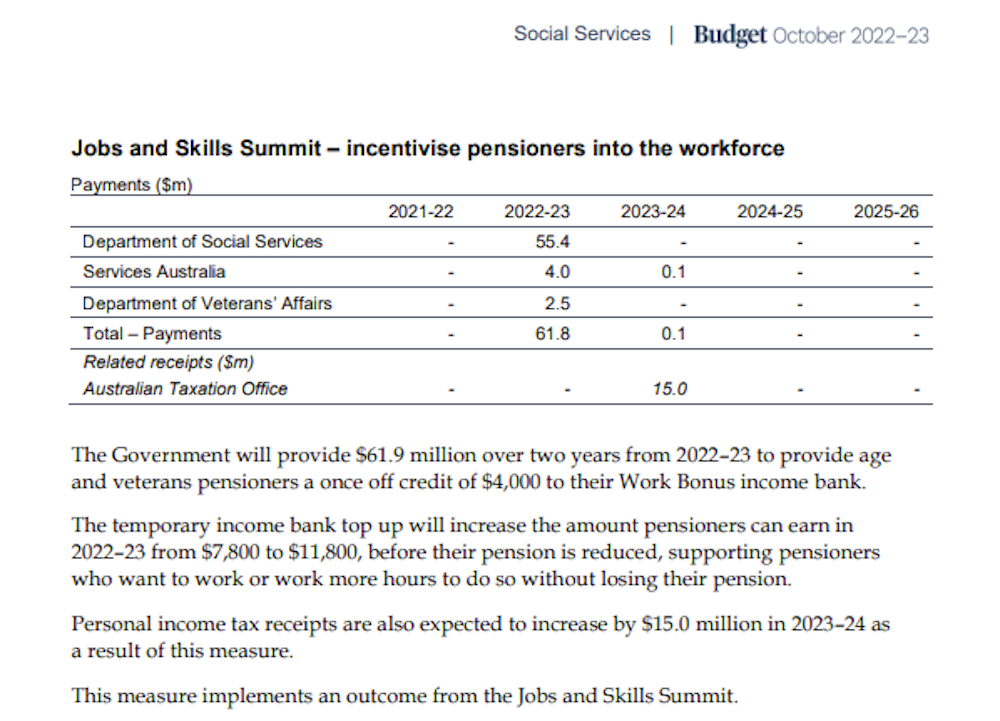
Late last year, it temporarily upped the so-called work bonus from $7,800 per year to $11,800 to “incentivise pensioners into the workforce”. It was part of the government’s response to its September jobs and skills summit.
It meant pensioners could earn an underwhelming $227 per week from work without harming their pension, up from the previous $150.
The rules for older workers are very different in New Zealand. In fact, if Australia adopted New Zealand’s approach, we could have an extra 500,000 willing workers – a fair chunk of them paying tax.
What’s NZ doing differently for older workers?
Last month, as part of his employment white paper, Australian Treasurer Jim Chalmers made the increase to $227 per week permanent.
Chalmers headlined the announcement: Getting more Australians back into work.
But it’s doing an underwhelming job. In Australia, 15.1% of the population aged 65 and older are in some kind of paid work, up from 14.7% a year earlier.
In contrast, in New Zealand the proportion has just hit 26%. That’s right: more than one-quarter of New Zealanders aged 65 and older are employed.
It’s a similar story if we look at how Australia and New Zealand compared to others internationally on labour force participation (which covers those in paid work plus people actively looking for it).
New Zealand wants to see that number rise further. It has been talking about 33.1% of its population aged 65 or more in paid work, which is what Iceland has.
What is New Zealand doing for over-65s that Australia is not?
You won’t find it mentioned in either treasury’s employment white paper (released in September) or intergenerational report (released in August) – even though National Seniors Australia pointed it out in submissions.
One crucial thing New Zealand is not doing is annoying pensioners who work.
Australian pensioners in paid work get called in for discussions with Centrelink, if it looks as if they are at risk of doing too many hours and going over the $227 per week limit.
The more you work, the more your pension is cut
Pensioners who do go over the $227 per week limit lose half of every extra dollar they earn in a cut to their pension.
Plus tax, this means they lose a total of 69% of what they earn over the limit where their tax rate is 19%, and 82.5% on the portion of earnings taxed at 32.5%.
And this is after the boost designed to “incentivise pensioners into the workforce”.
Last year’s jobs summit also set up a Women’s Economic Equality Taskforce. It reported this week, drawing attention to the “disincentive rates” facing second earners (usually women) who return to work after caring for children.
It said that taking the loss of benefits, tax and childcare costs together, the penalty for returning to work was more than half of what was earned on the first three days of the week, and up to 110% of what was earned on the fourth and fifth days.
My point here is that the losses facing age pensioners who attempt to work are of a similar order – in Australia but not in New Zealand.
Australia’s rules aren’t just stopping pensioners from taking on extra hours. They seem to stop them taking up paid work at all.
There were 2.6 million Australians on the age pension in June this year. Only 83,925 reported income from working. That’s just 3.2%.
NZ pensioners keep their pensions
What’s different about New Zealand is that New Zealand’s pensioners don’t face a penalty if they work. They simply face income tax.
In New Zealand, the age pension (which is called superannuation, making it confusing for Australians) is paid to everyone of pension age. There’s no income test or assets test. You get it because you are a citizen or permanent resident.
Australia wouldn’t need to go as far as New Zealand to get the same benefit. We would simply need to ditch the pension income test in cases where that income came from paid work, leaving the assets test in place.
Then there would be no concern about working.
Read more: Here's a radical reform that could pay every retiree the full pension
Half a million reasons for change
If we made that change – and if the same proportion of older Australians chose to work as New Zealanders – we would soon have an extra half a million older Australians able to step into fields such as teaching, where there are 15,500 vacancies, and health care and social assistance, where there are 68,100 vacancies.
It would cost the federal government money because it’d put more Australians of pension age on the pension.
But it’d cost less if we abolished the special tax concession for seniors and pensioners, known as the seniors and pensioners tax offset. In New Zealand, senior citizens face the same tax rates as everyone else.
And it would cost less as more pensioners earned wages and paid income tax.
Calculations prepared for National Seniors Australia by Deloitte suggest that beyond a certain point, the change would become revenue-positive – actually boosting federal coffers – as the extra income tax revenue outweighed the cost of the extra pensions.
National Seniors is calling its campaign “let pensioners work”.

Tapping into the cash economy
Importantly – and here’s where we get to a fact National Seniors might not like me mentioning – that would happen not only because more senior Australians were employed, but also because more senior Australians were employed legitimately.
It’s hard to get a handle on how many senior Australians are working and being paid in cash, which they store rather than bank to avoid tripping the income test. But we do know this.
At the end of March, there were 18 Australian $100 notes in circulation for each Australian resident, an astonishingly high proportion given the use of cash for transactions is collapsing.
In New Zealand at the end of March, there were just five New Zealand $100 notes in circulation for each New Zealand resident.
That may be just a coincidence.
But New Zealand is certainly making it easier for retirees to work legitimately, rather than stay at home or accept cash in hand.
Authors: Peter Martin, Visiting Fellow, Crawford School of Public Policy, Australian National University