Why do people with hoarding disorder hoard, and how can we help?
- Written by Jessica Grisham, Professor in Psychology, UNSW Sydney

Hoarding disorder is an under-recognised serious mental illness that worsens with age. It affects 2.5% of the working-age population and 7% of older adults. That’s about 715,000 Australians.
People who hoard and their families often feel ashamed and don’t get the support they need. Clutter can make it hard to do things most of us take for granted, such as eating at the table or sleeping in bed.
In the gravest cases, homes are completely unsanitary, either because it has become impossible to clean or because the person saves garbage. The strain on the family can be extreme – couples get divorced, and children grow up feeling unloved.
So why do people with hoarding disorder hoard? And how can we help?

What causes hoarding disorder?
Saving millions of objects, many worthless by objective standards, often makes little sense to those unfamiliar with the condition.
However, most of us become attached to at least a few possessions. Perhaps we love the way they look, or they trigger fond memories.
Hoarding involves this same type of object attachment, as well over-reliance on possessions and difficulty being away from them.
Research has shown genetic factors play a role but there is no one single gene that causes hoarding disorder. Instead, a range of psychological, neurobiological, and social factors can be at play.
Although some who hoard report being deprived of material things in childhood, emotional deprivation may play a stronger role.
People with hoarding problems often report excessively cold parenting, difficulty connecting with others, and more traumatic experiences.
They may end up believing people are unreliable and untrustworthy, and that it’s better to rely on objects for comfort and safety.
People with hoarding disorder are often as attached or perhaps more attached to possessions than to the people in their life.
Their experiences have taught them their self-identity is tangled up in what they own; that if they part with their possessions, they will lose themselves.
Research shows interpersonal problems, such as loneliness, are linked to greater attachment to objects.
Hoarding disorder is also associated with high rates of attention deficit and hyperactivity disorder. Difficulties with decision-making, planning, attention and categorising can make it hard to organise and discard possessions.
The person ends up avoiding these tasks, which leads to unmanageable levels of clutter.
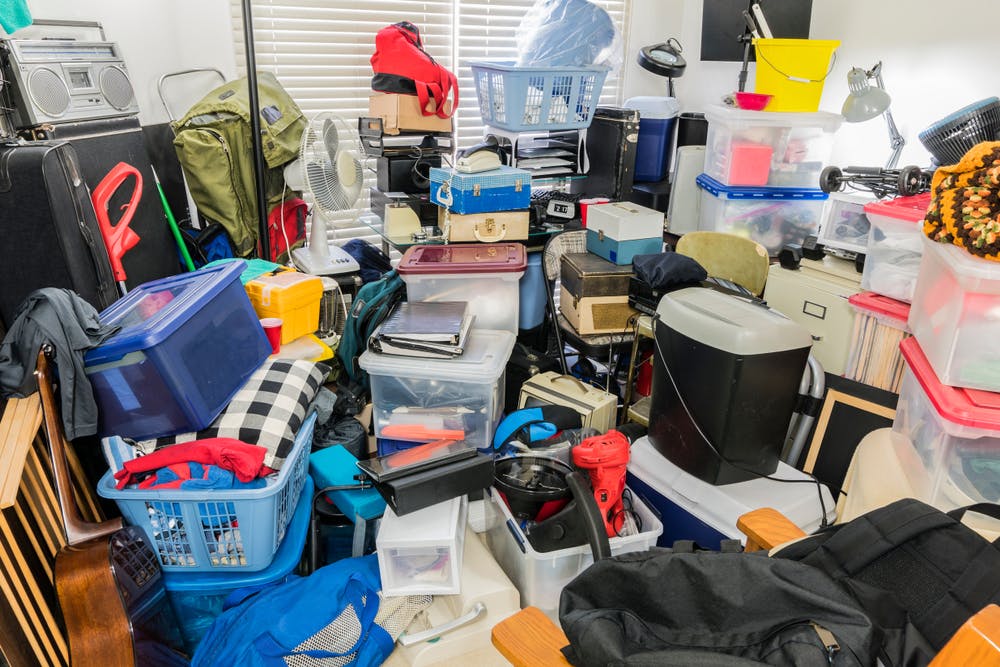 Some end up believing it’s better to rely on objects rather than people.
Shutterstock
Some end up believing it’s better to rely on objects rather than people.
Shutterstock
Not everyone takes the same path to hoarding
Most people with hoarding disorder also have strong beliefs about their possessions. For example, they are more likely to see beauty or usefulness in things and believe objects possess human-like qualities such as intentions, emotions, or free will.
Many also feel responsible for objects and for the environment. While others may not think twice about discarding broken or disposable things, people with hoarding disorder can anguish over their fate.
This need to control, rescue, and protect objects is often at odds with the beliefs of friends and family, which can lead to conflict and social isolation.
Not everyone with hoarding disorder describes the same pathway to overwhelming clutter.
Some report more cognitive difficulties while others may have experienced more emotional deprivation. So it’s important to take an individualised approach to treatment.
How can we treat hoarding disorder?
There is specialised cognitive-behavioural therapy (CBT) tailored for hoarding disorder. Different strategies are used to address the different factors contributing to a person’s hoarding.
Cognitive-behavioural therapy can also help people understand and gradually challenge their beliefs about possessions.
They may begin to consider how to remember, connect, feel safe, or express their identity in ways other via inanimate objects.
Treatment can also help people learn the skills needed to organise, plan, and discard.
Regardless of their path to hoarding, most people with hoarding disorder will benefit from a degree of exposure therapy.
This helps people gradually learn to let go of possessions and resist acquiring more.
Exposure to triggering situations (such as visiting shopping centres, op-shops or mounds of clutter without collecting new items) can help people learn to tolerate their urges and distress.
Treatment can happen in an individual or group setting, and/or via telehealth.
Research is underway on ways to improve the treatment options further through, for example, learning different emotional regulation strategies.
Sometimes, a harm-avoidance approach is best
Addressing the emotional and behavioural drivers of hoarding through cognitive behavioural therapy is crucial.
But hoarding is different to most other psychological disorders. Complex cases may require lots of different agencies to work together.
For example, health-care workers may work with fire and housing officers to ensure the person can live safely at home.
When people have severe hoarding problems but are reluctant to engage in treatment, a harm-avoidance approach may be best. This means working with the person with hoarding disorder to identify the most pressing safety hazards and come up with a practical plan to address them.
We must continue to improve our understanding and treatment of this complex disorder and address barriers to accessing help.
This will ultimately help reduce the devastating impact of hoarding disorder on individuals, their families, and the community.
Read more: My possessions spark joy! Will the KonMari decluttering method work for me?
Authors: Jessica Grisham, Professor in Psychology, UNSW Sydney
Read more https://theconversation.com/why-do-people-with-hoarding-disorder-hoard-and-how-can-we-help-208102