

Australian school students are experimenting with 'space veggies' in a NASA initiative
- Written by: Kim Johnson, Senior lecturer, La Trobe University
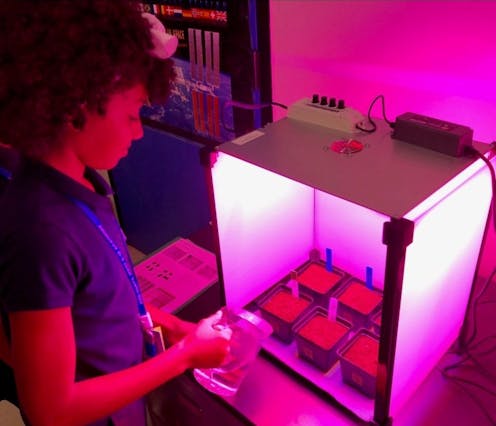
A pink glow is shining on the faces of enthusiastic students as they tend to plants in purpose-built grow boxes for space stations.
These students are the first in Australia to experience Growing Beyond Earth – a schools citizen science program from NASA and Fairchild Tropical Botanic Garden in the United States.
In Australia, Royal Botanic Gardens Victoria is working with the La Trobe Institute for Agriculture and Food, and Melbourne Archdiocese of Catholic Schools. The educational initiative ties into the Australian curriculum and gives students a unique introduction to gardening through science.
In this project, students grow plants in controlled conditions to test if they would be suitable for NASA missions, to help feed a future cadre of astronauts.
Plants evolved on Earth, so they might not grow so well in space. Before we start sending plants “off-world” to the Moon and Mars, we need to test their suitability. That way we can select the best for success.
Read more: Humans are going back to the Moon, and beyond – but how will we feed them?
Gardening on the Moon and beyond
The NASA Artemis mission aims to establish a long-term presence on the Moon and send astronauts to Mars. If all goes to plan, humans will be living and working on the Moon by 2030.
Currently, astronauts on the International Space Station rely on a pre-packaged diet that is frequently resupplied. But in the long term, space gardens providing fresh, edible plants will be essential to maintain astronaut health and wellbeing.
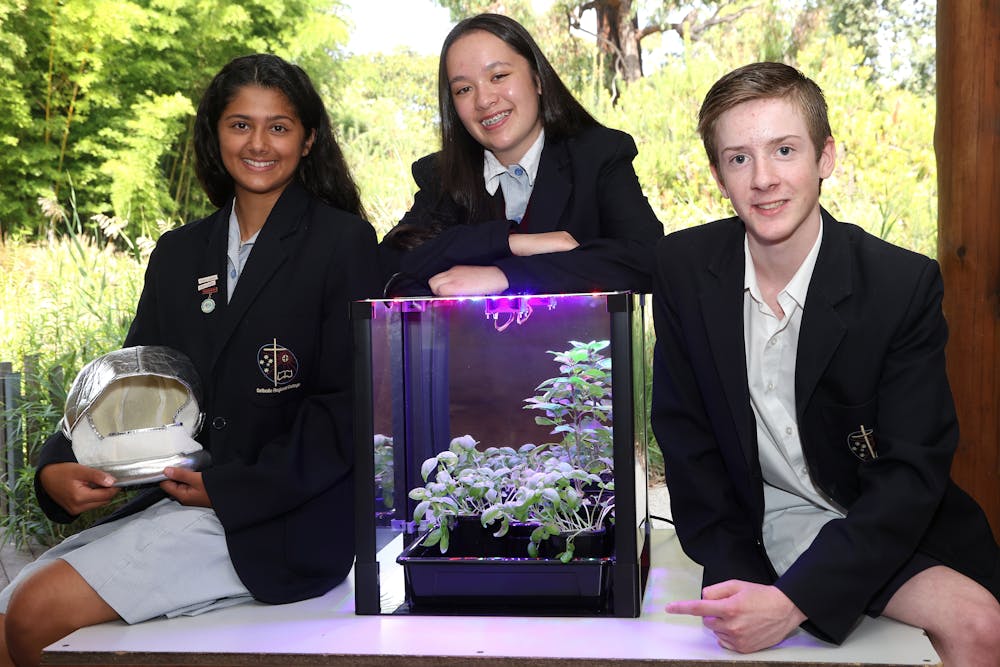
For Growing Beyond Earth, students build the “growth habitat” inside a box roughly the size of a large microwave fitted with LED lights and sensors.
Then they plant the seeds of a leafy green called misome, which grows reliably and quickly – both on and off-Earth.
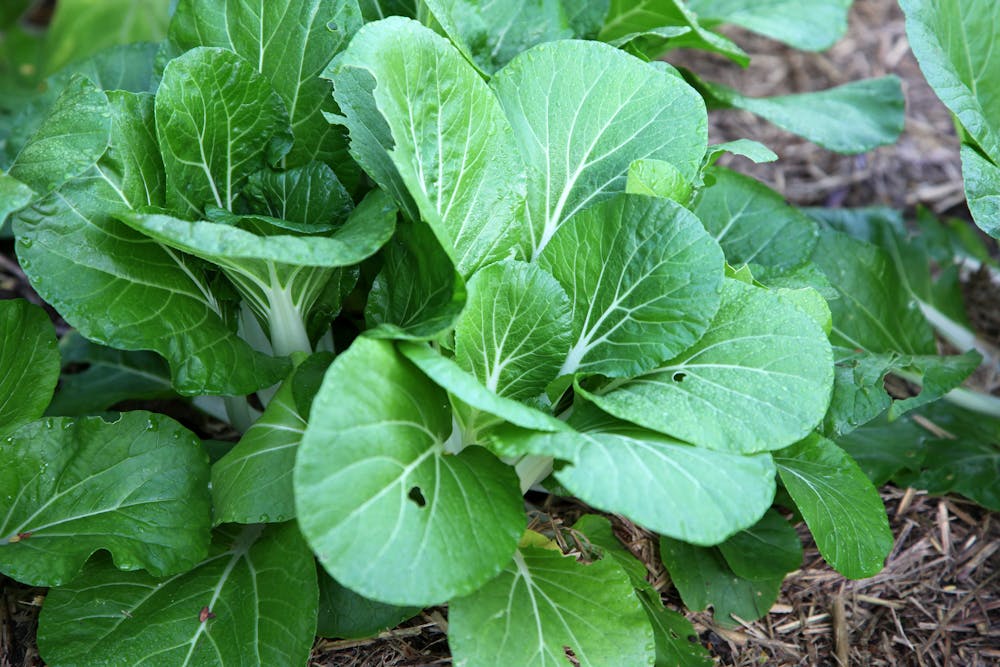 The green leafy vegetable misome grows well on Earth and in space.
Jacqui Martin, Shutterstock
The green leafy vegetable misome grows well on Earth and in space.
Jacqui Martin, Shutterstock
The students gain valuable experience in running their own experiments, including planting the seeds in pots and using growth media that match the NASA Vegetable Production System (Veggie).
They monitor growth and water use, making notes about plant size, colour and fitness. Students learn what plants need, how fast they can grow, what can be recycled and how much can be harvested. Also, would anyone want to eat it?
Students can extend their skills in a second experiment to test other plant types. So far, nearly 200 plants have been trialled and several new candidate plants, including pak choi, cress and kale, were found suitable.
Introducing Growing Beyond Earth (FairchildChallenge)Supporting the curriculum and connecting to nature
Growing Beyond Earth ties into the Australian curriculum through “science as a human endeavour”. This relates to the role of science in society, including how scientific knowledge influences people’s lives and can be used to make decisions.
A growing body of evidence shows student-led, activity-based projects lead to better learning outcomes. When students are exposed to real-world content, they remember it better, earn better grades and improve their critical thinking and problem-solving skills. These students can then apply their knowledge to new situations.
Another important part of the project is the connection with plants and nature. The positive effects of nature on wellbeing came to the fore during COVID lockdowns. Studies show indoor plants helped reduce mental stress during isolation, and people chose to garden to connect with nature, release stress and address issues with food supply.
Nature has a strong influence on student learning too. Greater academic achievement and personal development comes from connection to the environment. For example, students in classrooms that have a view of nature report lower levels of stress and perform better on concentration tests compared to windowless rooms.
Better learning could also simply come from being in a good mood. Students are more interested and self-motivated during nature-based activities. This finding has very real implications for students who are normally disengaged.Time spent with nature also has a greater influence on how we view the environment than knowledge of conservation alone. Simply knowing climate change is contributing to species loss is less likely to inspire conservation action than frequently observing environmental change during time spent outdoors.
Emotional connection with nature promotes interest in learning about sustainability and in turn, caring for natural resources.
Exploring an exciting new frontier
The influence of the Growing Beyond Earth program on student attitudes to gardens, conservation and food is still being assessed. As the program expands to more countries, it will track student achievement, career paths and leadership.
So far, surveys reveal Growing Beyond Earth students are more knowledgeable and confident about science, technology, engineering and maths (STEM) topics and related careers.
These students may go on to play crucial roles in building future crop production systems on Mars, designing space plants for food and medicines, and using nature to improve the wellbeing of people experiencing isolation.
Authors: Kim Johnson, Senior lecturer, La Trobe University


















