Žižek: his key ideas explained
- Written by Matthew Sharpe, Associate Professor in Philosophy, Australian Catholic University
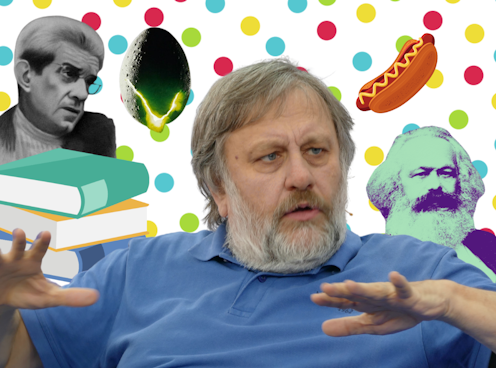
It might be said that books by Slavoj Žižek don’t conclude, they just end. And indeed, no matter which of his many books you open, you’ll find philosophy, psychoanalysis, pop culture, a smattering of off-key jokes, and commentary on recent events – often in no readily-discernible order.
Žižek, a Slovenian philosopher and cultural theorist, is known to many today for his 2019 debate with psychology professor and culture warrior Jordan Peterson. This debate, held in Toronto, Canada, was about the relationship between Marxism, capitalism, and happiness.
Žižek was presented as the Leftist counterpoint to Peterson’s reactionary stylings. While the two disagreed on much, they agreed on certain things, such as their criticism of identity politics. Yet this debate, too, arguably ended rather than came to any conclusions.
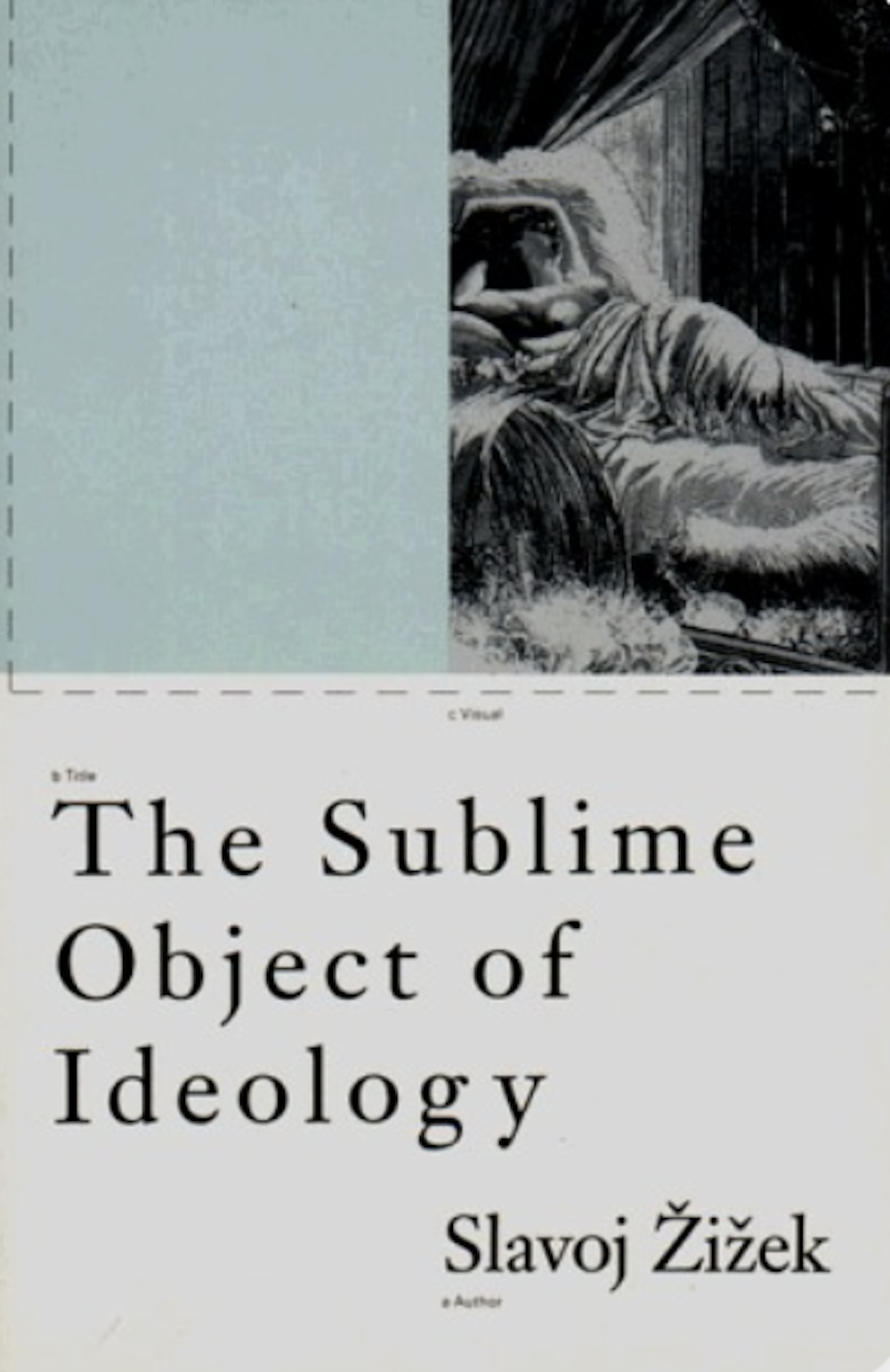
Žižek burst onto the anglophone academic scene over 30 years ago with a sequence of groundbreaking works, starting with the 1989 book, The Sublime Object of Ideology. Then there were wonderful explorations of Hollywood cinema in Enjoy your Symptom! and Looking Awry.
Once dubbed a “celebrity philosopher” by Foreign Policy, he has since written books on everything from violence, the GFC and September 11 to Christianity and the pandemic. His latest book explores the question of freedom.
Read more: Karl Marx: his philosophy explained
The critique of ideology
The title of Žižek’s 1989 book, The Sublime Object of Ideology, points towards a key aspect of his profuse intellectual productivity. From the start, Žižek has been interested in what motivates people to act the ways they do. He is especially interested in why people passionately identify with political ideas and causes that may not serve their own best interests.
 Jacques Lacan.
Blatterhin/Wikimedia Commons, CC BY-SA
Lacan argued that a good deal of human behaviour is motivated by irrational drives and wishes we do not consciously grasp. This is why one of Žižek’s early books bears the portentous Biblical title, For They Know Not What They Do.
In order to understand these “unconscious” motives, Lacan drew on the linguistics and anthropology of his time, producing writings of almost legendary difficulty. One reason for Žižek’s success is his great ability to help Lacan make sense to us today by using examples from pop culture, jokes, and politics.
For instance, Žižek illustrates the Lacanian idea of the unsymbolisable Real, by comparing it to the monsters of the Alien movies.
Žižek’s basic Lacanian claim, in terms of his “critique of ideology”, is that people do not always identify with political causes on rational bases. They form passionate, sometimes unconditional identifications with causes and leaders based on their earliest attachments to parental figures. They are thus identifying with what Žižek calls the “sublime objects” of ideologies: whether it is a “charismatic” leader, or an elevating idea like “the revolution” or “human freedom”.
Jacques Lacan.
Blatterhin/Wikimedia Commons, CC BY-SA
Lacan argued that a good deal of human behaviour is motivated by irrational drives and wishes we do not consciously grasp. This is why one of Žižek’s early books bears the portentous Biblical title, For They Know Not What They Do.
In order to understand these “unconscious” motives, Lacan drew on the linguistics and anthropology of his time, producing writings of almost legendary difficulty. One reason for Žižek’s success is his great ability to help Lacan make sense to us today by using examples from pop culture, jokes, and politics.
For instance, Žižek illustrates the Lacanian idea of the unsymbolisable Real, by comparing it to the monsters of the Alien movies.
Žižek’s basic Lacanian claim, in terms of his “critique of ideology”, is that people do not always identify with political causes on rational bases. They form passionate, sometimes unconditional identifications with causes and leaders based on their earliest attachments to parental figures. They are thus identifying with what Žižek calls the “sublime objects” of ideologies: whether it is a “charismatic” leader, or an elevating idea like “the revolution” or “human freedom”.
 Supporters of former US president Donald Trump in Iowa this month.
Charlie Neibergall/AAP
This identification does not turn upon any individual necessarily knowing what the cause means, truly, or what their “beloved leader” actually stands for. It is enough for us each to see that others around us identify with the ideological cause, and assign especial significance to it. We then “believe through the Other”, as Žižek characteristically says.
Parishioners in medieval churches, he writes, would mostly have not understood the mass, which was carried out in Latin. But it did not matter. The ritual still acted as a salve. People “believed through their priests”, who they supposed knew the meaning of the words being recited.
In exchange for our identification with ideologies, Žižek claims, we gain a sense of “ideological enjoyment”: that we are “all in this together”, sharing everything from public events and festivals to the micro-customs organising everyday life, including shared cultural senses of humour.
On the flipside, Žižek’s analyses suggest that what subjects of ideologies most despise in “out-groups” (ie outsiders), is that they seem not to enjoy the same things, in the same way, that “we” do. They smell, speak, eat, worship, even play differently. It is therefore a very common ideological device to position these others as trying to steal our enjoyment from us: taking away our jobs, our taxpayer’s dollars, our “way of life” …
Whither Žižek?
Žižek’s early work suggested that the goal of his Lacanian rethinking of ideology was to enable societies to free themselves from “ideological fantasies” – like recurrent ideas of a utopian “end of history”, or of a “purified”, fascistic community of the People. The result would be a form of enlightened political democracy.
Read more:
The End of History: Francis Fukuyama's controversial idea explained
Since around the turn of the millennium, Žižek has, however, vacillated as to whether any political regime can endure without resting on such irrational political myths. From this time, often seeming to utilise parodic humour, Žižek has positioned himself as a “defender of lost causes”, to echo the title of arguably his most controversial book.
These causes sometimes seemingly include even the Jacobin Terror of the French revolution or Stalinism. He has claimed, too, that Martin Heidegger’s embrace of Nazism was a “right step in the wrong direction”.
Read more:
Heidegger in ruins? Grappling with an anti-semitic philosopher and his troubling rebirth today
Meanwhile, critics like political theorist Ernesto Laclau have questioned the credentials of Žižek’s professed “Marxism”. Some wonder if his patented radical poses are under-girded by any progressive vision of the political good.
Others point out that his own political record in Slovenia in the late 1980s, in which he supported “more privatizations” (“if it works, why not try a dose of it?”), does not sit easily with his Marxist stances in the West since the mid-1990s.
Žižek was recently described by philosopher Gabriel Rockhill as a kind of unlikely “court jester” in today’s hyper market-driven societies: a radical anti-capitalist who is a commercial success, and whose scattered writings are uncannily suited for readers in a rapid-pace world.
Žižek’s evident delight in reversing expectations, and making almost unbelievably provocative propositions, at times makes it difficult to ascertain just how seriously we are meant to take him. Žižek has defended himself against such criticisms by saying he wishes to challenge the “post-political” idea that social change is no longer possible, after the fall of the iron curtain.
Beyond the brilliant exegeses and application of some formidably difficult theory, it is perhaps as an intellectual provocateur that Žižek is most generously to be read.
Authors: Matthew Sharpe, Associate Professor in Philosophy, Australian Catholic University
Supporters of former US president Donald Trump in Iowa this month.
Charlie Neibergall/AAP
This identification does not turn upon any individual necessarily knowing what the cause means, truly, or what their “beloved leader” actually stands for. It is enough for us each to see that others around us identify with the ideological cause, and assign especial significance to it. We then “believe through the Other”, as Žižek characteristically says.
Parishioners in medieval churches, he writes, would mostly have not understood the mass, which was carried out in Latin. But it did not matter. The ritual still acted as a salve. People “believed through their priests”, who they supposed knew the meaning of the words being recited.
In exchange for our identification with ideologies, Žižek claims, we gain a sense of “ideological enjoyment”: that we are “all in this together”, sharing everything from public events and festivals to the micro-customs organising everyday life, including shared cultural senses of humour.
On the flipside, Žižek’s analyses suggest that what subjects of ideologies most despise in “out-groups” (ie outsiders), is that they seem not to enjoy the same things, in the same way, that “we” do. They smell, speak, eat, worship, even play differently. It is therefore a very common ideological device to position these others as trying to steal our enjoyment from us: taking away our jobs, our taxpayer’s dollars, our “way of life” …
Whither Žižek?
Žižek’s early work suggested that the goal of his Lacanian rethinking of ideology was to enable societies to free themselves from “ideological fantasies” – like recurrent ideas of a utopian “end of history”, or of a “purified”, fascistic community of the People. The result would be a form of enlightened political democracy.
Read more:
The End of History: Francis Fukuyama's controversial idea explained
Since around the turn of the millennium, Žižek has, however, vacillated as to whether any political regime can endure without resting on such irrational political myths. From this time, often seeming to utilise parodic humour, Žižek has positioned himself as a “defender of lost causes”, to echo the title of arguably his most controversial book.
These causes sometimes seemingly include even the Jacobin Terror of the French revolution or Stalinism. He has claimed, too, that Martin Heidegger’s embrace of Nazism was a “right step in the wrong direction”.
Read more:
Heidegger in ruins? Grappling with an anti-semitic philosopher and his troubling rebirth today
Meanwhile, critics like political theorist Ernesto Laclau have questioned the credentials of Žižek’s professed “Marxism”. Some wonder if his patented radical poses are under-girded by any progressive vision of the political good.
Others point out that his own political record in Slovenia in the late 1980s, in which he supported “more privatizations” (“if it works, why not try a dose of it?”), does not sit easily with his Marxist stances in the West since the mid-1990s.
Žižek was recently described by philosopher Gabriel Rockhill as a kind of unlikely “court jester” in today’s hyper market-driven societies: a radical anti-capitalist who is a commercial success, and whose scattered writings are uncannily suited for readers in a rapid-pace world.
Žižek’s evident delight in reversing expectations, and making almost unbelievably provocative propositions, at times makes it difficult to ascertain just how seriously we are meant to take him. Žižek has defended himself against such criticisms by saying he wishes to challenge the “post-political” idea that social change is no longer possible, after the fall of the iron curtain.
Beyond the brilliant exegeses and application of some formidably difficult theory, it is perhaps as an intellectual provocateur that Žižek is most generously to be read.
Authors: Matthew Sharpe, Associate Professor in Philosophy, Australian Catholic UniversityRead more https://theconversation.com/zizek-his-key-ideas-explained-213247