

how bacterial enzymes encoded by unknown genes might help clean up pollution
- Written by David Ackerley, Professor of Biotechnology, Te Herenga Waka — Victoria University of Wellington
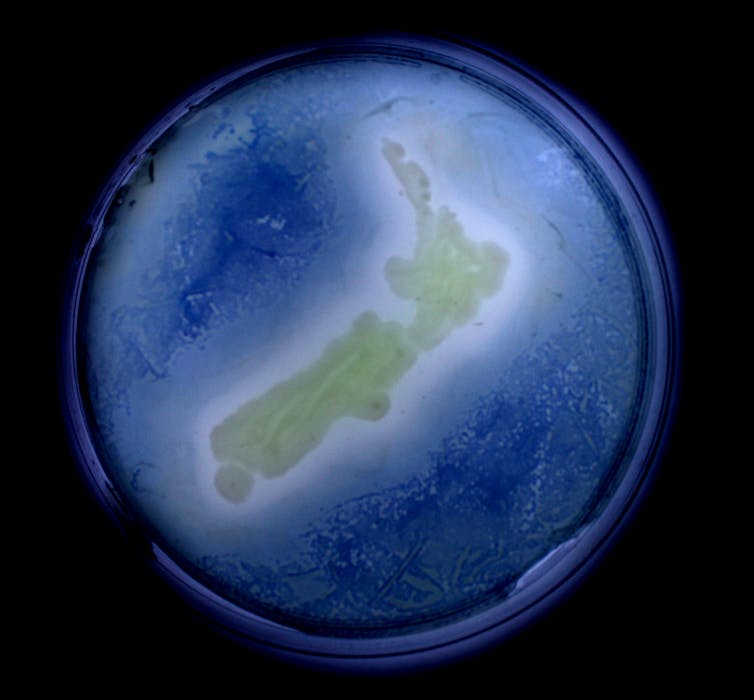
Enzymes are biological nanomachines. They make almost all of life’s chemistry happen, when and where required.
Because of their versatility and power, enzymes can be very useful for biotechnology. Taken outside of living cells, they can be used to synthesise or modify pharmaceuticals or to degrade potential pollutants.
Bacteria contain genes that encode an unfathomable range of enzymes. However, scientists have barely scratched the surface of this potential because 99% of bacteria cannot be grown in laboratory conditions, and hence are largely unstudied.
My team has addressed this by treating the entirety of bacterial DNA in soil – representing thousands of bacterial species – as “genetic software”.
In our new research we show how we can transfer this software to laboratory bacterial strains and then screen for desirable new functions and isolate the enzymes responsible.
Discovering new enzymes
For more than a century, scientists have been collecting soil samples and culturing bacteria, then finding uses for enzymes the bacteria produce. However, when sophisticated DNA-sequencing technologies were developed around the turn of the millennium, it became apparent that standard culturing methods were missing most of the bacteria present.
These technologies showed that a gram of soil, from which typically fewer than 100 different microbial species can be cultured, actually contains many thousands.
The same DNA-sequencing technologies have revealed that the hard-to-grow bacteria contain large numbers of genes whose function is entirely unknown. We are discovering that some of these mystery genes can help us address major problems.
Genes are really just passive units of information – pieces of software code within the hard drive of a living cell. But when that information is activated, the outcome is the production of proteins. Most of these are enzymes.
These enzymes then act as nanoscale catalysts for the chemistry that happens in a living cell. Here the software analogy struggles somewhat, as life is biological, not digital - which means it’s noisy and messy.
Thus, an enzyme might perform a primary job that makes an obvious contribution to a cell’s wellbeing. But it might also be capable of doing a dozen other minor things that may or may not have any obvious value.
Those minor “moonlighting” roles are very important for evolution. A function that has no importance today could turn out to be essential in the future, when an entirely new stress arises.
My team is interested in leveraging the evolutionary potential of “unknown unknown” enzymes from soil-dwelling bacteria to solve important problems. To achieve this, we are partnering with Te Herenga Waka’s Living Pā team to discover new enzymes from soil samples, collected on site with their permission.
Using enzymes to tackle problems
One of the unfortunate consequences of evolution is that bacteria frequently contain enzymes that can provide low levels of protection against new antibiotics developed to fight disease. If those antibiotics are overused, or used inappropriately, the bacteria might start to promote the protective function. This is how full-on antibiotic resistance evolves.
This is a very real problem. Every year millions of people die of bacterial infections that used to be treatable, but no longer are. My team has been studying how bacterial resistance to promising new antibiotics can arise, so countermeasures can be put in place before it’s too late.
Read more: Will we still have antibiotics in 50 years? We asked 7 global experts
But we are also interested in how unknown enzymes encoded by unknown genes might be directly useful – or evolve to be useful – for applications that protect and preserve the environment. For example, enzymes are being discovered and evolved to enable more effective recycling of plastics or remediate persistent environmental pollutants.
Our latest work represents a breakthrough in developing new methods to study the many millions of unknown genes that can be extracted from dirt samples.
Our approach starts by extracting all of the bacterial DNA present in soil and breaking it into bite-sized pieces that contain just one or two genes. We then place them in a special carrier system that allows them to be introduced into a tame laboratory bacterium called Escherichia coli.
Our innovation lies with how we access the information within the newly introduced genes, which is not immediately easy to do. By way of analogy, we all know that Android software usually won’t work on Apple operating systems. Imagine if there were not just a few incompatible operating systems, but many thousands. That’s the problem we face.
We have booted up a commonly used laboratory bacterial strain (E. coli) with new software that would usually be entirely incompatible. But we have developed a universally applicable emulator that allows E. coli to run most of the new software going into it.
We can then screen for individual E. coli bacteria that have gained new properties of interest to us – for example, degradation of target pollutants. Although the enzymes responsible for these new activities might not initially be very efficient, mimicking natural evolutionary processes within the lab environment can improve a low-grade starting activity to an industrially useful level.
Because enzymes are non-living, biodegradable and cannot in any way replicate themselves, they offer safe and controlled solutions to a vast array of problems – if we can find ones able to get the job done.
Authors: David Ackerley, Professor of Biotechnology, Te Herenga Waka — Victoria University of Wellington

















