how the moral panic over 'sexual sadists' silenced their victims
- Written by: Joanna Bourke, Professor of History, Birkbeck, University of London
Between the 1920s and the 1950s, sexual sadism was widely discussed in Australian newspapers. Ironically, attempts to ban the Marquis de Sade’s books gave journalists an excuse to write about them, thus spreading knowledge of this “perversion”. Public awareness of sadism also incited social panic, provoked by a series of highly publicised murders of Australian women.
One of these was the mutilation and killing of Dorothy (“Dot”) May Everett in Newcastle in November 1937. Everett was a 27-year-old kitchenmaid who worked at the Broughton Church of England School for Boys. After a night at the theatre, she was last seen walking home.
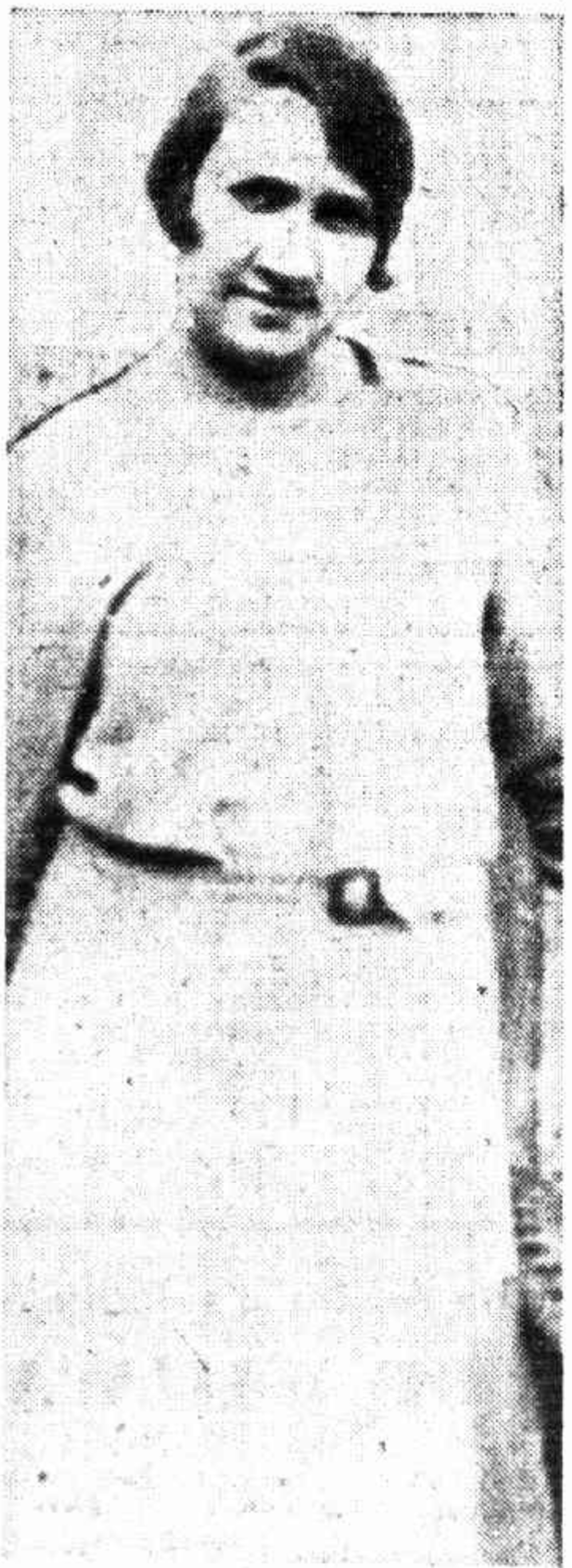 Dorothy May Everett, who was killed in November 1937. Daily Telegraph, Saturday December 11.
Trove
Dorothy May Everett, who was killed in November 1937. Daily Telegraph, Saturday December 11.
Trove
At eight the following morning, her naked body was found. Her clothes had been ripped from her body, there were teeth marks on her chest, and one nipple had been bitten off. She had been strangled with her own stockings.
This was a particularly brutal murder, made worse by the fact that it took place in one of the most fashionable areas of Newcastle. Women living in the city were reported to be extremely frightened: they were reluctant to go out at night without a male escort. A “School Killer” (later sensationalised as the “Vampire Killer”) was at large.
One word dominated discussions of Everett’s murder: sadism. All the newspapers agreed that the perpetrator was “of no ordinary type”: he was “someone known as a sadist”, a “person of abnormal tendencies, a pervert, and a sadist”. Newspapers warned that “A SADIST of a type not previously known in the State is being sought”, and if this “sex-maniac” was not caught soon “he might commit similar horrible crimes”.
Everett herself seems to have been a fairly typical young woman. She was a bit moody, in part because she shared a room that was only 12 feet wide and contained two beds. She was said to have been frightened after an unknown man had attacked her only a fortnight before her murder. Tragically, she had not reported this to the police “because of the fuss it might have caused”.
It was discovered that dozens of other women in Newcastle had also endured sexual attacks at the time, but none had officially reported the assaults for fear of publicity. In the words of a headline in Brisbane’s Telegraph, a “Wave of Sex Assaults Revealed After Murder of Newcastle Woman”.
Read more: Between innocence and experience: the sexualisation of girlhood in 19th century postcards
Eventually, 34-year-old Leonard (“Len”) William Roberts, a former gardener at the school, was charged with her murder. The main evidence was the bite marks. The man who had bitten Everett had no teeth in his lower jaw and Roberts had no teeth at all (although he habitually wore false teeth in his upper jaw).
After consulting leading British and American forensic texts, the detectives asked Roberts to bite the “fleshy” chest of Police Sergeant Stephen Pender in an attempt to match the teeth marks. In court, Pender claimed that Roberts had merely “simulated” biting him.
 Leonard William Roberts, who was accused of killing Dorothy May Everett in 1937. Daily Telegraph, Saturday April 30.
Trove
Leonard William Roberts, who was accused of killing Dorothy May Everett in 1937. Daily Telegraph, Saturday April 30.
Trove
There was, however, a secret witness: “Miss X” whose identity was never disclosed on the grounds that her reputation would otherwise have been destroyed. “Miss X” regularly engaged in sexual intercourse with Roberts and claimed that he was perverted.
She told police that Roberts had beaten her with a rolled newspaper and threatened her in other ways as well. There were things he had done to her that were “too horrible to tell”. When she heard about the murder, the first thing she asked was: “Was Dot bitten?”
The problem with all this evidence was not only that it was circumstantial, but that Roberts didn’t fit the image of a sadistic monster. He made an impression in court, appearing (in the words of one journalist) “faultlessly dressed in a navy blue suit, white shirt and collar and striped blue tie. He was clean shaven. His hair was neatly brushed and he looked well.” Indeed, there were demonstrations in his favour outside the court.
At the end of the trial, Roberts left the courtroom an innocent man.
From de Sade to sadists
Reportage on the Everett murder was fairly typical and reveals a lot about the moral panic about sadism in the first half of the 20th century. Although there was huge interest in the concept of the “sadist” in Australia, journalists nevertheless felt obliged to explain what “sadism” actually involved. This suggests it was a fairly new word for many Australians. Newspapers informed their readers that a “sadist” was “a person who experienced pleasure when inflicting pain on another” and it was derived from the French nobleman, the Marquis de Sade.
They noted that there was a continuum in cruelty – from the sadist who murdered women to those who believed that naughty children should be caned. In Australian publications, as well as in British and American ones, there was also a constant conflation of sadists and homosexuals. Indeed, in 1952, the Psychiatric Section of the West Australian branch of the British Medical Association used the term “sadist” and “queerness” interchangeably.
Where were journalists getting information about sadists? In Australian publications, the most common authorities mentioned were European psychiatrists Richard von Krafft-Ebing, Albert Moll and Ivan Block.
Of these, Krafft-Ebing is mentioned the most frequently, especially his view that sadism arose from biological degeneracy. A sadist’s parents and other relatives were likely to have been insane, syphilitic, epileptic, or “constitutionally neuropathic”. Sadists possessed the “seed” of their perversion from birth.
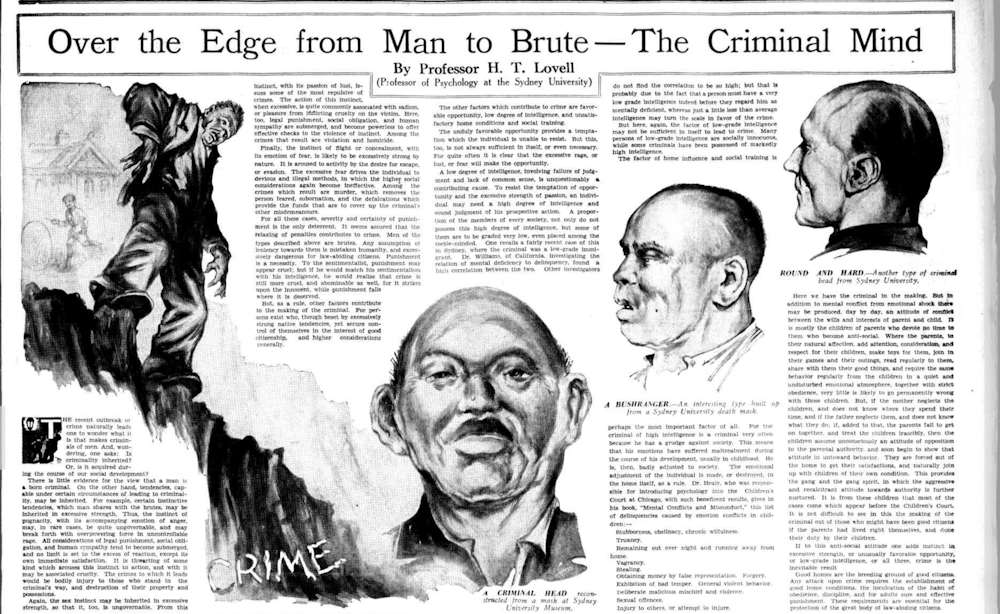 Article by Sydney psychology professor H.T. Lovell. The Sun, Sunday July 28 1928.
Trove
Article by Sydney psychology professor H.T. Lovell. The Sun, Sunday July 28 1928.
Trove
Read more: From reproducers to 'flutters' to 'sluts': tracing attitudes to women's pleasure in Australia
Other commentators maintained that sadism arose from a mixture of causes. In 1930, for example, an unnamed “leading Sydney psychiatrist” interviewed about the sadistic strangling of some young girls claimed that the “Melbourne murderer” must have had his “natural instincts repressed” as a young person, and these instincts “found an unnatural outlet” in a fetish for suffocating girls with their own stockings.
This psychiatrist also believed that in “most cases of sadism” there would be “a taint of insanity in his ancestry”, a history of “intermarriage of close relatives”, or even evidence of “an injury to the head during childhood”.
The anxiety-inducing conclusion, therefore, was:
Any one of us is capable of sadism … We might acquire it through an accident, or through the repression of our natural instincts.
Monsters and men
Most commentators believed that sadists were outwardly normal men. This may seem strange, given the overblown language of monstrosity that was routinely applied to them, particularly in the sensationalist or tabloid press. After all, lurid descriptions of the “Vampire Killer” (as Everett’s killer was called) and “bestial” murderers boosted sales. It gave licence for prurient descriptions of wounds, torn flesh and gaping holes.
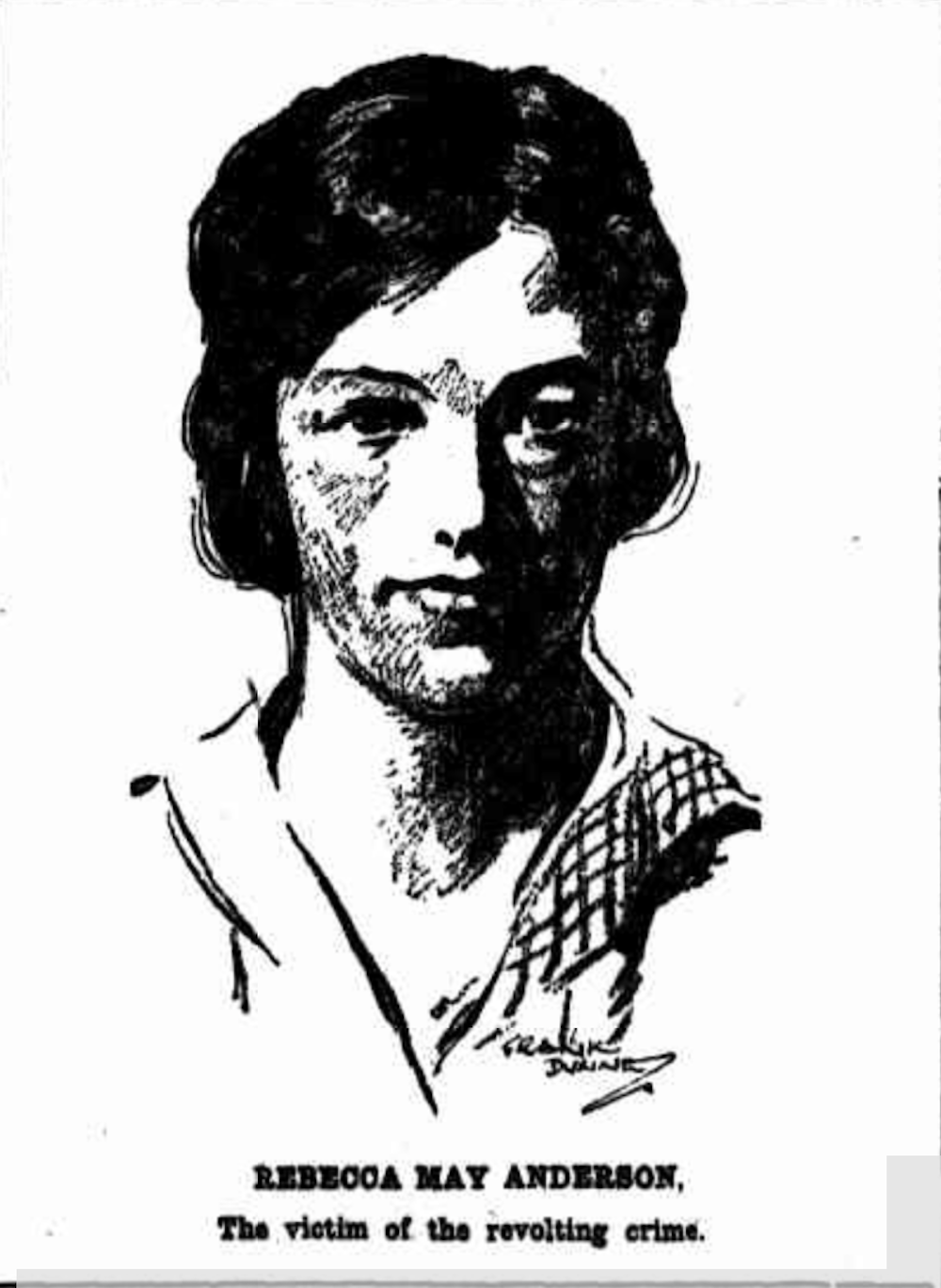 Rebecca May Andersen, who was killed in Sydney in May 1924. Truth, May 18 1924.
Trove
Rebecca May Andersen, who was killed in Sydney in May 1924. Truth, May 18 1924.
Trove
One example is the way Sydney’s Truth newspaper reported the “Devilish Murder and Mutilation” of Rebecca May Andersen, who was tortured, mutilated, then killed near Long Bay Prison in Malabar (Sydney) in May 1924. Readers were told the murderer had to be “lust-mad”, or a “revengeful demonical monster with an appetite for inhuman atrocity”: he suffered from “a perverted, depraved, sexual degeneracy”.
However, at the same time, these reports suggested sadists could be “any of us” – that is, a male “us”. They possessed a normal outward appearance, the sadist being “a monster in human form”. In the words of a psychiatrist explaining a brutal abduction, rape and torture of a woman in Corrimal (northern suburb of Wollongong) in 1946:
People capable of sadistic acts like the Corrimol crime would never be noticed in a crowd. They would appear quite normal individuals. But the latent tendency to sadism comes out if the opportunity arises. Some sadists suffer from the “tough guy” complex. By inflicting pain on a weaker person, most often a woman, they boost their own ego. But usually sadists are sexually frustrated people, who express their perversion in bodily cruelty.
Alcohol abuse was often blamed for transforming a “normal” man into a sadistic one. This was the explanation given by Sir John Macpherson, the first professor of psychiatry at the University of Sydney and the author of Mental Affections: An Introduction to the Study of Insanity (1899). Referring to the sadistic attack on Andersen, Macpherson observed:
Some of the most extraordinary and dastardly crimes in history have been committed by alcoholics who, under the influence of the drink, perform deeds which, in their normal state, they would shrink from contemplating.
This was the explanation for the sadistic violence of Roy Governor, an Indigenous Australian. After drinking half a bottle of wine, Governor had raped an elderly, white, disabled woman. In his statement from the dock, Governor explained:
When I drink wine my sex controls me; I have no control over it; I am what they call a sadist; I have read a lot of books on sex things … I am a funny man when I drink wine I want with a woman.
Curiously, sadism was conceived of as an excess of normal male sexuality. In other words, a sadist would not harm anyone if he could be “relieved” of his “natural” passions by regularly engaging in sexual intercourse with a “legitimate” partner. In 1920, for example, Perth’s Truth concluded that sadism was the “Cave-Man Kink”. The journalist contended that the perversion was:
more common than is generally supposed. The nips and pinches and the playful slaps, that in many cases mark the preliminary stages of love’s young dream likewise denote a tendency towards that kink. Fortunately for the happiness of mankind, or rather womankind, this tendency becomes weaker in the vast majority of cases, and mostly dies away altogether with the satisfaction of the sexual appetite. Should it persist, however, it eventually develops into plain brutality, usually of a most revolting type.
Blaming the victims
Disturbingly, victims were often said to be partly responsible for their fate. Of course, there were degrees. The press failed to find anything salacious about Everett, for example. But Andersen was “fair game”. “Big Nose May”, as she was known, was castigated as a slut and “insatiable” alcoholic. Newspapers even speculated that she might have been murdered because she stole money from one of her customers or had given them a sexually transmitted disease.
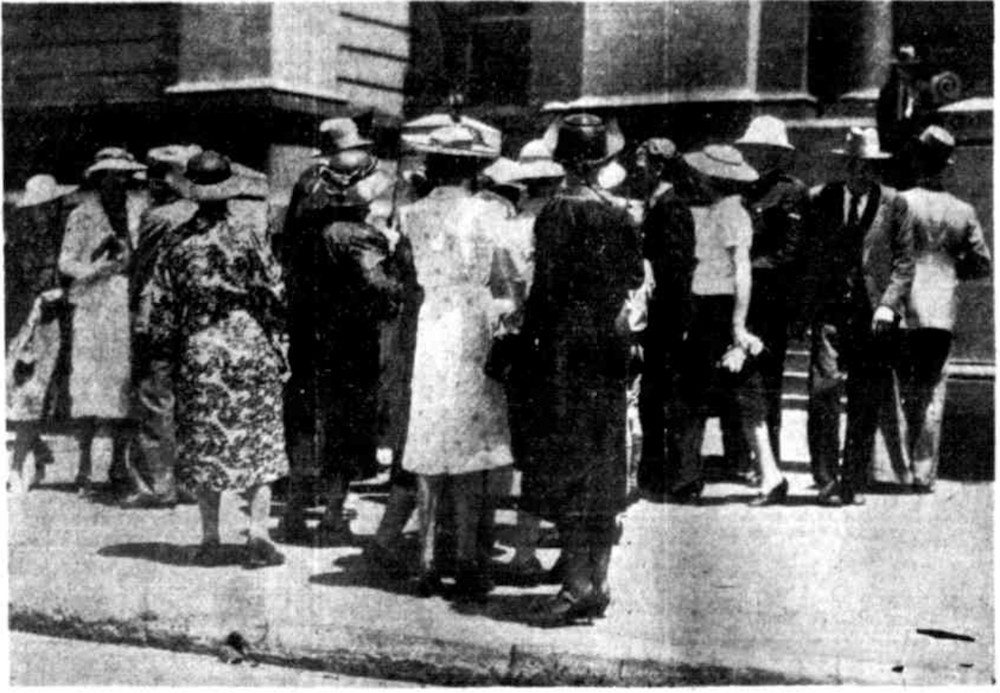 Women gather outside the court for the inquest into Dorothy May Everett’s murder. Newcastle Sun, Tuesday January 4 1938.
Trove
Women gather outside the court for the inquest into Dorothy May Everett’s murder. Newcastle Sun, Tuesday January 4 1938.
Trove
Finally, sadists were a type of person, as opposed to a practice. In particular, he had a racial identity: he was “foreign”. In writing about Everett’s cruel murder, readers were informed that the perpetrator had probably arrived recently in the Newcastle port. There was nothing “Australian” about such perversions.
More importantly, newspaper reports increasingly focused less on the victim’s sufferings and more on the identity of the perpetrator. In the late 19th and early 20th centuries, the perpetrator had been labelled a sadist because of the mutilation and extreme violence done to the victim. Increasingly, though, the victim’s pain became secondary to the perpetrator’s identity and, in particular, his fantasies.
Indeed, to be labelled a “sadist” a man did not even have to harm anyone. Sadistic acts became secondary to a sadistic identity, which was located in the fantasy life of the perpetrator. This medicalisation of perpetrators of extreme violence had the effect of silencing the victims of sadism.
Women like “Dot” Everett were doubly silenced – both by their murderer and by newspaper reportage that was more interested in speculating about the “sadist” than his victims.
Authors: Joanna Bourke, Professor of History, Birkbeck, University of London