

Luminous 'mother-of-pearl' clouds explain why climate models miss so much Arctic and Antarctic warming
- Written by Katrin Meissner, Professor and Director of the Climate Change Research Centre, UNSW, UNSW Sydney
Our planet has warmed by about 1.2°C since 1850. But this warming is not uniform. Warming at the poles, especially the Arctic, has been three to four times faster than the rest of the globe. It’s a phenomenon known as “polar amplification”.
Climate models simulate this effect, but when tested against the past 40 years of warming, these models fall short. The situation is even worse when it comes to modelling past climates with very high levels of greenhouse gases.
This is a problem because these are the same models used to project into the future and forecast how the climate will change. They are likely to underestimate what will happen later this century, including risks such as ice sheet melting or permafrost thawing.
In our new research published today in Nature Geoscience we used a high-resolution model of the atmosphere that includes the stratosphere. We found a special type of cloud appears over polar regions when greenhouse gas concentrations are very high. The role of this type of cloud has been overlooked so far. This is one of the reasons why our models are too cold at the poles.
Polar Stratospheric Clouds over Norway (Night Lights Films - Adrien Mauduit)Read more: Climate explained: why is the Arctic warming faster than other parts of the world?
Back to the future
Looking into past climates can give us glimpses of possible futures for a range of extreme conditions. For us, this means we can use Earth’s history to find out how well our climate models perform. We can test our models by simulating episodes in the past when Earth was much warmer. The advantage of this is that we have temperature reconstructions for these episodes to evaluate the models, as opposed to the future, for which measurements are not available.
If we go back 50 million years or so, our planet was very hot. Carbon dioxide (CO₂) concentrations ranged between 900 and 1,900 parts per million (ppm), compared with 415 ppm today. Methane (CH₄) concentrations were likely also much higher.
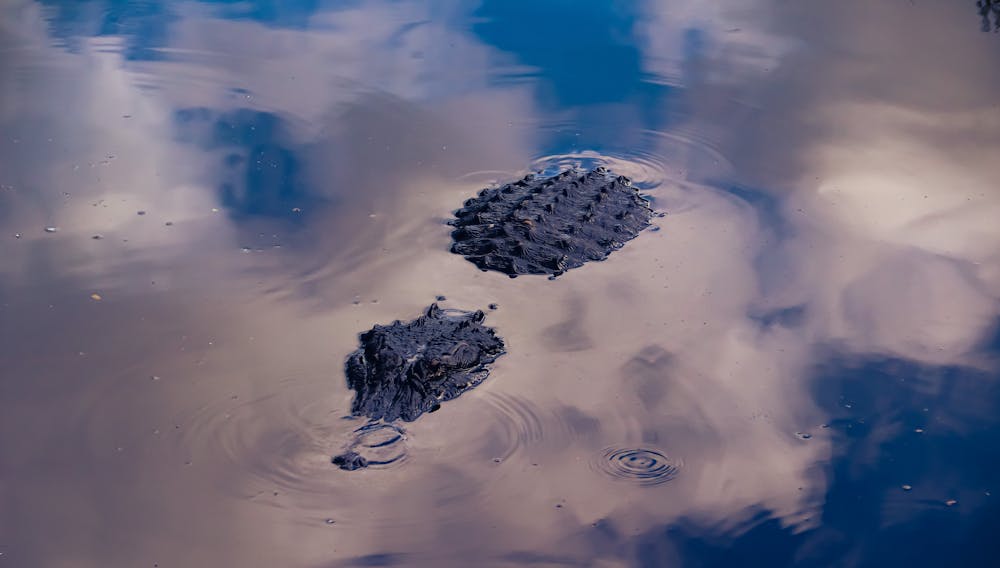
Canada’s arctic archipelago was covered in lush rainforests inhabited by alligators, turtles, lizards and mammals.
For these plants and animals to survive, conditions must have been warm and ice-free year-round. Indeed, surface ocean temperatures exceeded 20°C near the north pole (at about 87°N) and 25°C in the Southern Ocean (at about 67°S).
This period called the early Eocene is a perfect test bed for our models, because it was globally very warm, and the poles were even warmer, meaning it was a climate with extreme polar amplification. In addition, the Eocene is recent enough for temperature reconstructions to be available.
But as it turns out, the models fail again. They are much too cold at high latitudes. What are our models missing?
Polar stratospheric clouds
In 1992 American paleoclimatologist Lisa Sloan suggested polar stratospheric clouds might have caused extreme warming at high latitudes in the past.
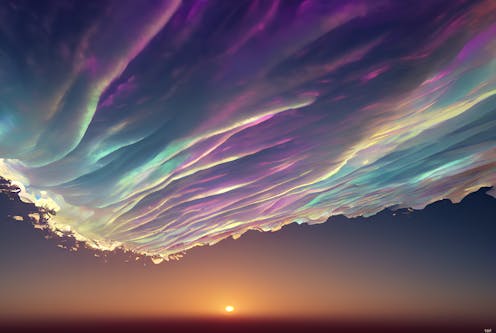
These clouds are a rare and beautiful sight today. They are also called nacreous or mother-of-pearl clouds for their vivid and sometimes luminous colours.
They form at very high altitudes (in the stratosphere) and at very low temperatures (over the poles). In the present day climate, they appear mainly over Antarctica, but have also been observed during winter months over Scotland, Scandinavia and Alaska, at times when the stratosphere was particularly cold.
Read more: Explainer: what are the 'nacreous clouds' lighting up the winter skies?
Just like greenhouse gases, they absorb infrared radiation emitted by the Earth’s surface and re-emit a portion of this energy back to the surface. This suggests polar stratospheric clouds could be one of the missing puzzle pieces.
They warm the surface. And their effect could be significant, especially in winter, when the sun does not rise. But they are difficult to simulate in a climate model, so most models ignore them. This omission could explain why climate models miss some of the polar warming, because they miss a process that warms the poles.
Three decades after Sloan’s paper, a few atmosphere models are finally complex enough to allow us to test her hypothesis. In our research we use one of them and find that under certain conditions, the additional warming due to these polar stratospheric clouds exceeds 7°C during the winter months. This significantly reduces the gap between climate models and temperature evidence from the early Eocene. Sloan was right.
Implications for future projections
Our research explains why climate models don’t work so well for past climates when greenhouse gas levels were much higher than they are today. But what about the future? Should we be concerned?
There is some good news. While polar stratospheric clouds do warm the poles, they won’t be as common in the future as they were in the distant past, even if both CO₂ and CH₄ reach very high levels.
This is due to another difference between the Eocene and today: the position of continents and mountains, which were different back then and which also influence the formation of polar stratospheric clouds. So even if we hit early Eocene levels of CH₄ and CO₂ in the future, we would expect less polar stratospheric cloud to be formed. This suggests the standard climate models are better at predicting the future than the past.
It’s therefore unlikely the Arctic and Antarctica will be covered by these beautiful clouds anytime soon. But our research shows evidence from past climates can reveal processes that only become important when greenhouse gas concentrations are high. Some of these processes are not included in our models because models are tested against present day observations and other processes simply seemed more important to include. Looking into the past is a way of broadening our horizon and learning for the future.
Authors: Katrin Meissner, Professor and Director of the Climate Change Research Centre, UNSW, UNSW Sydney

















