

the Israel-Hamas war enters a precarious new phase
- Written by Charles Knight, Adjunct Lecturer in Terrorism and Assymetric Conflict and Senior Researcher in Urban Warfare (UNSW), Charles Sturt University
With Israeli Defence Forces now reportedly surrounding Gaza City, the most densely packed part of the Gaza Strip, their fight against Hamas has entered a new phase focused primarily on urban warfare – some of it underground.
Sappers are the soldiers who clear paths through obstacles with machines and explosives, enabling other troops to overwhelm the enemy. They also create such obstructions and lay traps and mines when trying to defend a position.
Tunnels are a sapper’s job, too. Indeed, this is where the word comes from: the ancient technique of “sapping” beneath the surface to approach an enemy position protected from their arrows, bullets or shells.
As part of their plan for defence, Hamas sappers have excavated a huge series of tactical tunnels. Some are interlinked, some isolated. Some have been dug far below where bombs can reach, some are near the surface to allow access.
Tunnels and “mouseholes” in walls also allow for undetected movement between buildings. Hamas fighters expect they can emerge from these holes to attack Israeli soldiers before disappearing again.
In addition, Hamas sappers have likely prepared many improvised explosive devices (IEDs) – some hidden in walls to detonate when armoured vehicles pass by and other, larger explosives buried under roads.
Some tunnels may also be set as traps to entice Israeli soldiers to enter as they search for hostages.
Urban warfare is excruciatingly slow
As the war enters a new phase, it is pitting a grimly determined Israeli Defence Force (IDF), with the world’s best capabilities for urban warfare, against a force ready for martyrdom that has prepared for this fight for years. It will also be happening on terrain that analysts argue greatly favours the defender.
Though fighting in Gaza presents its own unique challenges, there are some lessons to be learned from the operations to eliminate Islamist fighters from the Iraqi city of Mosul and the southern Philippines city of Marawi in 2016-17.
In Mosul, a US-supported Iraqi force of about 100,000 took nine months to destroy an ISIS force of thousands in a thoroughly fortified city. The coalition lost 8,000 troops and many tanks and bulldozers to massive IEDs.
Progress was equally slow in Marawi, where it took five months for Filipino forces to defeat ISIS-Maute fighters. Troops could sometimes secure only one building per day because of the constant threat of ambush from tunnels and IEDs hidden in entrances, windows and stairwells.
Three layers of challenges
Urban war presents armies with compounding challenges.
The first layer is perceptual. There is a cognitive dissonance between a liberal society’s beliefs around the need for restraint in conflict and the primordial demands of urban war with its high costs in blood, destruction and legitimacy. Armies are averse to preparing for such horror.
Second, there are tactical challenges with fighting among buildings:
the threat of remote attack by drones or IEDs
the uncertainty created by hidden adversaries
the extreme exposure of forces as they advance
the dilution of combat power as forces are channelled, isolated and dispersed among buildings, with very restricted views
the degrading of sensors and communications systems.
Third, and critically, the presence of civilians in urban war zones imposes moral and ethical challenges. They suffer disproportionately and catastrophically, both as immediate casualties and from displacement and disease following the destruction of cities.
Military commanders also face a proportionality dilemma when it comes to interpreting international humanitarian law. They need to balance the necessity of their actions and the survival of soldiers against causing unintended but foreseeable civilian harm.
Further complexities include:
the obligation of forces to provide security and logistical support to noncombatants
the security threat from phone and social media usage by civilians
civilians who are hostile, obstructive or offer unarmed resistance
the psychological and political burden on commanders that may distort their decision-making.
How Israel has been preparing for this moment
The IDF has previously experienced these challenges in Gaza. After Israeli occupation ended in 2005, militant attacks prompted major incursions by the army in 2008 and 2014. That fighting taught the IDF key lessons.
From a political standpoint, Israel realised the importance of winning the contest of international and domestic public opinion. From a military and operational standpoint, the IDF learned that precision air power alone could not eliminate the threat from Hamas. Well-protected armoured vehicles were essential, and new capabilities were needed to counter the increasing use of tunnels by Hamas.
As a result, the IDF is uniquely well-equipped for urban operations, with the world’s best-protected tanks and armoured personnel carriers.
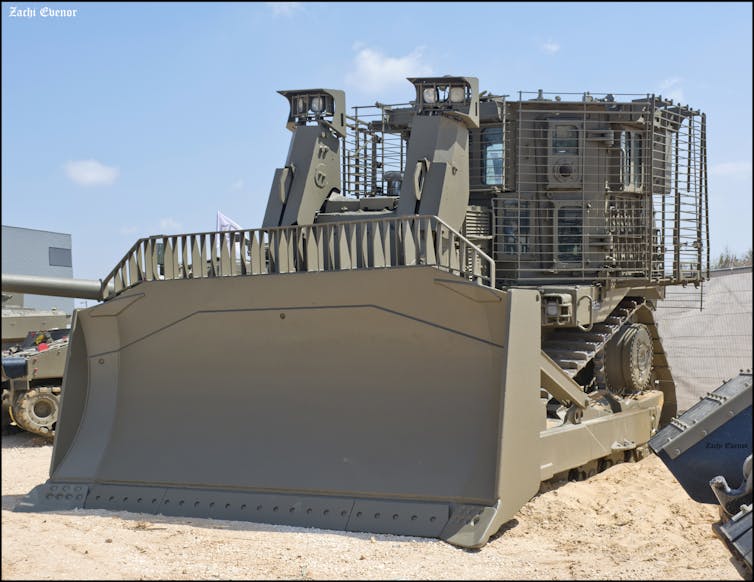
It also has world-leading armoured engineering vehicles, such as the D9 armoured “Doobi” bulldozer. With the D9, houses can be demolished instead of entered, reducing the risk of ambush and IEDs. However, these bulldozers have been controversially associated with destroying homes as punishment.
The D9 will be used in the war to create safe paths through terrain that may be mined, push alternative routes through buildings and build protective berms around “secured areas” to consolidate the IDF’s progress. Some of these bulldozers can even be operated by remote control.
Other armoured engineering vehicles include the Puma minefield breacher, with the Carpet mine and IED clearing system that can detonate or disrupt hidden munitions with blasts from fuel-air explosive rockets. Engineer vehicles also carry equipment that can jam IED circuits or transmissions. Some may also have the THOR system, which uses lasers to explode IEDs.
Soldiers are also trained to find, operate in and destroy tunnels. They include elements of the Sarayet Yahalom, a special forces unit that uses specialised demolition charges, subterranean drones and robots.
The Israelis lead the world in highly classified subterranean sensing research, including the use of geospatial, acoustic, seismic, electrical resistivity tomography (ERT) and ground-penetrating radar technologies. The IDF’s public statements suggest tunnels within 20 metres of the surface can be mapped.
The IDF tunnel sappers also have niche armoured fighting vehicles. Some are fitted with the technologies mentioned above, others with drilling equipment that can bore down into tunnels to deliver devices, materials or explosives. One, the Nakpilon, uniquely has a door at the front to deploy soldiers straight into tunnel entrances.
The IDF has generally preferred to destroy tunnels from the surface rather than entering, but some Yahalom and other reconnaissance special forces train to fight below ground, alongside the Oketz dog unit, with specialised vision, breathing and communications equipment.
Given the scale of the tunnel network and the task of recovering hostages, some human reconnaissance seems unavoidable. History suggests this will be done by pairs or individuals, perhaps the Mista’arvim elite undercover units, who may operate by disguising themselves as Hamas fighters.
Given the Hamas advantage of home terrain and the advanced technology deployed by Israel, both sides will likely inflict bloody surprises on one another. The IDF has the military capability to prevail, but the human cost of the ground war and the outcome of the crucial geopolitical war of narratives remain unclear.
Authors: Charles Knight, Adjunct Lecturer in Terrorism and Assymetric Conflict and Senior Researcher in Urban Warfare (UNSW), Charles Sturt University

















