

Fire is consuming more than ever of the world's forests, threatening supplies of wood and paper
- Written by David Lindenmayer, Professor, The Fenner School of Environment and Society, Australian National University
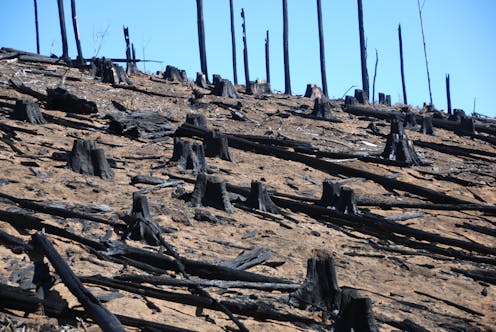
A third of the world’s forests are cut for timber. This generates US$1.5 trillion annually. But wildfire threatens industries such as timber milling and paper manufacturing, and the threat is far greater than most people realise.
Our research, published today in the journal Nature Geoscience, shows that between 2001 and 2021, severe wildfires worldwide destroyed timber-producing forests equivalent to an area the size of Great Britain. Severe fires reach the tree tops and consume the forest canopy.
The amount of timber-producing forest burning each year in severe wildfires has increased significantly in the past decade. The western United States, Canada, Siberia, Brazil and Australia have been most affected.
Timber demand is expected to almost triple by 2050. Supplying demand is clearly going to be challenging. Our research highlights the need to urgently adopt new management strategies and emerging technologies to combat the increasing threat of wildfires.

Read more: Our planet is burning in unexpected ways - here’s how we can protect people and nature
What we found
We combined global maps of logging activity and severe wildfires to determine how much timber-producing forest was lost to wildfire this century. Between 2001 and 2021, up to 25 million hectares of timber-producing forest was severely burned. The extent of fire has jumped markedly in the past decade, from an average of less than one million hectares a year up to 2015 to triple that since then.
At a national scale, the three countries with the largest absolute wildfire-induced losses of timber-producing forest were Russia, the US and Canada. When it comes to proportion of their forestry land lost, the nations with the highest percentages burnt were Portugal, followed by Australia.
Why are more forests burning?
Climate change is a major driver of fire weather and fire behaviour. The increased risk of high-severity wildfire is an entirely expected outcome of warmer temperatures and, in some places, reduced rainfall.
However, it remains unclear why so much wood-production forest is being lost, and why the increase in burnt area has been so marked in the past decade.
One possible reason is logging makes forests more flammable. This has been documented in parts of southeastern Australia, where intact forest always burnt at lower severity than harvested forest across the entire footprint of the Black Summer fires. Forests that have been subject to thinning also are at risk of high-severity wildfire.
What does this mean for us?
Whatever the reason, it is clear these fires in wood-production forests will have profound impacts on global timber supplies and all the industries associated with them. This is a huge problem for society and the environment, because timber demand is expected to triple by 2050, in part to facilitate the transition away from carbon-intensive cement in construction.
In many parts of the world, it typically takes 80–100 years or even longer to grow a tree to a size at which it can be a sawlog for products like furniture and floorboards. So the increased frequency of high-severity wildfire means fewer areas of forest will escape fire for long enough to reach timber harvesting age.
This is especially problematic where logging makes forests more prone to burning in a high-severity wildfire.
Furthermore, given the long-term nature of timber production, typically on cutting cycles ranging from 40 years to more than a century, future timber crops will face a very different climate as they mature.
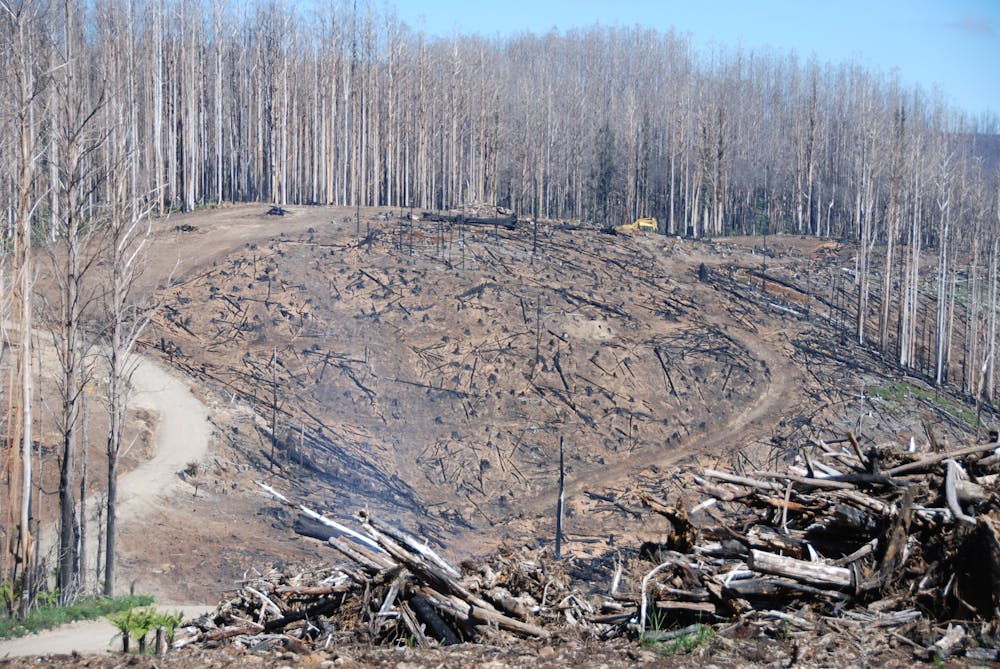 Timber production forests such as this, near Marysville in Victoria, are burning before they reach maturity.
David Lindenmayer
Timber production forests such as this, near Marysville in Victoria, are burning before they reach maturity.
David Lindenmayer
Responding to the challenge
If wood production from forests becomes increasing costly and timber is increasingly hard to source, there may be more pressure from industry and government to log other places, such as tropical forests, with high biodiversity and conservation value.
One way to tackle the problem is to grow more timber in plantations. Plantations already produce a third of the main forms of wood-producing timber – called industrial roundwood. They do this from just 3% of the area of natural forests.
Well managed plantations can grow a successful timber crop within a couple of decades. This is a lot shorter than the many decades and sometimes even centuries required to grow sawlogs in native forests. Having a shorter growing time in plantations increases the chances of harvesting trees before they are destroyed in a wildfire.
But plantations, like some logged and regenerated native forests, can be highly flammable. Fire risks need to be carefully managed. That includes planning, to avoid putting neighbouring areas and human communities at greater risk of being burnt.
Another key strategy to better protect timber resources will be to adopt new technologies to more quickly detect and then rapidly suppress ignitions such as those originating from lightning strikes.
Big fires start as small fires. The best time to suppress fires is when they are small, and as soon as ignition occurs. We have been involved in the development of drone fleets and unmanned aerial water and fire suppressant dispensing craft to more quickly detect and extinguish wildfires.
New technologies, as well as more, better planned and managed plantations will be crucial in not only protecting forests, but also safeguarding the flow of marketable timber and the industries dependent upon them.
Authors: David Lindenmayer, Professor, The Fenner School of Environment and Society, Australian National University

















