

what's the history of aircraft squawk codes and how do they work?
- Written by: Andrew Dowse, Director, Defence Research and Engagement, Edith Cowan University
This is an article from Curious Kids, a series for children. The Conversation is asking kids to send in questions they’d like an expert to answer. All questions are welcome – serious, weird or wacky! You might also like the podcast Imagine This, a co-production between ABC KIDS listen and The Conversation, based on Curious Kids.
Hi, I’m Daniel, 12, and I would like to know the history behind squawk codes on aircraft and how they work. Thanks! – Daniel, age 12, Perth.
Thank you, Daniel, for this question. As you have guessed there is a very interesting back story to “squawk codes”. These codes have been used in radio signalling systems for more than 75 years to identify and determine the location of aircraft in flight.
Read more: Curious Kids: How does glow in the dark paint work?
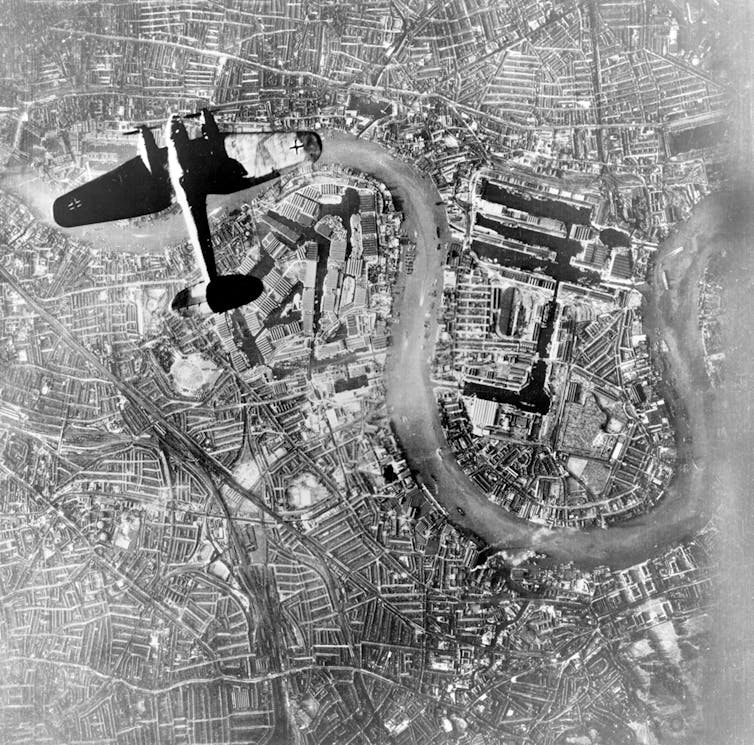 A Nazi plane flies over South London in 1940. Germany used bomber aircraft to attack the UK in the Battle of Britain. The British won, thanks partly to their early radar systems – but these systems initially had a limitation.
Wikimedia, CC BY-SA
A Nazi plane flies over South London in 1940. Germany used bomber aircraft to attack the UK in the Battle of Britain. The British won, thanks partly to their early radar systems – but these systems initially had a limitation.
Wikimedia, CC BY-SA
Code name: Parrot
Early radar systems used in the second world war were critical to allied success in the Battle of Britain in 1940, when Britain’s Royal Air Force (RAF) defended the United Kingdom against a huge air attack campaign by Nazi Germany’s air force, the Luftwaffe.
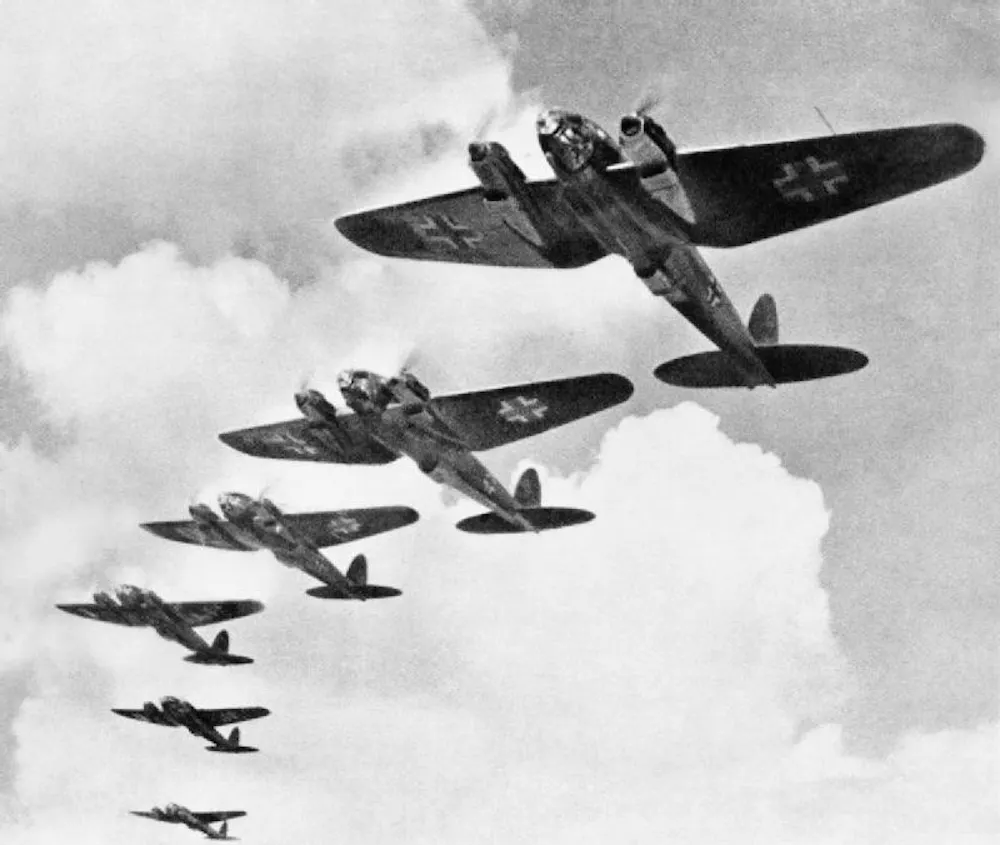 Nazi Germany used aircraft like these Heinkel He 111 to attack the UK in the Battle of Britain.
Wikimedia, CC BY
Nazi Germany used aircraft like these Heinkel He 111 to attack the UK in the Battle of Britain.
Wikimedia, CC BY
But these early radar systems had a major limitation. They could detect aircraft by radio signals being reflected by moving objects, but the reflected signal could not tell you whether an aircraft was friendly or hostile.
This led to the rapid development of secondary surveillance radars, which required an active and cooperative response from aircraft. In other words, the aircraft had to answer back. This would help to identify the “friendlies” in the skies.
The secondary radar system would send a transmission of radio frequency pulses directed at the aircraft. Friendly aircraft were fitted with equipment that would respond with an identification code. If no response was received, radar operators would presume the aircraft was an enemy plane.
This innovation meant that radar operators could now use the main radars (known as “primary radars”) in combination with the secondary radars to detect the presence of aircraft and to distinguish between friends and foes.
This system was known as Identification Friend or Foe (IFF) and the concept remains important to military forces even today.
The aircraft transponder, which received and transmitted signals, was initially code-named Parrot. Soon, airmen started using the nickname “squawk codes”.
While the name Parrot didn’t last, the term “squawk” continues to be used today to describe the activity of the transponder.
Read more: Curious Kids: how does gravity pull things down to Earth?
How it works
After the war, the concept was adapted for civil aircraft – the kinds of plane we fly on when we go on holiday.
The system identifies an aircraft through a four-digit octal number (each digit from 0 to 7), which provides for up to 4,096 possible codes. These codes can also be used to alert controllers of an aircraft emergency. Subsequently, another mode was added to inform radar controllers of an aircraft’s height, using data from the plane’s altimeter (the instrument that tells you how high a plane is flying).
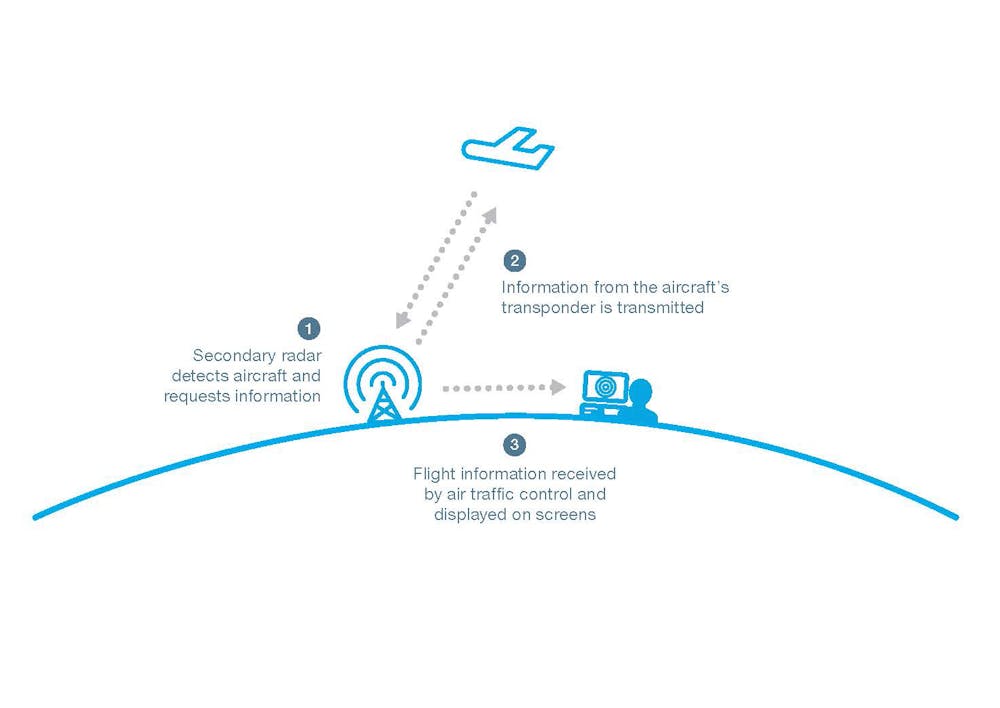 Diagram showing how an en route, or secondary, radar works.
© Copyright Airservices Australia 2015
Diagram showing how an en route, or secondary, radar works.
© Copyright Airservices Australia 2015
For those of you who are technically minded, the frequencies used in secondary surveillance radar are 1030 Megahertz for the interrogation (the “hello, who are you?” signal) and 1090 Megahertz for the response (the answer you get back). The response is a sequence of pulses spaced 1.45 microseconds apart – that’s very fast!
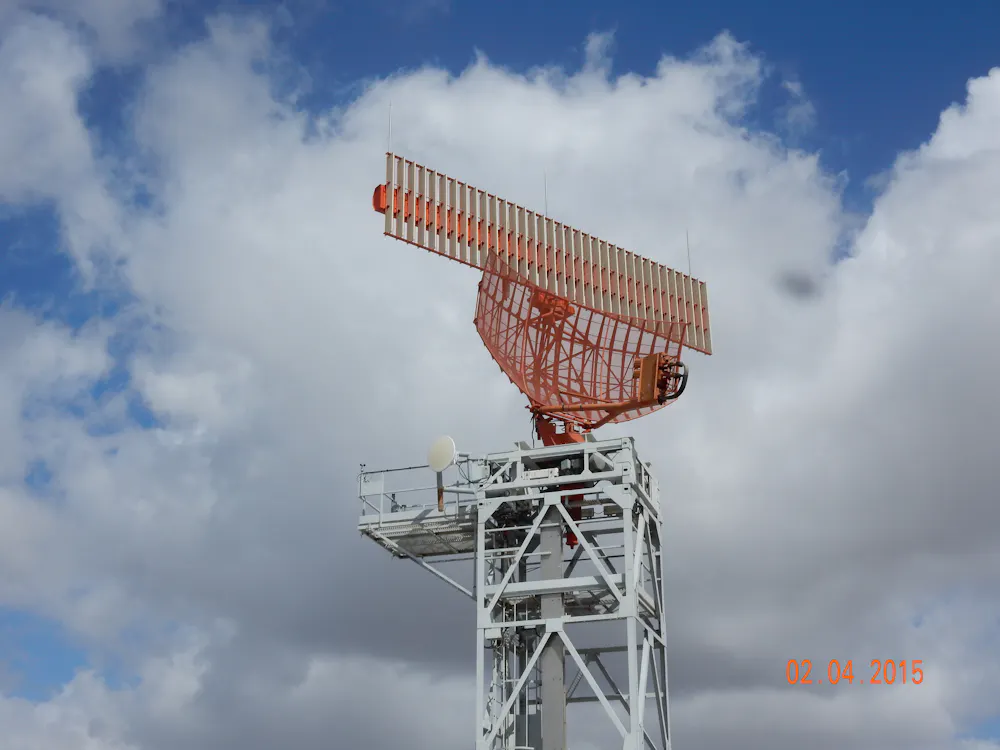 A temporary en route or secondary radar at Melbourne Airport. Airservices uses en route radar to assist with separation of aircraft in controlled airspace.
© Copyright Airservices Australia 2015
A temporary en route or secondary radar at Melbourne Airport. Airservices uses en route radar to assist with separation of aircraft in controlled airspace.
© Copyright Airservices Australia 2015
Air traffic control towers
Imagine a pilot is flying a plane full of passengers on holiday to Sydney. As she or he flies towards the destination, the air traffic control tower at Sydney airport sends an interrogation signal. The aircraft automatically responds with a series of short pulses that let air traffic control know the identity of the plane and its altitude. Then air traffic control can compare the identity code to flight plans to identify the aircraft.
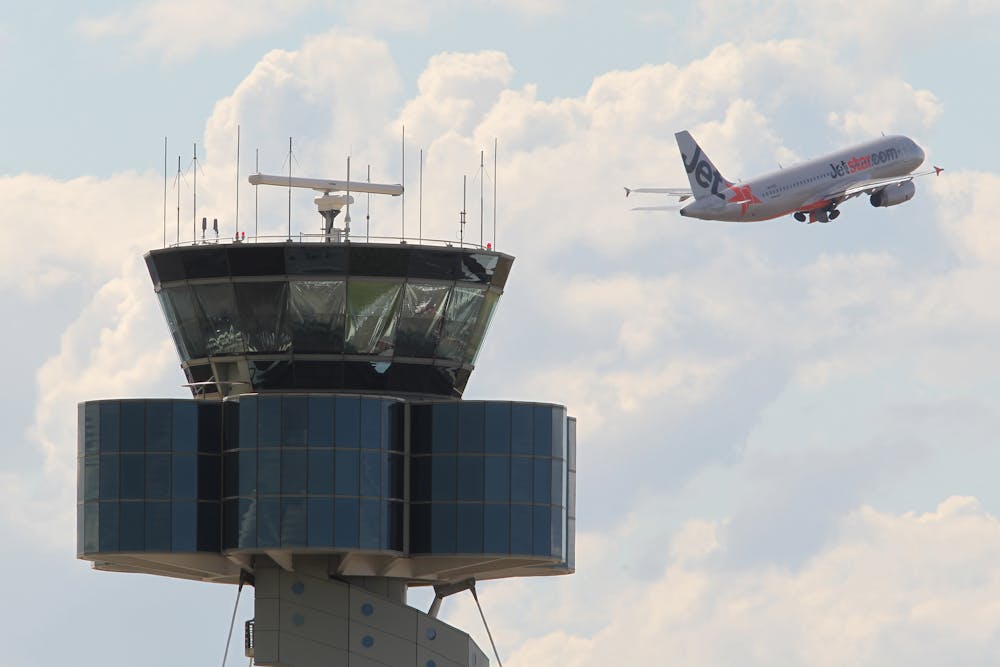 Airservices control tower at Sydney Airport.
© Copyright Airservices Australia 2014
Airservices control tower at Sydney Airport.
© Copyright Airservices Australia 2014
The time taken between the interrogation transmission and the received code lets us know the distance between the radar and the aircraft. Air traffic control computer systems use this information, the direction of the interrogation signal, and the altitude to determine exactly where the aircraft is.
Other navigation and airspace management systems have been developed over the years. The most recent is the Automatic Dependent Surveillance Broadcast (ADS-B) system, which incorporates Global Positioning System (GPS) data into the responses from aircraft.
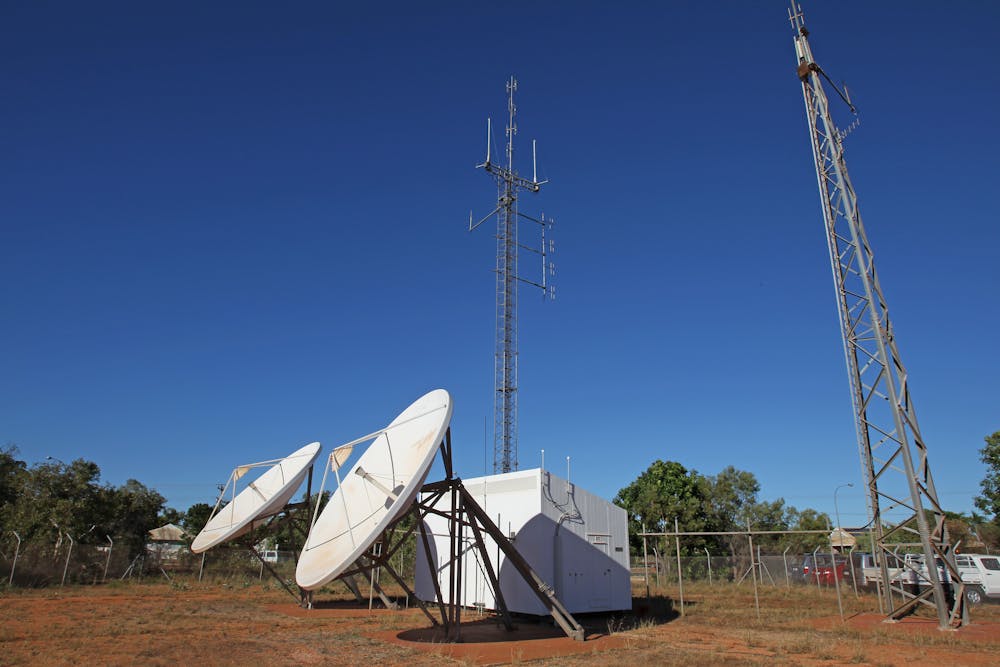 The Automatic Dependent Surveillance Broadcast (ADS-B) ground station at Broome, Western Australia. ADS-B enables aircraft to be accurately tracked by air traffic controllers and other pilots without the need for conventional radar.
© Copyright Airservices Australia 2014
The Automatic Dependent Surveillance Broadcast (ADS-B) ground station at Broome, Western Australia. ADS-B enables aircraft to be accurately tracked by air traffic controllers and other pilots without the need for conventional radar.
© Copyright Airservices Australia 2014
Secondary surveillance radar was an important development in the safety of aviation and remains a key element of airspace management today.
Read more: Curious Kids: what's it like to be a fighter pilot?
Hello, curious kids! Have you got a question you’d like an expert to answer? Ask an adult to send your question to us. They can:
* Email your question to curiouskids@theconversation.edu.au * Tell us on Twitter
 CC BY-ND
Please tell us your name, age and which city you live in. You can send an audio recording of your question too, if you want. Send as many questions as you like! We won’t be able to answer every question but we will do our best.
CC BY-ND
Please tell us your name, age and which city you live in. You can send an audio recording of your question too, if you want. Send as many questions as you like! We won’t be able to answer every question but we will do our best.
Authors: Andrew Dowse, Director, Defence Research and Engagement, Edith Cowan University


















