

Here's how a TV series inspired the KeepCup revolution. What's next in the war on waste?
- Written by: Danie Nilsson, Behavioural Scientist, CSIRO
Changing habits can be hard. So when a single episode of an Australian television show prompted a national shift in behaviour, as behavioural researchers, we took notice.
The first (2017) and second (2018) seasons of the ABC TV program War on Waste reached audiences of 3.8 million and 3.3 million viewers, respectively. That’s one in seven Australians. It inspired action, slashing the waste footprint of hundreds of Australian organisations. So it remains a valuable example of TV driving social change, and one we can still learn from today.
Through focus groups conducted in 2018, we explored how the first season encouraged Melbourne millennials’ to adopt reusable coffee cups. Then, when the COVID pandemic prompted greater use of disposable consumer products, we revisited the data and delved deeper into behavioural science.
Our analysis revealed people were drawn to the engaging storytelling, confronting visuals and prankster ex-Chaser host Craig Reucassel. He demonstrated, step-by-step, how to minimise waste in a relatable and guilt-free way. Our research, recently published in the journal Communication Research and Practice, can guide others to achieve similar success in behavioural change.
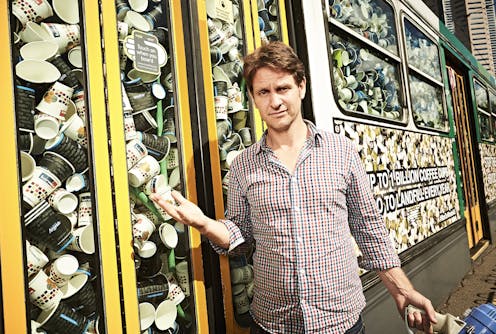
The #BYOCoffeeCup tram in Melbourne from the ABC’s War on Waste series, May 2017.Read more: What makes people switch to reusable cups? It's not discounts, it's what others do
Educational entertainment
In War on Waste, Reucassel confronts Australia’s many waste-management problems and potential solutions.
The series is an example of what behavioural psychologists call “entertainment-education interventions”.
In one episode, Reucassel staged a stunt on a Melbourne tram during peak hour, proclaiming it was filled with 50,000 disposable coffee cups – the amount sent to landfill every 30 minutes in Australia.
Almost overnight, KeepCup sales quadrupled, crashing the company’s website. Membership of a Responsible Cafes initiative promoting reusable coffee cups spiked from 400 cafes to 1,800.
An ABC study found more people of all ages bought coffee in reusable cups after War on Waste aired (up from 37% to 42%).
The survey also revealed millennials (aged 18-34 in 2017) were generally less likely to adopt waste-reduction behaviours compared with other age groups. But they excelled in using reusable coffee cups.
Why was the show so successful in encouraging people, and specifically millennials, to use reusable coffee cups?
If we can explain why this behaviour was so readily adopted, perhaps we can promote other sustainable behaviours at scale, in other entertainment-education interventions.
Our research uncovered five tactics used by the show to get these results.
1. Use a relatable host
Humans relate to people on TV. Research shows celebrities and people we consider engaging and credible are more likely to influence us.
Reucassel is a popular host with celebrity status. One focus group participant said:
A lot of films […] feel very preachy. It’s often either an expert, or just a narrator, who clearly didn’t know anything about the topic beforehand, who has now researched things, who is telling you things. Whereas in the case of the War on Waste, it felt more like he [Reucassel] was learning it with you, at the same time.
In the first season, we watched as Reucassel sorted the contents of a recycling bin, sharing the learning experience with the viewer. Research shows we are more likely to adopt a new behaviour if we’re shown how to do it rather than told what to do.
2. Mix statistics with confronting visuals
High-impact visuals have lasting effect. Reucassel’s many stunts served not only as an engaging way to present statistics, but also a way to connect with viewers by stirring up emotions. This approach builds audience knowledge and willpower, making a change in behaviour more likely.
As one focus group participant put it:
My favourite thing about the show was all the stunts that Craig pulled – it’s classic Chaser stuff. Like the big rolling ball of plastic bags and the tram full of coffee cups. I thought that aspect of it was the most hard-hitting and interesting.

Read more: We found 3 types of food wasters, which one are you?
3. Promote widespread community action
A common problem with behaviour change initiatives is a person will only change their behaviour if they feel like others are going to change their behaviour too. This often leads to “the tragedy of the commons”, where no one ends up taking action.
The opposite was true for War on Waste. Focus group participants felt the show created a groundswell for environmental change, so they were more inspired to take action because they felt others were taking action too. In the words of one:
I really enjoyed how it was a mix of personal actions [and] more systemic changes […] like getting Coles and Woolworths to change cosmetic standards [for fresh produce] but also the episode with the fast fashion, about getting the teenage girls to consider their own personal choices.
Read more: Households find low-waste living challenging. Here's what needs to change
4. Choose behaviours with an easy learning curve
Reducing waste may never be “easy”, but by choosing behaviours perceived to be low-cost with little inconvenience, we have a better chance of success.
Swapping the disposable coffee cup for a reusable cup was considered relatively easy with a “quick learning curve” – compared to composting or having a worm farm – and so became more readily adopted than other behaviours demonstrated in War on Waste.
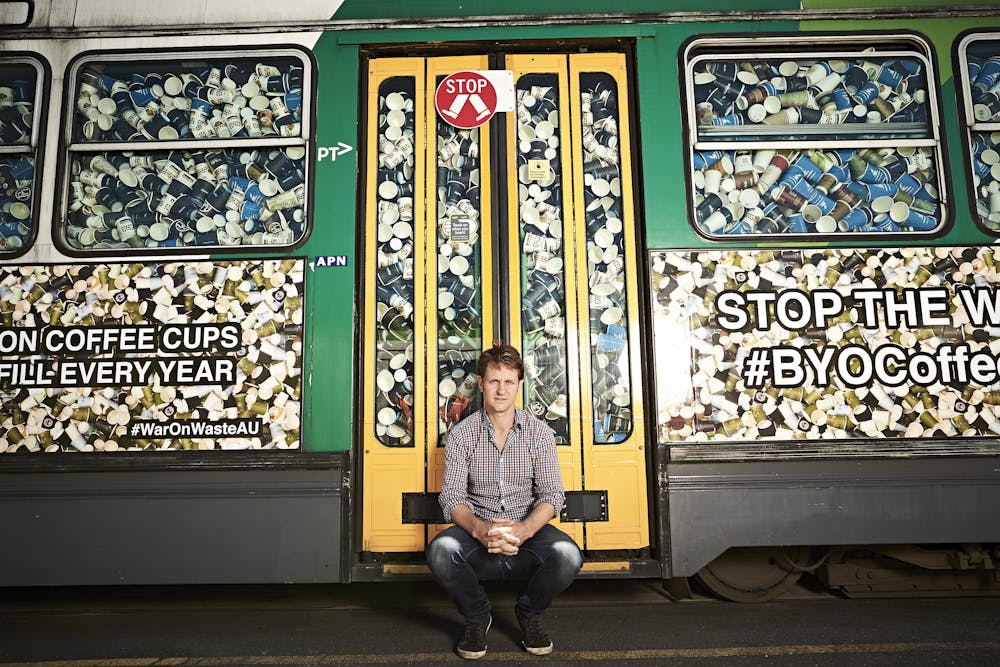 The shocking sight of a Melbourne tram filled with 50,000 disposable coffee cups stopped city commuters in their tracks.
Lune Media
The shocking sight of a Melbourne tram filled with 50,000 disposable coffee cups stopped city commuters in their tracks.
Lune Media
5. Show how behaviour can reveal social identity
People from all generations prefer to act in accordance with what society deems acceptable. So pro-environmental behaviours are more likely to be adopted when social pressure is placed on them.
War on Waste placed social pressure on us all to reduce our waste. Adopting a reusable coffee cup became a visible symbol for millennials to demonstrate to others that they were doing their bit, while expressing their environmental values.
As one participant said:
I think it’s just a trendy, convenient way to maybe look and feel like you are doing something that’s […] the right step.
What can we learn from this, and what’s next?
Many of the strategies we identified as successful in season one reappeared this year in season three, such as confronting visual stunts, shared learning experiences and targeting easy behaviours.
Based on the findings from our research, we expect to see further positive change generated from this season.
Our research also presents an opportunity to practitioners wanting to create behaviour change at scale by providing them with behavioural science strategies to embed in entertainment-education interventions.
Read more: What to wear for a climate crisis
Authors: Danie Nilsson, Behavioural Scientist, CSIRO

















