

Did this chemical reaction create the building blocks of life on Earth?
- Written by: Quoc Phuong Tran, PhD Candidate in Prebiotic Chemistry, UNSW Sydney
How did life begin? How did chemical reactions on the early Earth create complex, self-replicating structures that developed into living things as we know them?
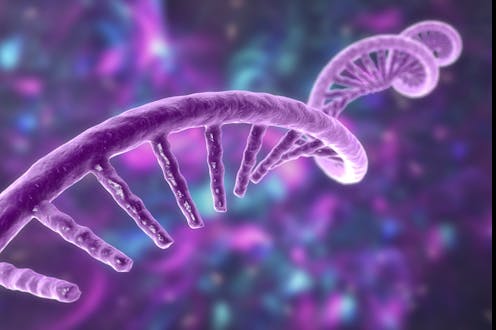
According to one school of thought, before the current era of DNA-based life, there was a kind of molecule called RNA (or ribonucleic acid). RNA – which is still a crucial component of life today – can replicate itself and catalyse other chemical reactions.
But RNA molecules themselves are made from smaller components called ribonucleotides. How would these building blocks have formed on the early Earth, and then combined into RNA?
Chemists like me are trying to recreate the chain of reactions required to form RNA at the dawn of life, but it’s a challenging task. We know whatever chemical reaction created ribonucleotides must have been able to happen in the messy, complicated environment found on our planet billions of years ago.
I have been studying whether “autocatalytic” reactions may have played a part. These are reactions that produce chemicals that encourage the same reaction to happen again, which means they can sustain themselves in a wide range of circumstances.
In our latest work, my colleagues and I have integrated autocatalysis into a well-known chemical pathway for producing the ribonucleotide building blocks, which could have plausibly happened with the simple molecules and complex conditions found on the early Earth.
The formose reaction
Autocatalytic reactions play crucial roles in biology, from regulating our heartbeats to forming patterns on seashells. In fact, the replication of life itself, where one cell takes in nutrients and energy from the environment to produce two cells, is a particularly complicated example of autocatalysis.
A chemical reaction called the formose reaction, first discovered in 1861, is one of the best examples of an autocatalytic reaction that could have happened on the early Earth.
In essence, the formose reaction starts with one molecule of a simple compound called glycolaldehyde (made of hydrogen, carbon and oxygen) and ends with two. The mechanism relies on a constant supply of another simple compound called formaldehyde.
A reaction between glycolaldehyde and formaldehyde makes a bigger molecule, splitting off fragments that feed back into the reaction and keep it going. However, once the formaldehyde runs out, the reaction stops, and the products start to degrade from complex sugar molecules into tar.
Read more: Can bleach help solve the origin of life in the primordial soup?
The formose reaction shares some common ingredients with a well-known chemical pathway to make ribonucleotides, known as the Powner–Sutherland pathway. However, until now no one has tried to connect the two – with good reason.
The formose reaction is notorious for being “unselective”. This means it produces a lot of useless molecules alongside the actual products you want.
An autocatalytic twist in the pathway to ribonucleotides
In our study, we tried adding another simple molecule called cyanamide to the formose reaction. This makes it possible for some of the molecules made during the reaction to be “siphoned off” to produce ribonucleotides.
The reaction still does not produce a large quantity of ribonucleotide building blocks. However, the ones it does produce are more stable and less likely to degrade.
What’s interesting about our study is the integration of the formose reaction and ribonucleotide production. Previous investigations have studied each separately, which reflects how chemists usually think about making molecules.
Generally speaking, chemists tend to avoid complexity so as to maximise the quantity and purity of a product. However, this reductionist approach can prevent us from investigating dynamic interactions between different chemical pathways.
These interactions, which happen everywhere in the real world outside the lab, are arguably the bridge between chemistry and biology.
Industrial applications
Autocatalysis also has industrial applications. When you add cyanamide to the formose reaction, another of the products is a compound called 2-aminooxazole, which is used in chemistry research and the production of many pharmaceuticals.
Conventional 2-aminooxazole production often uses cyanamide and glycolaldehyde, the latter of which is expensive. If it can be made using the formose reaction, only a small amount of glycolaldehyde will be needed to kickstart the reaction, cutting costs.
Our lab is currently optimising this procedure in the hope we can manipulate the autocatalytic reaction to make common chemical reactions cheaper and more efficient, and their pharmaceutical products more accessible. Maybe it won’t be as big a deal as the creation of life itself, but we think it could still be worthwhile.
Read more: We've been wrong about the origins of life for 90 years
Authors: Quoc Phuong Tran, PhD Candidate in Prebiotic Chemistry, UNSW Sydney



















