

Classroom design should follow evidence, not architectural fads
- Written by: Terry Byers, Research fellow, University of Melbourne
The past decade has seen a boom in the construction of trendy buildings with visually appealing interiors in schools and universities. Proponents highlight the potential of these flexible and technology-rich spaces, referred to as innovative learning environments (ILEs), to shape behaviours to enhance student learning.
Economic and technological changes have caused a reconsideration of the nature of teaching and learning. This narrative has been used to underpin the call to re-imagine school learning environments.
Critiques highlight the constrained, static design of conventional classrooms, which favours more traditional teaching practices. It is suggested this is not conducive to those learning experiences favoured in current policy.
However, this claimed relationship between space and teacher practice is flimsy. There is a lack of evidence to underpin it.
What evidence is there for this relationship?
Systematic investment in new learning environments is a matter of policy in many countries. In Australia alone, more than A$16 billion funded the Rudd government’s Building the Education Revolution program. Current state government initiatives will soon increase this public investment.
The need for innovative classroom spaces stems from questions about how efficient existing classrooms are. Analysis by the Innovative Learning Environments and Teacher Change (ILETC) project suggests conventional or traditional classrooms account for about 75% of all spaces in Australian and New Zealand schools. It has been suggested most current classrooms are obsolete and unfit for today’s learners.
A systematic review conducted for the project identified empirical studies that evaluated the relationship between educational spaces and academic achievement. Of the 5,521 articles retrieved (since 1960), only 21 studies evaluated impacts of the physical environment of primary and secondary schools on measures of student learning outcomes. In particular, the review highlighted how little is understood about the long-term impact of different learning spaces.
The review highlighted that the large and interconnected spaces of the open-plan movement from the 1960s to 1970s had questionable effects on academic outcomes.
Similar reviews highlighted the problems of top-down implementation, lack of teacher consultation and support, poor acoustics and overt focus on design over use that contributed to their varying impact. Radical spatial changes, like those in some Australian schools, were rarely evaluated and outpaced desired changes in teacher practices.
Key studies in the field often focused on the design and physical performance of buildings. A small number evaluated their use in teacher practice and effects on student learning experiences.
With few reliable and robust methods and metrics available, the current narrative for spatial change must be considered with caution.
What works
The review of literature suggests that, by themselves, new educational spaces are not a catalyst for direct improvement in learning. Typically, the beliefs, practice and technical expertise of the teacher mediated positive effects on measures of student learning. School culture and the contexts that affect learning influenced teachers’ abilities to use the elements of different classroom layouts, rather than these spaces dictating their practice.
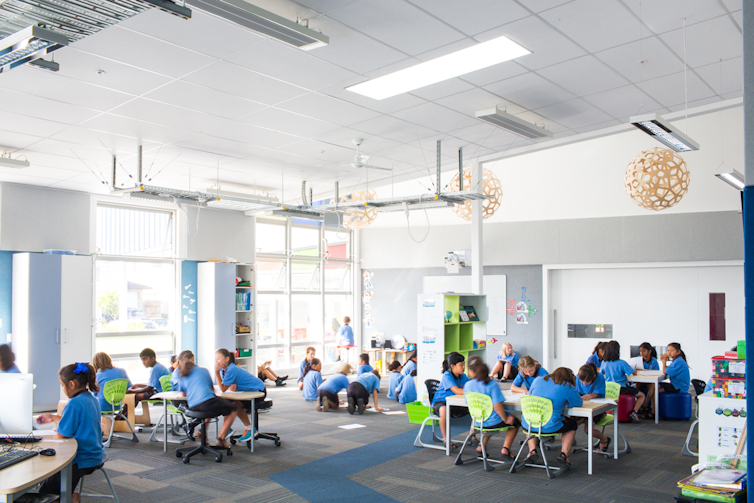 Stonefields School.
Alex de Freitas, Author provided
Stonefields School.
Alex de Freitas, Author provided
Stonefields School in Auckland, New Zealand, presents the archetype for the use of innovative classrooms to facilitate a collaborative learning culture. Its success is built on the creation of a co-operative space for teachers to engage in continuous professional learning. Collective teacher capacity ensures the elements of the space are used to enhance teacher practice.
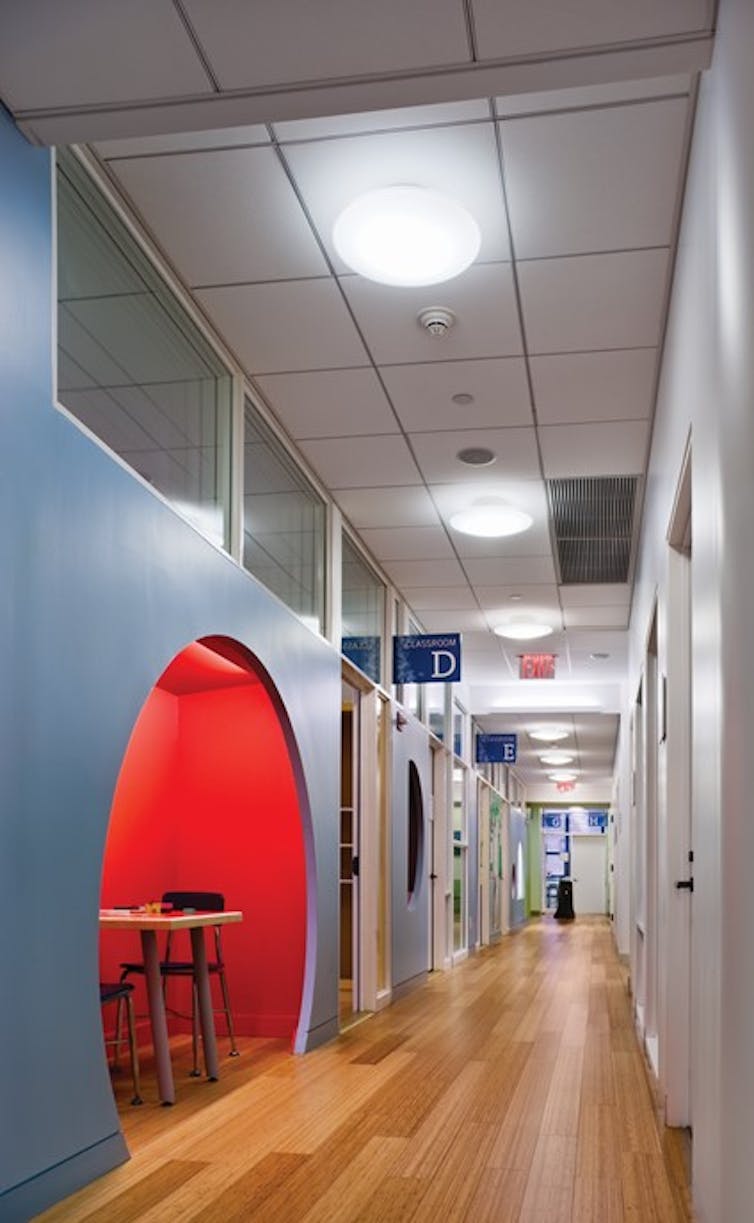 Gateway School.
Peter Lippman, Author provided
Gateway School.
Peter Lippman, Author provided
Evaluation at the Gateway School in New York City indicates innovative learning environments are neither open-plan nor a series of differentiated classrooms and breakout spaces. Rather, classrooms and breakout spaces must be understood and designed as interconnected and defined activity settings. These complementary spaces provide opportunities to reinvent the use of communal or shared spaces outside the classroom.
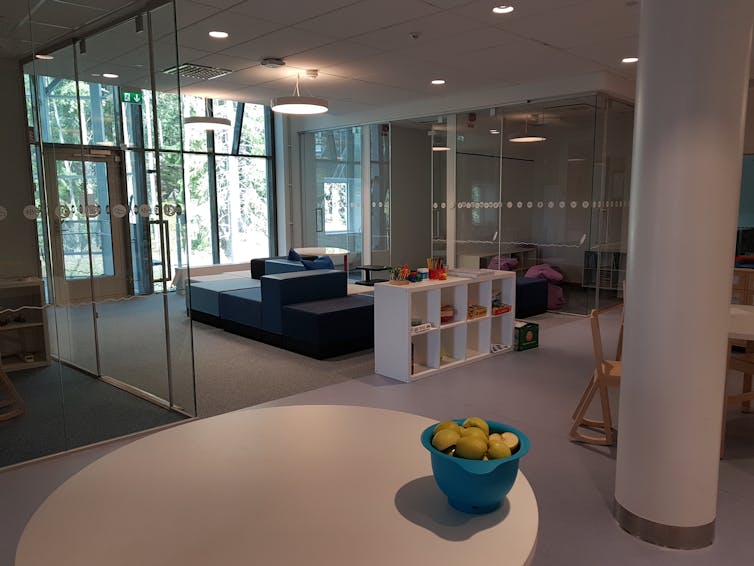 Glömsta School.
Peter Lippman, Author provided
Glömsta School.
Peter Lippman, Author provided
The learning community at Glömsta School in Huddinge, Sweden, reinforces this concept of placemaking. Despite the design, which followed a top-down philosophy, the learning community identified a unique solution to a cluster of classrooms around a common space. Rather than the view of classrooms as primarily instructional spaces, they are used as a breakout setting to complement the activities that occur in the common areas.
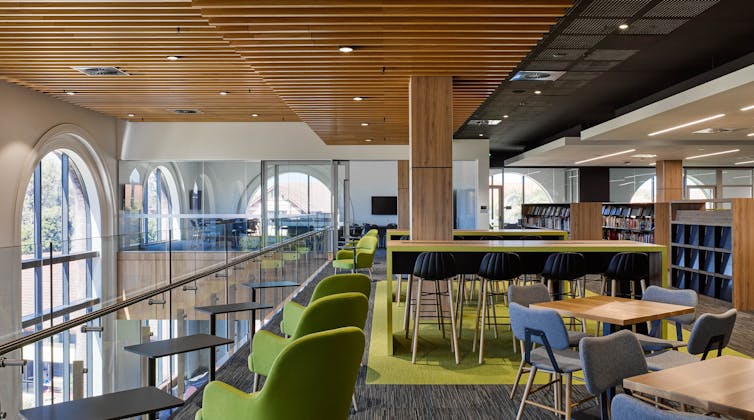 Churchie Centenary Library.
Brand and Slater Architects, Author provided
Churchie Centenary Library.
Brand and Slater Architects, Author provided
Anglican Church Grammar School (Churchie) in Brisbane, the Learning Environments Applied Research Network (LEaRN) and Brand and Slater Architects used evaluation as a fulcrum for strategic improvement. Longitudinal studies correlated different learning space designs to improvement in student perceptions and engagement that affected significant academic gain in English and mathematics.
The process identified removing the front teaching position by a combination of visual technologies (whiteboards and screen), which allowed greater teacher movement to actively engage with students and moderate their behaviour and focus. An unexpected outcome was the development of collective teacher capacity in the optimal use of traditional classrooms and innovative learning spaces to enhance learning experiences.
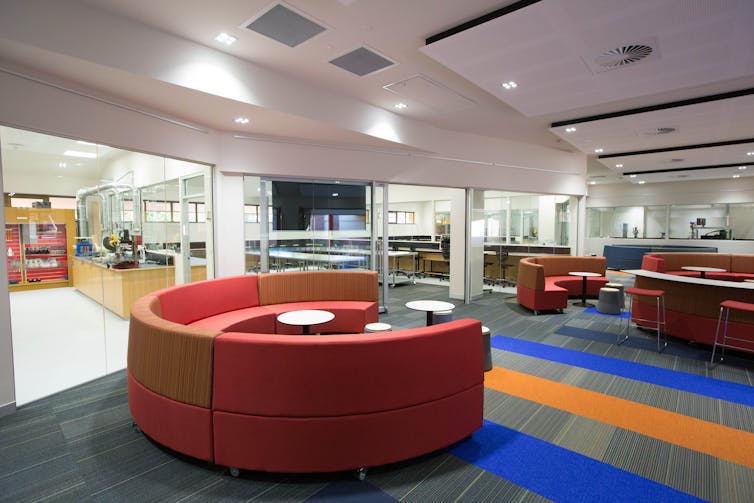 Hayward Midson Creative Precinct Studio Design.
Brand and Slater Architects, Author provided
Hayward Midson Creative Precinct Studio Design.
Brand and Slater Architects, Author provided
We need better evidence to inform classroom design
There is limited evidence to support the idea that making physical changes to classrooms boosts learning outcomes. The reason for this is schools are complex places.
The case studies emphasise the mediating influence of context and school culture. So, designs can’t be imposed on the basis of current architectural trends or policy. Further evidence of how different physical layouts support best practice for teachers is required.
Authors: Terry Byers, Research fellow, University of Melbourne
Read more http://theconversation.com/classroom-design-should-follow-evidence-not-architectural-fads-89861


















