Building sea walls is a small bandaid on a gaping wound
- Written by: Tayanah O'Donnell, Honorary senior lecturer, Australian National University
The Kingscliff seawall, in the Tweed Shire in northern New South Wales, is an engineering marvel. It is 300 metres long and 6 metres deep, with a projected cost of between A$3 million and A$5 million. Its depth enables it to be covered in sand. When beach erosion occurs, the wall’s large concrete steps should, in theory, allow the public to carry on using and enjoying the waterfront.
The main purpose of the wall is to protect a beachfront caravan park, the main street, and the beach itself, from coastal erosion.
But while the seawall is innovative, it symbolises a major problem with how we approach coastal erosion and rising sea levels. Councils around Australia must chose between long-term adaption to a changing coastline, or fighting an expensive rearguard battle to protect mainly private property.
Read more: Far-sighted adaptation to rising seas is blocked by just fixing eroded beaches
My PhD research has found that some elected councillors are willing to override long-range climate change planning so as to protect voters’ private property.
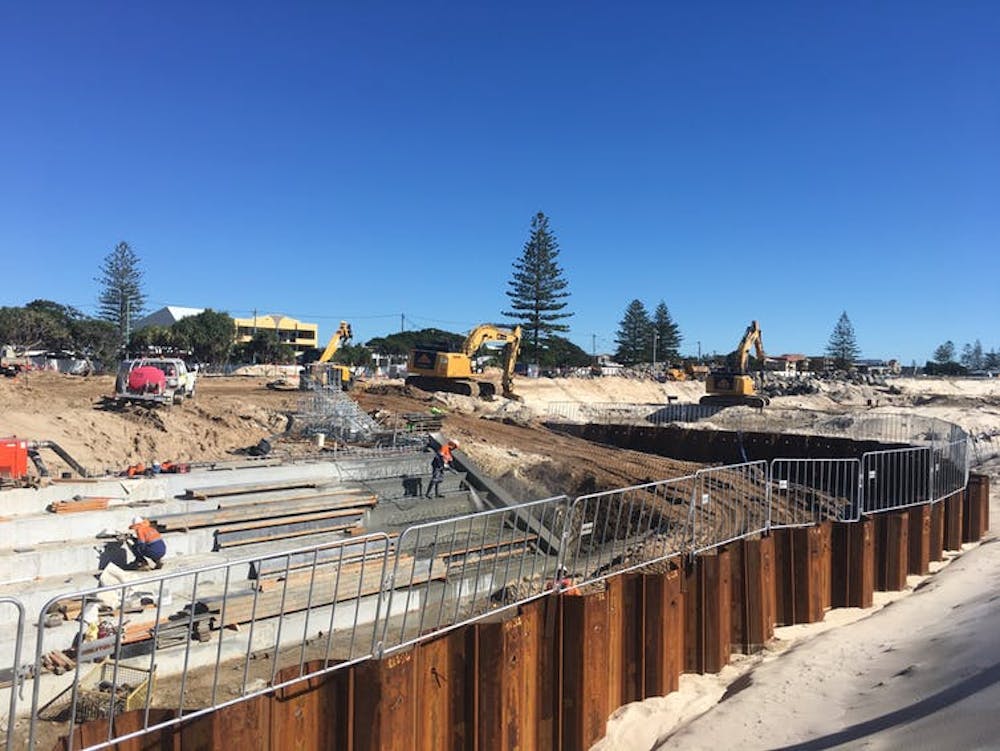 Kingscliff sea wall under construction.
Author provided
Kingscliff sea wall under construction.
Author provided
The problem with just building walls
The construction of seawalls is usually controversial. A plethora of research has shown that community interests diverge on the question of whom these walls are protecting (and who should have to pay for them).
Fundamentally, this can be categorised as a conflict of private versus public interests, especially where sea walls protect private property at the expense of public amenity and access to beaches.
Seawalls also provide a false sense of security to property owners who should not be encouraged to buy in high-risk locations. While it’s true that Kingscliff’s wall is sensitively designed, seawalls do not allow the coast to function as as a coast should. Coastal environments are dynamic and movable ecosystems; they are special places.
Sometimes, adapting to climate change means allowing places to change. Change can include retreating from some locations, well before disaster strikes. Climate change impacts will render some environments unrecognisable to the people who live in them now. The ultimate injustice would be for marginalised communities to fund the protection of high-risk private properties.
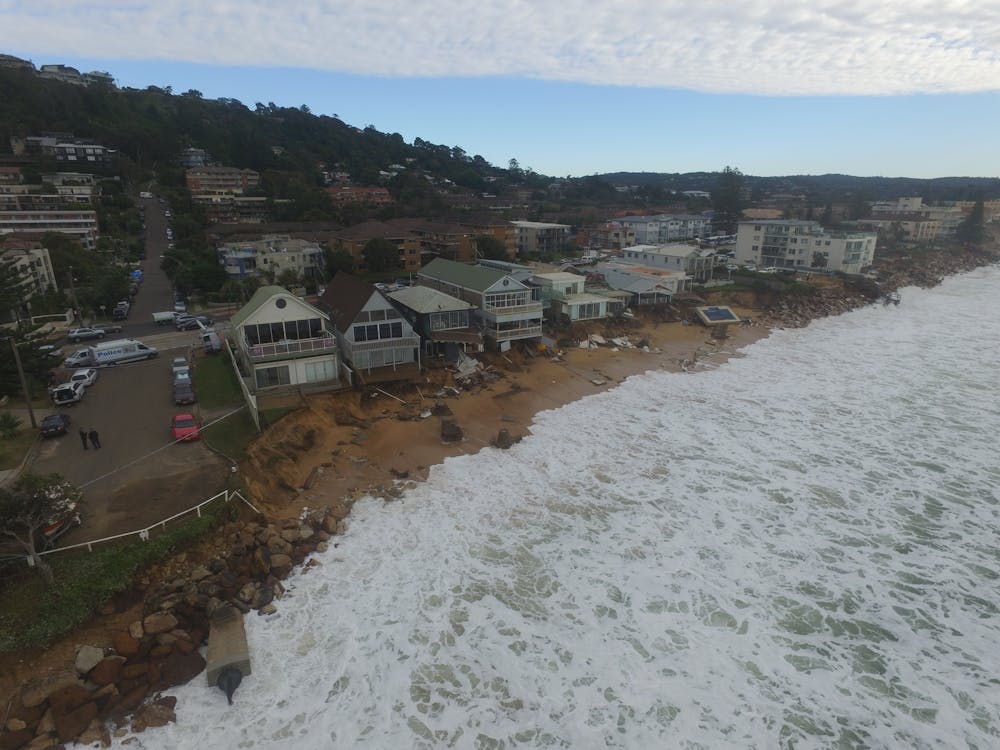 Severe storms in 2016 caused massive erosion at Collaroy on Sydney’s northern beaches.
AAP Image/UNSW Water Research Laboratory
Severe storms in 2016 caused massive erosion at Collaroy on Sydney’s northern beaches.
AAP Image/UNSW Water Research Laboratory
Protecting private property
The problem for local councils is that the main options for coastal adaptation (defend, manage, or retreat) are all likely to curtail individual property freedoms in some way. A key challenge for coastal management and climate adaptation planning is the ongoing priority afforded to private property rights.
During my PhD I explored how residents, local government staff and councillors in Port Stephens and Lake Macquarie approached climate change adaption.
I found that strategies are developed in negotiation between local councils, property owners and local communities, with reference to state policy. This dynamic makes it easier for the advancement of private property rights to become a default priority for some local governments.
This is not because of council staff – quite the opposite. Overwhelmingly, council staff are working hard to implement robust long-term planning to respond to climate risk. However, elected councillors have sometimes overridden staff decisions. They usually do so where decisions negatively affect local constituents’ private property rights or values. One councillor told me “it’s common sense” to allow people to do as they liked with their property. To protect themselves against future liability, some staff minuted legal advice.
Another interesting result of my research was seeing how residents rely on law and popular ideas associated with private property to advance individual property rights (such as exclusivity and freedom to redevelop). At the same time many look to the state for help when their own property is threatened by climate variability.
My data show that residents tend to view coastal residential property in two primary ways: as an asset, and through lived experiences. Most of the residents involved in my research had lived in their localities for decades.
Many respondents said they wanted intervention to protect their own properties from climate change impacts. However, they favoured no intervention for broader property protections. This was especially so where these interventions were because of “climate change”, or where these interventions would reduce property values or public amenity. Others thought we shouldn’t be paying to protect someone who has chosen to live in a high-risk location.
Local governments remain at the forefront of climate adaptation planning on developed coastlines around the world. Authorities can no longer ignore the legal, political, and cultural consequences of climate change impacts to our coastlines.
Read more: Coral reefs work as nature's sea walls – it pays to look after them
To respond effectively, elected officials must trust their staff to act in the best interests of the council. Council staff can and should create evidence-based policy, recognise their legal responsibilities, work with key stakeholders for effective community engagement, and most importantly, keep good, clear records.
This research, including additional fieldwork, is currently under contract for a monograph with Palgrave MacMillan, for publication in 2019.
Authors: Tayanah O'Donnell, Honorary senior lecturer, Australian National University
Read more http://theconversation.com/building-sea-walls-is-a-small-bandaid-on-a-gaping-wound-104134