

Giant eagles and scavenging vultures shared the skies of ancient Australia
- Written by Ellen K. Mather, Adjunct Associate Lecturer in Palaeontology, Flinders University
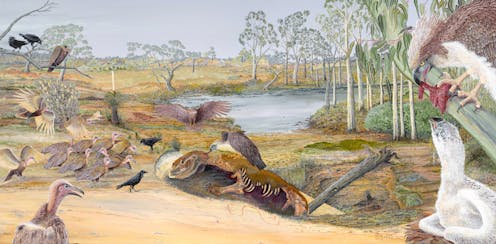
Today, Australia is home to 17 species of hawks and eagles. But the fossil record shows some other, rather special raptors were present in the relatively recent past.
Tens of thousands of years ago, Australia was home to species such as Dynatoaetus gaffae, the largest eagle ever to have lived in Australia, and Cryptogyps lacertosus, our only known vulture.
Now, we have discovered another ancient eagle shared the skies with these prehistoric predators. In a new paper in the journal Alcheringa, we describe the formidable Dynatoaetus pachyosteus, based on fossils found in the Naracoorte Caves in South Australia.
A new eagle unearthed
Dynatoaetus pachyosteus (the name means “powerful eagle with thick bones”) lived during the Pleistocene (a time period spanning from 2.5 million to 11,700 years ago). It had a wingspan similar to that of a wedge-tailed eagle, but with much more robust and powerful wings and legs. It was slightly smaller than its cousin, the massive Dynatoaetus gaffae.
This formidable predator would most likely have preyed on medium to large marsupials and birds. It may even have attacked juveniles and weakened individuals of huge megafaunal species like the giant flightless bird Genyornis.
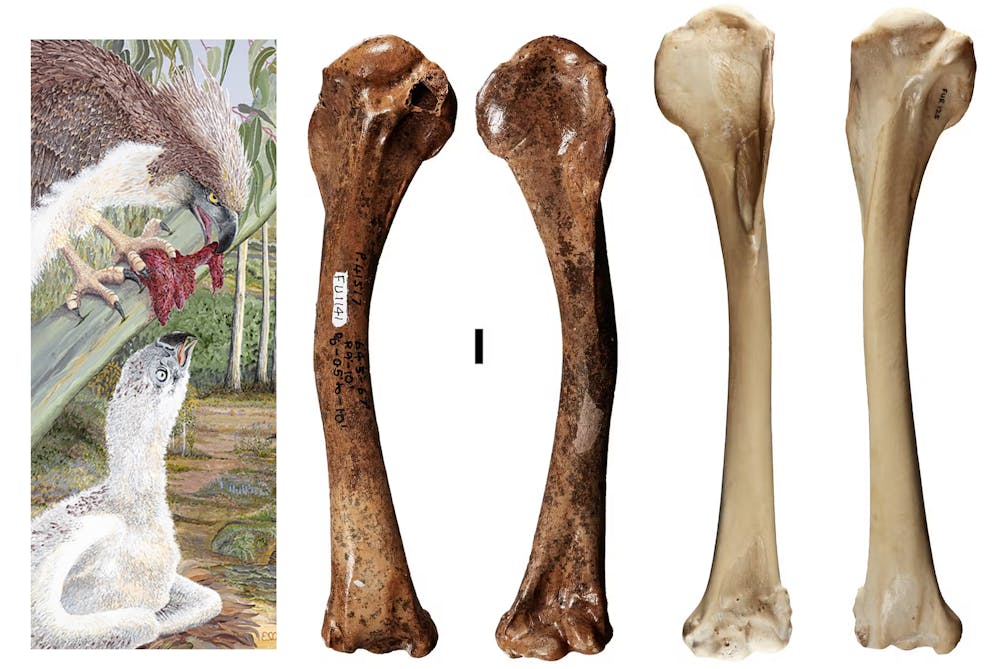
Dynatoaetus pachyosteus shared the Pleistocene landscape with at least two other large eagles, the huge Dynatoaetus gaffae and the wedge-tailed eagle we know today. For these species to coexist, they would have likely needed to have slightly different ecological roles to avoid outright competition.
“Niche separation” typically occurs by exploiting different kinds of food or habitats. These three eagles most likely coexisted by specialising in hunting different prey and nesting in different places.
The occurrence of both species of the Dynatoaetus genus in Australia (and nowhere else) has implications for the evolution of eagles. Dynatoaetus gaffae and D. pachyosteus presumably evolved from a common ancestor in Australia that diverged into two species, a process that typically takes a very long time.
Read more: Australia's extinct giant eagle was big enough to snatch koalas from trees
This suggests the ancestor of this genus was already ensconced on our continent millions of years before the two Pleistocene species arose. Dynatoaetus pachyosteus and D. gaffae together form a rare example of a raptor genus diversifying into multiple species entirely on the Australian continent (what scientists call “endemic evolutionary radiation”).
There are only two raptor genera today restricted to Australia, and both consist of only a single species: Hamirostra (the black-breasted buzzard) and Lophoictinia (the square-tailed kite).
Primitive vultures of ancient Australia
Our research has also revealed intriguing new information about another extinct raptor, the vulture Cryptogyps lacertosus.
Fossils from the Green Waterhole (also known as Fossil Cave), in the Tantanoola district near Mt Gambier, give us a more complete picture of this species. We found several paired wing bones, two shoulder bones, a vertebra and a toe bone, all probably from a single individual.
The additional bones of Cryptogyps indicate it was a rather primitive vulture, less adapted for the long periods of soaring flight characteristic of modern vultures.
Thanks to the sediment around the fossils, we also have a very precise date of when Cryptogyps was alive. Many of the Green Waterhole fossils were buried in a deposit of calcite rafts – crystals that form on the surface of still bodies of water in caves.
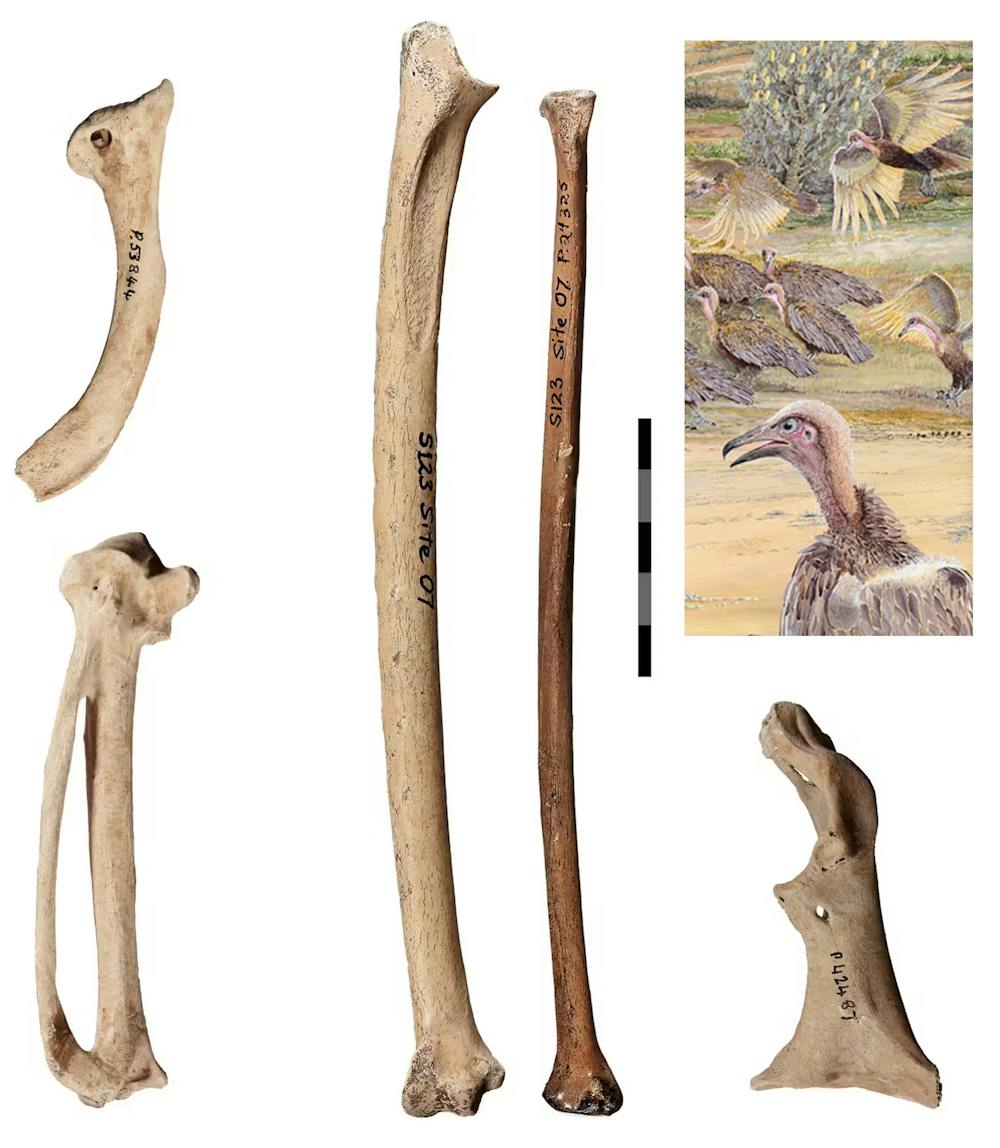 Fossil bones from the wing and shoulder of the extinct vulture Cryptogyps lacertosus, recovered from Green Waterhole, South Australia. Scale bar = 50mm. Life reconstruction top right.
Ellen Mather (photos) / John Barrie (reconstruction)
Fossil bones from the wing and shoulder of the extinct vulture Cryptogyps lacertosus, recovered from Green Waterhole, South Australia. Scale bar = 50mm. Life reconstruction top right.
Ellen Mather (photos) / John Barrie (reconstruction)
Today, most of the cave is submerged because of a high water table, but in the past, it was mostly dry. A pool of water deeper in the cave was where these calcite rafts formed.
The water was likely what attracted animals into the cave in the first place. These animals then died, and their bones sank to the bottom of the pool along with the calcite rafts. Our team dated these calcite rafts – and thus the entombed Cryptogyps fossils – at approximately 60,000 years old.
Mammal extinctions affect birds of prey
When we think of the mass extinction of Australian megafauna, we tend to think about the demise of large mammals, such as the “giant wombat” Diprotodon optatum, the “marsupial lion” Thylacoleo carnifex, and the giant short-faced kangaroo Procoptodon goliah. Some large reptiles are also commonly recognised as victims: the giant goanna (Megalania) Varanus priscus, the constricting snake Wonambi naracoortensis, and even a giant armoured skink Tiliqua frangens.
But as we can see from the case of our large eagles and vultures, other groups of animals were also affected. Birds of prey, especially large and scavenging species, went extinct around the world during the Late Pleistocene, their food supply likely affected by the loss of large mammalian species. Australia appears to have been no exception to the rule.
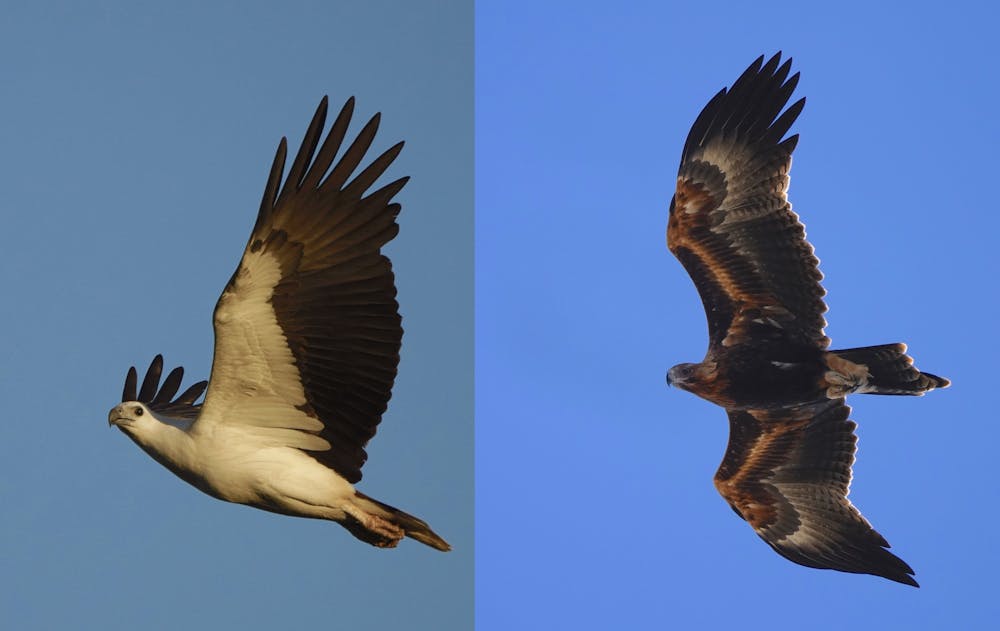 The wedge-tailed eagle (Aquila audax) and the white-bellied sea eagle (Icthyophaga leucogaster) are the largest birds of prey found in modern Australia.
Michael Lee
The wedge-tailed eagle (Aquila audax) and the white-bellied sea eagle (Icthyophaga leucogaster) are the largest birds of prey found in modern Australia.
Michael Lee
The new fossils reveal many of Australia’s large birds of prey did not survive the megafaunal extinction event in the Late Pleistocene, roughly 50,000 years ago. The two largest species that managed to persist to the present are the wedge-tailed eagle, which is a generalist hunter found throughout the continent, and the white-bellied sea eagle, which targets fish and has a coastal distribution.
It is likely our three extinct large raptors – two giant eagles and a vulture – were too specialised as hunters and scavengers of megafauna to adapt to a rapidly changing world. Their extinction likely caused a further cascade of effects through the ecosytem: in Asia, for instance, more recent loss of vultures has led to increased populations of scavenging feral dogs and higher prevalance of diseases such as rabies.
Authors: Ellen K. Mather, Adjunct Associate Lecturer in Palaeontology, Flinders University

















