how volcanoes can lie about their age, and what it means for us
- Written by: Richard N Holdaway, Adjunct Professor, University of Canterbury
Just like a teenager wanting to be older, volcanoes can lie about their age, or at least about their activities. For kids, it might be little white lies, but volcanoes can tell big lies with big consequences.
Our research, published today in Nature Communications, uncovers one such volcanic lie.
Accurate dating of prehistoric eruptions is important as it allows scientists to correlate them with other records, such as large earthquakes, Antarctic ice cores, historical events like Mediterranean civilisation milestones, and climatic events like the Little Ice Age. This gives us a better understanding of the links between volcanism and the natural and cultural environment.
Taupo’s last violent eruption
Lake Taupo, in the North Island of New Zealand, is a globally significant caldera supervolcano. The caldera formed after the collapse of a magma chamber roof following a massive eruption more than 20,000 years ago.
Now it seems that the Taupo eruption that occurred in the early part of the first millennium has been lying about its age. But like many lies, it was eventually found out, and it reveals exciting processes we hadn’t understood before.
The eruption of Taupo in the first millennium has been dated many times with radiocarbon, yielding a surprisingly large spread of ages between 36CE and 538CE.
Read more: Curious Kids: Why do volcanoes erupt?
Radiocarbon dating of eruptions
Radiocarbon dating of organic material is based on the concentrations of radioactive carbon-14 in a sample remaining after the organisms’ death. Over the past two decades, the method has been refined greatly by combining it with dendrochronology, the study of the environmental effects on the width of tree rings through time.
Radiocarbon dating of tree ring records has allowed scientists to construct a reliable record of the concentration of carbon-14 in the atmosphere through time.
In principle, this composite record allows eruptions to be dated by matching the wiggly trace of carbon-14 in a tree killed by an eruption to the wiggly trace of atmospheric carbon-14 from the reference curve (“wiggle-match” dating).
Scientists presently use wiggle-match dating as the method of choice for eruption dating, but the technique is not valid if carbon dioxide gas from the volcano is affecting a tree’s version of the wiggle.
Read more: Bali's Agung – using 'volcano forensics' to map the past, and predict the future
The effect of volcanic carbon on eruption ages
Our study re-analysed the large series of radiocarbon dates for the Taupo eruption and found that the oldest dates were closest to the volcano vent. The dates were progressively younger the farther away they were.
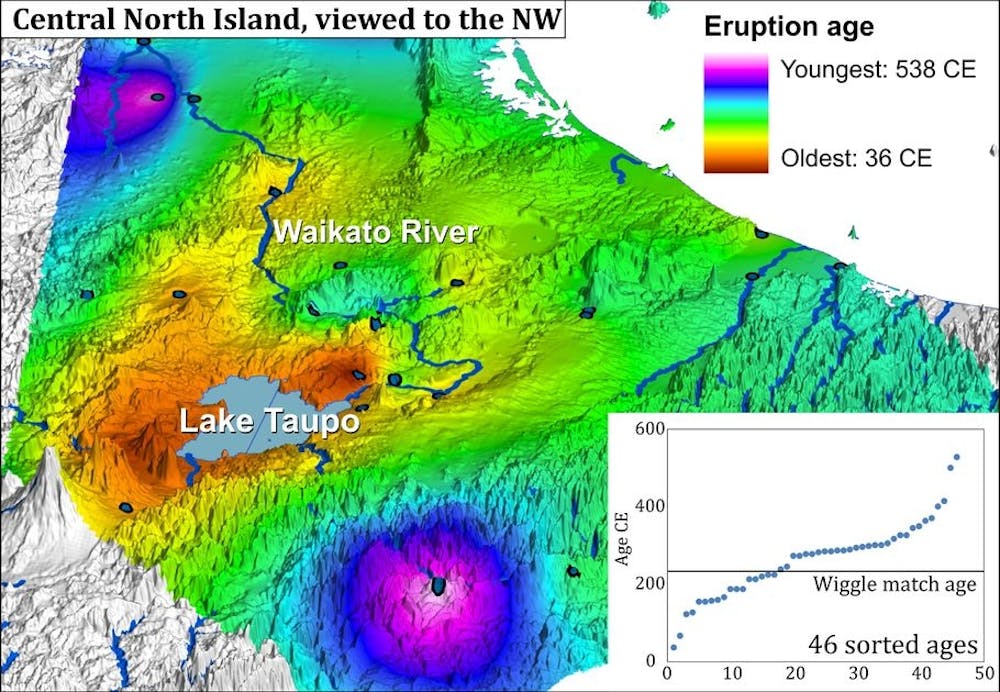 This graph shows all of the ages obtained for the Taupo first millenium eruption, sorted by age, plotted on a digital model of the North Island of New Zealand. Lake Taupo is the caldera from which the eruption occurred. The oldest ages for the eruption are clustered around Lake Taupo, and older ages are located further from the volcano. We interpret this pattern as being caused by contamination of red areas with volcanic carbon dioxide.
Provided by authors, CC BY-ND
This graph shows all of the ages obtained for the Taupo first millenium eruption, sorted by age, plotted on a digital model of the North Island of New Zealand. Lake Taupo is the caldera from which the eruption occurred. The oldest ages for the eruption are clustered around Lake Taupo, and older ages are located further from the volcano. We interpret this pattern as being caused by contamination of red areas with volcanic carbon dioxide.
Provided by authors, CC BY-ND
This unusual geographic pattern has been documented very close (i.e. less than a kilometre) to volcanic vents before, but never on the scale of tens of kilometres. Two wiggle match ages, taken from the same forest, located about 30km from the caldera lake, were among the oldest dates from the series of dates.
This enlarged influence of the volcano can be explained by the influence of groundwater beneath the lake and its surroundings. The Taupo wiggle-match tree grew in a dense forest in a swampy valley where volcanic carbon dioxide was seeping out of the ground and was incorporated in the trees.
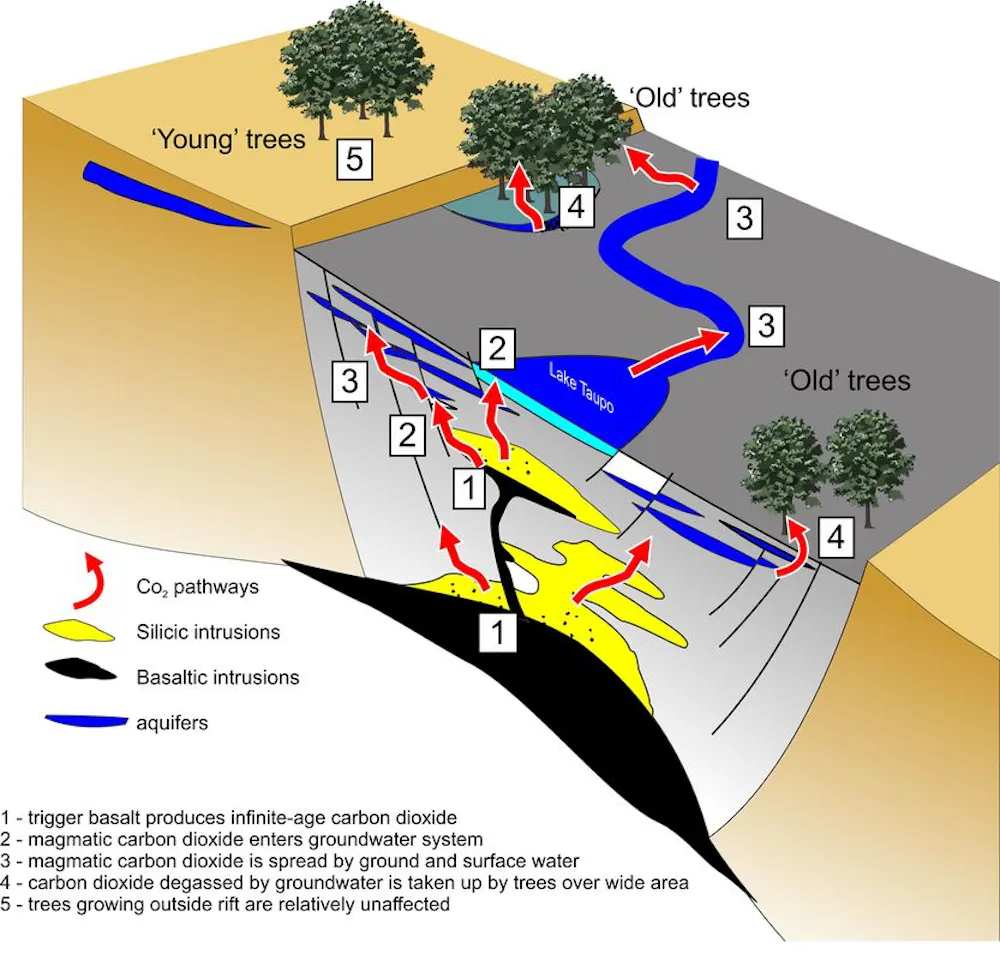 This conceptual image shows how gas from the triggering event, decades before the eruption, works its way into the groundwater system and is eventually incorporated in the wood of the trees that we date.
Provided by authors, CC BY-ND
This conceptual image shows how gas from the triggering event, decades before the eruption, works its way into the groundwater system and is eventually incorporated in the wood of the trees that we date.
Provided by authors, CC BY-ND
The ratio of carbon-13 to carbon-12 (the two stable isotopes of carbon) in the modern water of Lake Taupo and the Waikato River tells us that volcanic carbon dioxide is getting into the groundwater from an underlying magma body.
Can large eruptions be forecast over decades?
Our study shows that a large and increasing volume of carbon dioxide gas containing these stable isotopes was emitted from deep below the prehistoric Taupo volcano. It was then redistributed by the region’s huge groundwater system, ultimately becoming incorporated into the wood of the dated trees.
The increase was sufficiently large over several decades to dramatically alter the ratios of different carbon isotopes in the tree wood. The forest was subsequently killed by the last part of the Taupo eruption series. But the dilution of atmospheric carbon-14 by volcanic carbon made the radiocarbon dates for tree material from the Taupo eruption appear somewhere between 40 and 300 years too old.
The precursory change in carbon ratios gives us a way to gain insight into the forecasting of future eruptions, a central goal in volcanology. We found that the radiocarbon dates and isotope data that underpin the presently accepted “wiggle match” age reached a plateau (that is, stopped evolving normally). This meant that for several decades before the eruption, the outer growth rings of trees had ‘weird’ carbon ratios, forecasting the impending eruption.
We re-analysed data from other major eruptions, including at Rabaul in Papua New Guinea and Baitoushan on the North Korean border with China and found similar patterns. The anomalous chemistry mimics but exceeds the Suess effect, which reversed the carbon isotopic evolution of post-industrial wood. This implies that measurements of carbon isotopes in 200-300 annual rings can track changes in the carbon source used by trees growing near a volcano, providing a potential method of forecasting future large eruptions.
We anticipate that this will provide a significant focus for future research at supervolcanoes around the globe.
Authors: Richard N Holdaway, Adjunct Professor, University of Canterbury