

The world's 280 million electric bikes and mopeds are cutting demand for oil far more than electric cars
- Written by: Muhammad Rizwan Azhar, Lecturer, Edith Cowan University
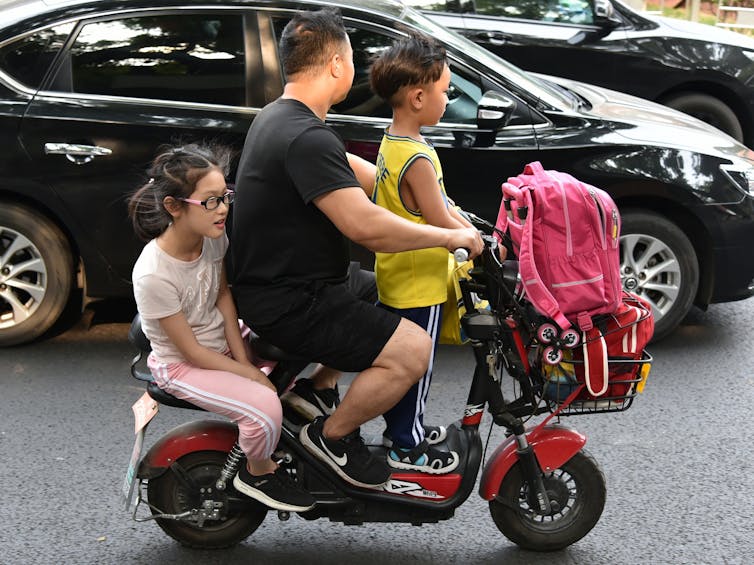
We hop in the car to get groceries or drop kids at school. But while the car is convenient, these short trips add up in terms of emissions, pollution and petrol cost.
Close to half (44%) of all Australian commuter trips are by car – and under 10km. Of Perth’s 4.2 million daily car trips, 2.8 are for distances of less than 2km.
This is common in wealthier countries. In the United States, a staggering 60% of all car trips cover less than 10km.
So what’s the best solution? You might think switching to an electric vehicle is the natural step. In fact, for short trips, an electric bike or moped might be better for you – and for the planet. That’s because these forms of transport – collectively known as electric micromobility – are cheaper to buy and run.
But it’s more than that – they are actually displacing four times as much demand for oil as all the world’s electric cars at present, due to their staggering uptake in China and other nations where mopeds are a common form of transport.

How can that be?
On the world’s roads last year, there were over 20 million electric vehicles and 1.3 million commercial EVs such as buses, delivery vans and trucks.
But these numbers of four or more wheel vehicles are wholly eclipsed by two- and three-wheelers. There were over 280 million electric mopeds, scooters, motorcycles and three-wheelers on the road last year. Their sheer popularity is already cutting demand for oil by a million barrels of oil a day – about 1% of the world’s total oil demand, according to estimates by Bloomberg New Energy Finance.
What about electric vehicles, you ask? After all, EVs have been heralded as a silver bullet for car emissions and air pollution in cities, as their tailpipe emissions are zero. If charged with renewable power, they get even greener.
But to see them as an inarguable good is an error. They are cleaner cars, but they are still cars, taking up space on the roads and requiring a lot of electricity to power them. Their batteries make them heavier than a traditional car, and draw heavily on the extraction of rare earth elements. While EVs are overall much greener than internal combustion engine cars, battery manufacture can undermine some of the gains.
On the plus side, petrol cars cost about A$0.14 per kilometre in fuel, or about $1,820 in fuel annually for the average car doing 12,000km. Maintenance averages at $910 a year, bringing the total to $2,730 for a petrol car.
By contrast, charging an EV would cost around $480 for that distance. Maintenance of $240 takes annual running costs to $720. So EVs are much cheaper to run. But they are expensive to buy.
What advantages do electric mopeds and bikes have?
The electric transport revolution is a great chance to rethink how we move through our cities – and whether we even need a car at all.
Cars, after all, often have only one occupant. You’re expending a lot of energy to transport yourself.
By contrast, electric mopeds and bikes use a lot less energy to transport one or two people. They’re also a lot cheaper to buy and run than electric cars.
If you commute on an e-bike 20km a day, five days a week, your charging cost would be about $20 – annually.
In Australia, electric bikes are very rapidly going from a hobbyist pursuit to a serious mode of urban transport. Over 100,000 e-bikes were sold here last year.
Of course, you’re unlikely to use electric mopeds or bikes to drive from Sydney to Melbourne. Their real value is in short-hop trips – the school run, the milk and bread run or even the commute – where they take roughly the same time or shorter than a car.
 E-bikes and electric mopeds are cutting oil demand more than electric vehicles.
Shutterstock
Smaller electric options like scooters and skateboards also offer a way to overcome the last kilometre problem which plagues public transport systems. This, in short, is the inconvenient distance between your home and the station or bus stop. Being able to cover this distance fast can be a game-changer for public transport.
If taken up, electric micromobility can cut urban emissions. A study of e-scooter riders in the United Kingdom found these trips produced up to 45% less carbon dioxide than alternatives.
US researchers estimate that if e-bike trips expanded to 11% of all vehicle trips, transport emissions would fall by about 7%.
As petrol prices increase and battery prices fall, the cheaper running costs of electric vehicles and even cheaper running costs of electric mopeds, bikes and scooters will keep eating away at the demand for oil.
Global oil demand is now projected to peak in 2028 at 105.7 million barrels per day – and then begin to fall, according to the International Energy Agency.
Electric vehicles will play a role in cutting oil demand. But it may well be that electric micromobility cuts demand faster, given how fast these cheaper, more plentiful options are being taken up.
What does this mean for me?
If you’re looking to go electric, it’s worth taking a close look at your transport needs. If you live in an outer suburb or regional towns, you may find the longer range and larger capacity of an electric car is better suited.
But for many people, it’s likely you’ll have a range of options. You might have one electric vehicle for longer trips, or group trips, as well as an e-bike for the school run or groceries.
Authors: Muhammad Rizwan Azhar, Lecturer, Edith Cowan University


















