

Plants are likely to absorb more CO₂ in a changing climate than we thought – here's why
- Written by Jürgen Knauer, Postdoctoral Research Fellow, Hawkesbury Institute for the Environment, Western Sydney University

The world’s vegetation has a remarkable ability to absorb carbon dioxide (CO₂) from the air and store it as biomass. In doing so, plants slow down climate change since the CO₂ they take up does not contribute to global warming.
But what will happen under more advanced climate change? How will vegetation respond to projected changes in atmospheric CO₂, temperatures and rainfall? Our study, published today in Science Advances, shows plants might take up more CO₂ than previously thought.
We found climate modelling that best accounted for the processes that sustain plant life consistently predicted the strongest CO₂ uptake. The most complex model predicted up to 20% more than the simplest version.
Our findings highlight the resilience of plants, and the importance of planting trees and preserving existing vegetation to slow climate change. While this is good news, it doesn’t let us off the hook in the fight against climate change. The rapid increase in atmospheric CO₂ means we must still cut emissions.
Read more: Carbon budget for 1.5°C will run out in six years at current emissions levels – new research
What happens to the CO₂ plants take up?
Plants take up CO₂ through photosynthesis. This process uses the Sun’s energy to convert – or “fix” – CO₂ from the air into the sugars plants use for growth and metabolic activity.
Plants release around half of that CO₂ back to the atmosphere via respiration relatively quickly. The other half is used for growth and stays in the plant biomass for longer – months to centuries.
That biomass will eventually die and decompose. Part of the carbon will be released again to the atmosphere, but other parts will enter the soil where it can stay for hundreds of years.
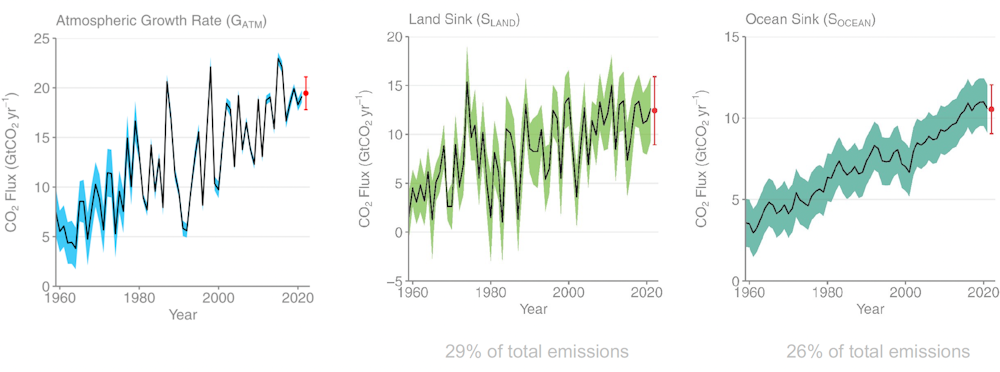
So, if plants take up more CO₂, it’s likely more carbon will be stored in vegetation and soils. This “land sink” of carbon has indeed increased over the past few decades as the annual global carbon budget assessment has shown.
What’s more, the increasing land carbon sink has largely been attributed to the beneficial effects of rising atmospheric CO₂ on plant photosynthesis. This is important because that carbon stored in plants and soils slows the increase in atmospheric CO₂ and therefore global warming.
A gap in current climate models
But how do we know how much carbon is taken up and stored on land? Even more challenging, how can we predict what happens in the future?
One attempt to answer these questions is to use so-called terrestrial biosphere models. These models encapsulate our understanding of how plants function and how they respond to changes in climate.
For example, we know from experiments that plants photosynthesise more under higher CO₂ concentrations but less when they don’t have enough water. Models translate all this knowledge into mathematical equations and allow them to interact with each other.
All this knowledge? Well, not really, and that was the motivation for our research. While today’s terrestrial biosphere models include a plethora of processes, they do not necessarily account for all mechanisms and processes that we know exist. There might not be enough data or information available to confidently represent a process across the entire globe, or it might just be difficult – conceptually or technically – to include it in models.
What did the study look at?
We included three of those neglected processes into the well-established Australian terrestrial biosphere model. We accounted for:
- how efficiently CO₂ can move inside the leaf
- how plants adjust to changes in their surrounding temperature
- how they distribute nutrients most economically.
We used the most recent data and research publications to include the processes as realistically as possible. We then confronted the model with a strong climate change scenario and looked at how much CO₂ plants will take up until the end of this century.
We repeated this experiment with eight different versions of the model. The simplest version did not account for any of the three physiological mechanisms. The most complex version accounted for all three.
The results were surprisingly clear: the more complex the model, the higher the predicted CO₂ uptake by plants. Model versions that accounted for at least two mechanisms (those with greater ecological realism) consistently predicted the strongest CO₂ uptake – up to 20% more than the simplest version.
What does this mean for climate action?
For modellers this is important news. It tells us our current models, which are usually at the lower end of this complexity range, likely underestimate future CO₂ uptake by plants.
These results suggest plants could be pretty resilient to even severe climate change.
However, we only looked at this from a plant physiological angle. Other processes in models are still oversimplified, such as the impacts of, and recovery from, fires and droughts. We clearly need to better capture these processes to get a more complete picture of how effectively plants will absorb CO₂ in the future.
And last but not least, because plants help fight climate change, it’s essential to conserve existing plant biomass and restore lost vegetation.
But while plants might even be more industrious helpers than previously assumed, they will never do the heavy lifting for us. It is still up to us humans to fight climate change by drastically cutting fossil fuel emissions. There is no shortcut.
Authors: Jürgen Knauer, Postdoctoral Research Fellow, Hawkesbury Institute for the Environment, Western Sydney University

















