

The informal water markets of Bangalore are a view of the future
- Written by: Georgina Drew, Lecturer, University of Adelaide
Bangalore is home to some ten million people. It might also be the next city to experience “day zero”: when it runs out of ground water entirely.
But in settlements just outside the city centre, people already live without municipal water supplies. Our research found that families – largely women – must piece together drinking, cooking and washing water through a mixture of limited tap supply, communally bought canned water, and “water ATMs”.
It takes enormous time, energy and money to negotiate these water markets. Bangalore offers a glimpse of a possible future, as more cities around the world approach “day zero”.
Read more: ‘Day Zero’: From Cape Town to São Paulo, large cities are facing water shortages
Beyond municipal water
In settlements just outside the city centre, the reach of the official water board is limited. These areas are not serviced by the municipality’s supply of Kaveri River water. Low-income households, especially migrants, living in these neighbourhoods have to negotiate limited water sources that are available in a narrow window of time.
The Bangalore water board does supply a range of tanker water services. However, tanker water is typically used for washing, cleaning, and other household purposes, but not for cooking and drinking. Residents feel that this tanker water is “dirty” and complain that it causes sore throats and gastrointestinal problems when consumed directly.
 A water tanker supplies water to a home in Bangalore.
Shutterstock
A water tanker supplies water to a home in Bangalore.
Shutterstock
To access drinkable water, some of the more fortunate areas have access to pipe connections where water flows once a week for an hour or so. However, the bore wells connected to these pipes are continually at risk of being depleted.
Read more: India's colonial legacy almost caused Bangalore to run out of water
The “lineman” of a given neighbourhood is the one who decides which area will get water from these pipes, and at what hours. However, such decisions are limited by the availability of groundwater, which has to remain untouched periodically to create sufficient “recharge” of groundwater for adequate discharge. This limited supply forces the households to look for elsewhere for drinking and cooking water.
Some places have access to water kiosks or water “ATMs”. These water kiosks are also connected to groundwater sources and water filters. A household pays 5 Indian rupees (INR) for 20 litres of water.
If kiosk water is limited or absent, residents have to depend on “canned” water for drinking and cooking purposes. One such plastic can of 20 litres costs between 25 to 35 INR depending on locality and frequency of purchase.
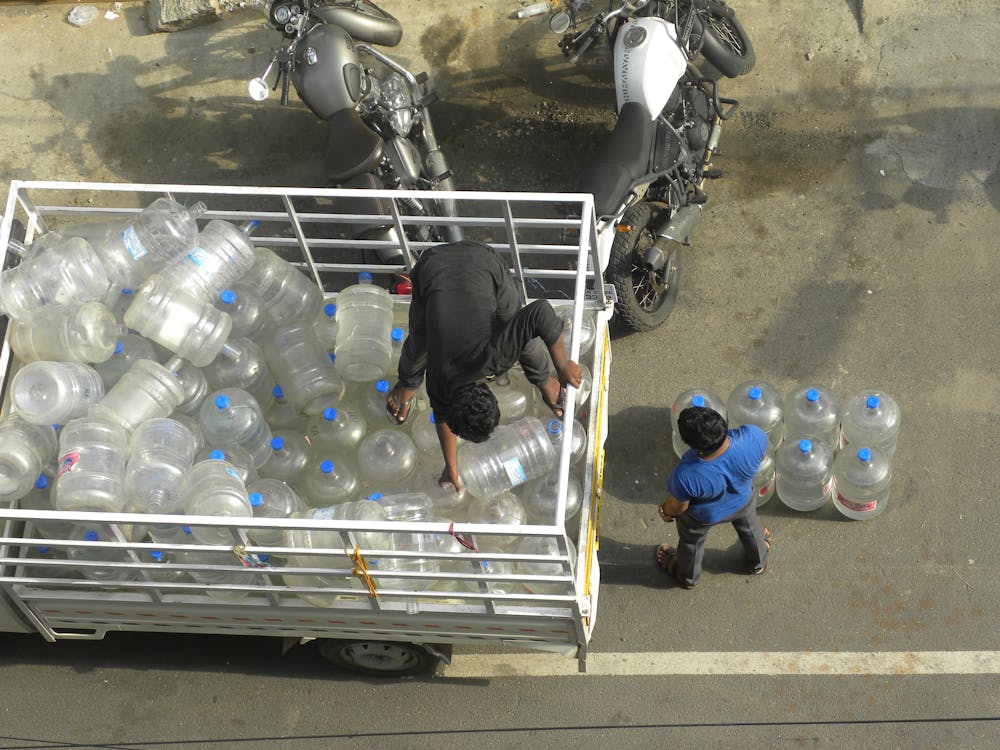 Men deliver water cans in Bangalore.
Shutterstock
Men deliver water cans in Bangalore.
Shutterstock
The more reputable brands cost as much as 70 INR, which is far beyond the reach of the poor. An average household of five members needs about three to five cans a week.
If a “can” delivery service refuses to deliver to households in one of these remote neighbourhoods, entrepreneurs arise to fill in the supply gap. Geetamma*, who runs a small eatery in one such neighbourhood, buys 20-litre cans in bulk and resells these to households with a small profit margin of 2 INR per can.
When municipally supplied or purchased tanker water is insufficient, households purchase water from private tankers. It is priced at 300-500 INR per tanker for 4,000-5,000 litres. Households collect the water in underground concrete tanks or in 200 litre plastic drums. In some neighbourhoods, residents collectively buy tanker water by pooling resources. The poorest migrants often resort to the collective option, or even to buying in smaller per-bucket quantities of 15 litres for 2 INR.
The range of ways that people access water in peri-urban Bangalore demonstrates that some transactions are formal, some are informal, and that others are a peculiar combination of both.
A huge cost
To secure water supplies from all these varied sources, people must spend a huge proportion of their income. A back-of-the-envelope calculation suggests that the monthly spend on water for a low-income household is between 5-8% of total income. Despite this relatively high rate of expenditure, such households are still far below the minimum target supply of 70 litres per person per day.
This limited water supply also comes at the cost of time. Based on our sampling of experiences in seven neighbourhoods of southeast Bangalore, adult women such as Manjula* typically spend between 3 and 5 hours a week working to secure water supplies – time that could be used to supplement household income.
Read more: What can other cities learn about water shortages from 'Day Zero'?
The water markets in Bangalore rely heavily on interpersonal relationships and collective action. These communities have so far been resilient and resourceful, but the formal and informal systems are in a delicate balance. One big supply-side shock can at any time distort this equilibrium.
Authors: Georgina Drew, Lecturer, University of Adelaide
Read more http://theconversation.com/the-informal-water-markets-of-bangalore-are-a-view-of-the-future-103684


















