

Google AI


Modern Australian

Think potholes on our roads are getting worse? You're right – and here's why

  • Written by: Marion Terrill, Transport and Cities Program Director, Grattan Institute
Think potholes on our roads are getting worse? You're right – and here's why

If you’re a driver, particularly in the country, you could be forgiven for thinking potholes have become a design feature of Australia’s local roads.

You would certainly know they are in a state of disrepair. And you have every reason to be fed up, because bad roads are dangerous, they increase your travel time, and they force you to spend more on fuel and on car maintenance.

They are getting worse because we’re not spending enough to maintain them.

Three-quarters of our roads are managed by local councils.

Every year, those councils spend A$1 billion less on maintenance than is needed to keep those roads in their current condition – let alone improve them.

The underspend is largest in regional and remote areas.

New Grattan Institute research finds the typical regional area has a funding shortfall of more 40%. In remote areas, it’s more than 75%.

Federal funding is falling behind

One reason for this underspend is that untied federal government grants to local councils haven’t kept pace with soaring costs.

Councils raise most of their own revenue – 80% on average. But in large parts of the country, there are a lot of roads and not enough ratepayers to pay for them.

Rural and remote councils have limited ability to raise more revenue from ratepayers. Their ratepayers already pay higher rates than those in cities, despite having lower average incomes.

Rate caps in place in New South Wales and Victoria also make it difficult for councils to raise more revenue.
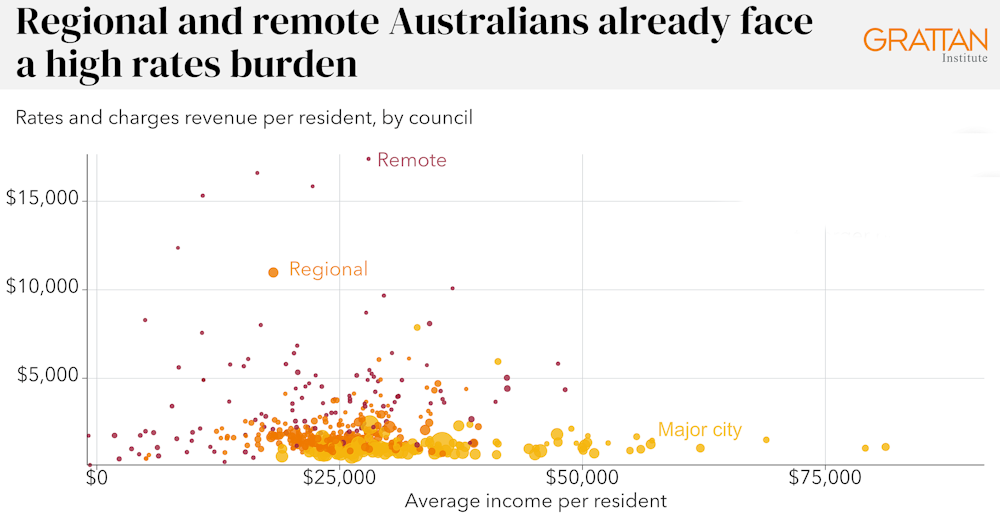
Larger dots represent councils with larger populations. Grattan Institute

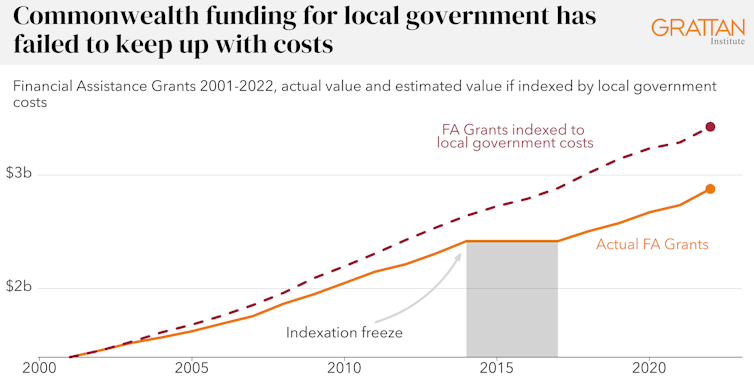
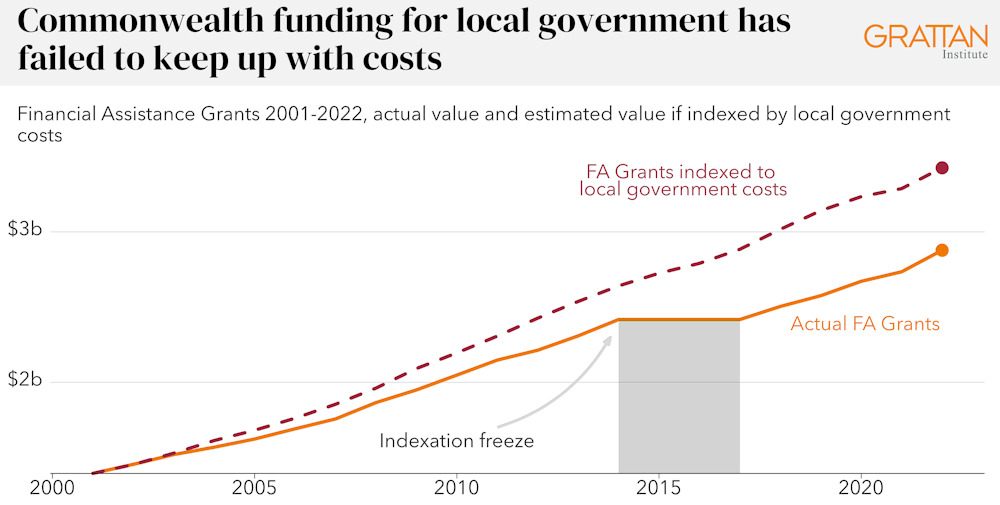
Councils receive top-up grants from the federal and state governments. The primary grants from the federal government, available for councils to spend as they see fit – including on roads – are called Financial Assistance Grants.

These are worth about $3 billion a year.

But their value has not kept pace with rising costs. If they had kept pace, on our estimates they would be 20% higher, at $3.6 billion per year.
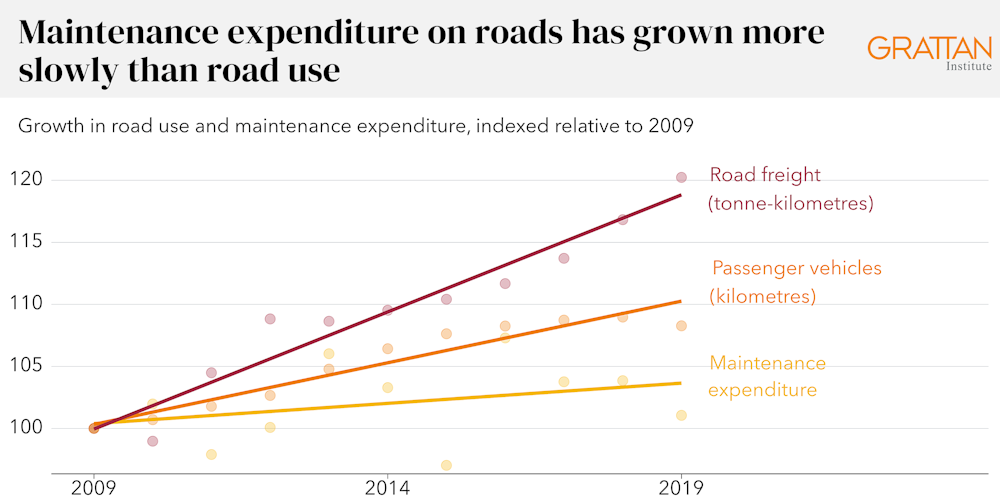
Grattan Institute, 2023 Road use is growing, but maintenance isn’t Another reason for the underspend is that even as funding dries up, we’re using roads more. A growing population means both more cars on our roads and more trucks needed to keep our shelves stocked. But despite the extra damage to our roads, spending on maintenance has stalled. Grattan Institute, 2023 Councils are spending more on other things Another reason roads are underfunded is that councils are coming under increasing pressure to fund other services. The legislation governing councils doesn’t clearly define what councils are responsible for, and there is no shortage of services communities want. Spending on transport has fallen from almost half of local government spending in the 1960s to 21% today. Environmental protection was only identified as its own area of spending for councils in 2018, but it now makes up 15% of all council spending. ABS Government Finance Statistics, Annual Delaying will cost us more If we don’t act now and start spending more to fix our roads, the pothole plague is going to spread. Australia is getting hotter, with more rain and floods. The Local Government Association expects the cost of repairing flood and rain-damaged roads in the eastern states and South Australia to top $3.8 billion. Tight budgets make it tempting to delay maintenance. But delaying will only end up costing more in the long run, leaving taxpayers paying more to fix more badly damaged roads. Read more: The government just killed 50 infrastructure projects – what matters is whether it will fund them on merit from now on Finally, a circuit-breaker Some might argue that now is not the time for more spending on roads, given pressures on the budget. But plenty is being spent on big roads and new roads. Infrastructure Minister Catherine King’s recent announcement of a funding boost of for local roads is a very welcome circuit-breaker. She announced the Roads to Recovery program will increase gradually from $500 million to $1 billion per year, the Black Spot program from $110 million to $150 million per year, and funding for an amalgamated Bridges Renewal and Heavy Vehicle Safety and Productivity program will climb form $150 million to $200 per year. This decision is important. Not only will councils receive more funding for maintenance, but it will be predictable funding, enabling better stewardship of long-lived assets. The money can’t start flowing soon enough. Authors: Marion Terrill, Transport and Cities Program Director, Grattan Institute
Read more https://theconversation.com/think-potholes-on-our-roads-are-getting-worse-youre-right-and-heres-why-217784

What to Do When an Older Car Is No Longer Worth Keeping in Melbourne

Ever looked at another repair quote and wondered whether your old car is still worth the trouble? It is a common turning point for Melbourne motoris...

Your Baby's First Year: A Local Guide to Feeding, Sleep, and When to Get Extra Support

Ask ten parents in a Brisbane mothers' group how their baby is feeding or sleeping, and expect ten different answers.  Someone's baby sleeps throug...

Kitchen and Laundry Makeover Ideas That Don't Require a Full Renovation

Full kitchen renos are expensive — and most people don't actually need one.  They need the kitchen to stop looking like it's stuck in 2009, or they...

How Technology Is Reshaping the Modern Australian Commercial Kitchen

The commercial kitchen has always been shaped by technology. Refrigeration changed how ingredients could be stored, modern ventilation transformed k...

The Number on a Roller Blind Fabric That Nobody Explains

Somewhere in the fabric book, next to the colour name, there is a percentage. Three per cent. Five per cent. Ten per cent. Nobody explains it, most c...

What’s Trending in Men’s Jewellery This Father’s Day!

Finding a Father’s Day gift that feels personal, stylish and genuinely wearable is not always easy. While socks and novelty mugs have traditionally ...

Road Signs: Understanding Their Role in Clear and Effective Signage

Effective signage and display hardware can help businesses communicate information, promote products and organise customer or visitor movement. Road...

Bottle Label Printing: Key Factors to Consider Before Your Next Packaging Run

Effective packaging begins with understanding the product, bottle material, artwork and production requirements when planning bottle label printing. H...

Planning a Long-Distance Move With Interstate Movers Melbourne

Moving between states involves more planning than a typical local relocation. Along with packing and transporting household belongings, you need to...

Understanding the Role of an I/O Controller in Industrial Automation

Modern industrial systems depend on accurate communication between sensors, machines and control systems. An I/O controller can help manage this commu...

How the Right Mining Hose Supports Demanding Operations

Mining environments place considerable demands on equipment used for material transfer, water management and processing. Hoses operating in these co...

Simple Ideas for Making Social Gatherings More Memorable

We have all been to those parties where everyone just stands around the kitchen island, staring at their phones, waiting for someone else to make a mo...

Outdoor Wall Lights: Improving Exterior Lighting Around Your Home

Lighting can influence how a room looks, feels and functions, so the right fitting should be selected according to both appearance and practical req...

Commercial Office Cleaning: Combining Routine Office Cleaning With Melbourne Service

Keeping a workplace clean requires a service that can accommodate everyday tasks as well as the particular needs of the business. Professional comme...

Caravan Sales in Queensland: How to Find the Right Caravan for Sale QLD

Caravan ownership is about more than having somewhere to sleep while travelling. For many Queenslanders, it is one of the best ways to explore regio...

What Sir Walter Buffalo Turf Actually Costs in 2026 (And Why Quotes Vary So Much)

Two quotes landed on a Hills District homeowner's kitchen table last spring for the exact same 80-square-metre backyard. One said $12 a metre. The o...

Nearly 1,300 NSW Hospital Beds Are Occupied By People Who Are Ready To Go Home

1,276 people in NSW hospitals have been medically cleared for discharge but remain in hospital because they're still waiting for NDIS or aged care sup...

National Survey Launched to Measure Operational Impacts of Federal NDIS Policy Reforms

The effects of recent NDIS reforms are beginning to move beyond policy papers and into day to day service delivery. A new national survey is asking ...
















