Farmers' climate denial begins to wane as reality bites
- Written by: Sarah Ann Wheeler, Professor in Water Economics, University of Adelaide
Australia has been described as the “front line of the battle for climate change adaptation”, and our farmers are the ones who have to lead the charge. Farmers will have to cope, among other pressures, with longer droughts, more erratic rainfall, higher temperatures, and changes to the timing of seasons.
Yet, puzzlingly enough to many commentators, climate denial has been widespread among farmers and in the ranks of the National Party, which purports to represent their interests.
Read more: The Nationals have changed their leader but kept the same climate story
Back in 2008, only one-third of farmers accepted the science of climate change. Our 2010-11 survey of 946 irrigators in the southern Murray-Darling Basin (published in 2013) found similar results: 32% accepted that climate change posed a risk to their region; half disagreed; and 18% did not know.
These numbers have consistently trailed behind the wider public, a clear majority of whom have consistently accepted the science. More Australians in 2018 accepted the reality of climate change than at almost any time, with 76% accepting climate change is occurring, 11% not believing in it and 13% being unsure.
Yet there are signs we may be on the brink of a wholesale shift in farmers’ attitudes towards climate change. For example, we have seen the creation of Young Carbon Farmers, Farmers for Climate Action, the first ever rally on climate change by farmers in Canberra, and national adverts by farmers on the need for climate action. Since 2016 the National Farmers Federation has strengthened its calls for action to reduce greenhouse emissions.
Our latest preliminary research results have also revealed evidence of this change. We surveyed 1,000 irrigators in 2015-16 in the southern Murray-Darling Basin, and found attitudes have shifted significantly since the 2010 survey.
Now, 43% of farmers accept climate change poses a risk to their region, compared with just 32% five years earlier. Those not accepting correspondingly fell to 36%, while the percentage who did not know slightly increased to 21%.
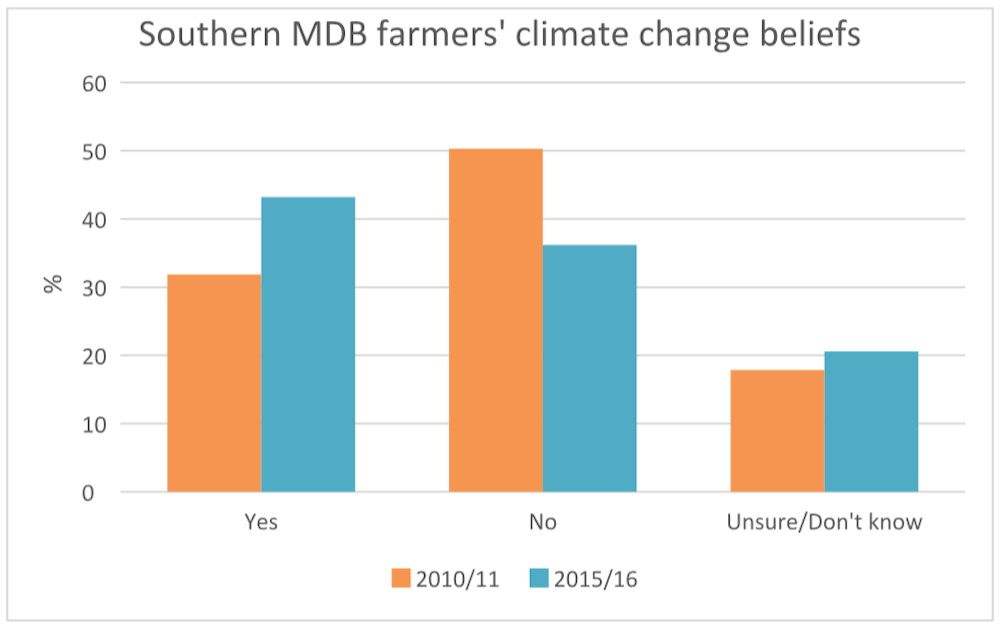 Farmers’ attitudes to climate change have shifted over the course of this decade.
Centre for Global Food and Resources, Author provided (No reuse)
Farmers’ attitudes to climate change have shifted over the course of this decade.
Centre for Global Food and Resources, Author provided (No reuse)
Why would farmers deny the science?
There are many factors that influence a person’s denial of climate change, with gender, race, education and age all playing a part. While this partly explains the attitudes that persist among farmers (who tend to be predominantly male, older, Caucasian, and have less formal education), it is not the full story.
The very fact that farmers are on the front line of climate change also drives their climate change denial. For a farmer, accepting the science means facing up to the prospect of a harsher, more uncertain future.
Yet as these changes move from future prospect to current reality, they can also have a galvanising effect. Our survey results suggest farmers who have seen their farm’s productivity decrease over time are more likely to accept the science of climate change.
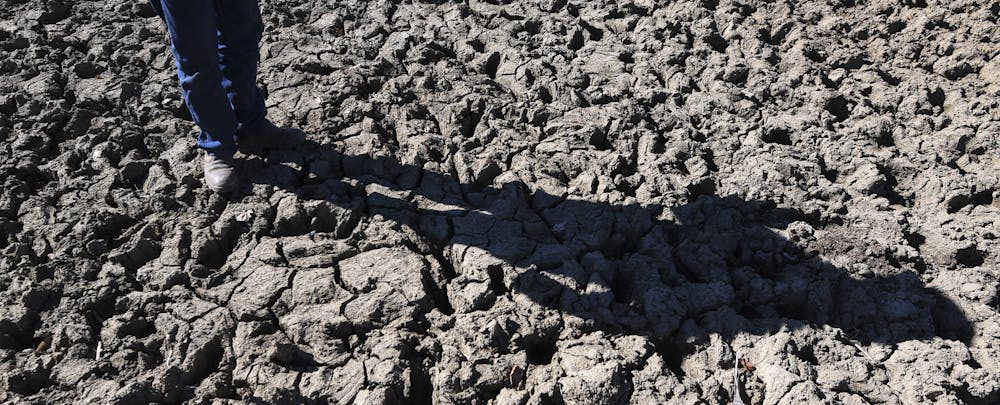 Doing it tough.
AAP Image/Lukas Coch
Doing it tough.
AAP Image/Lukas Coch
Many farmers who have turned to regenerative, organic or biodynamic agriculture talk about the change of mindset they went through as they realised they could no longer manage a drying landscape without major changes to their farming practices.
Read more: Farmers experiencing drought-related stress need targeted support
In addition, we have found another characteristic that is associated with climate change denial is whether farmers have identified a successor for their farm. Many farmers desire to turn their farm over to the next generation, hopefully in a better state than how they received the farm. This is where the psychological aspect of increased future uncertainty plays an important role – farmers don’t want to believe their children will face a worse future on the farm.
We all want our children to have better lives than our own, and for farmers in particular, accepting climate change makes that very challenging. But it can also prompt stronger advocacy for doing something about it before it’s too late.
What can we do?
Whether farmers do or do not accept climate change, they all have to deal with the uncertainty of weather – and indeed they have been doing so for a very long time. The question is, can we help them to do it better? Given the term “climate change” can be polarising, explicit climate information campaigns will not necessarily deliver the desired results.
Read more: To help drought-affected farmers, we need to support them in good times as well as bad
What farmers need are policies to help them manage risk and improve their decision-making. This can be done by focusing on how adaptation to weather variability can increase profitability and strengthen the farm’s long-term viability.
Farming policy should be more strategic and forward-thinking; subsidies should be removed for unsustainable practices; and farmers should be rewarded for good land management – both before and during droughts. The quest remains to minimise the pain suffered by all in times of drought.
Authors: Sarah Ann Wheeler, Professor in Water Economics, University of Adelaide
Read more http://theconversation.com/farmers-climate-denial-begins-to-wane-as-reality-bites-103906