You may not like reality TV but How 'Mad' Are You? rightly tests our assumptions about mental illness
- Written by: Fincina Hopgood, Lecturer in Screen Studies, University of New England
In recent years, Australia’s public broadcasters have been willing to program innovative, thought-provoking content to coincide with Mental Health Week. This year is no exception, with SBS taking a gamble on a new format in a two-part series How ‘Mad’ Are You?, which began last night.
The series is produced by Blackfella Films, which also made the factual series First Contact and Filthy, Rich and Homeless. Much like these shows, How ‘Mad’ Are You? adapts the reality TV format of “the social experiment” to examine a complex social issue.
Read more: Go back to where you came from: Reality TV encounters the refugee crisis
This format – in which a group of strangers is placed in shared living arrangements and assigned tasks by the producers to create unscripted drama – was pioneered by Big Brother and has become a familiar trope of reality TV, most commonly associated with the melodrama of The Bachelor or Survivor franchises.
How ‘Mad’ Are You? shows the compassion and support of a diverse group of people who have willingly participated in this social experiment to combat the stigma of complex mental health conditions such as schizophrenia, obsessive compulsive disorder, anorexia nervosa, clinical depression and bipolar disorder.
Perhaps most importantly, the series offers a platform for five people with a lived experience of these conditions to tell their stories.
Who is ‘mad’ anyway?
Using this reality TV format to explore mental illness – specifically its diagnosis and the social stigma that accompanies it – was bound to be provocative, as some early comments on social media indicate.
The series’ title alone is a provocation, but it also offers an invitation (How ‘Mad’ Are You?) to place ourselves in the shoes of the participants.
By using quote marks, the title actively questions the term “mad” and invites us to consider its shifting definition in different contexts. This also alerts us to the show’s intention, as declared by SBS, to “challenge assumptions about what it means to have a mental illness.”
Read more: Go back to where you came from: Reality TV encounters the refugee crisis
How ‘Mad’ Are You? highlights the importance of collaboration between the screen industry and the mental health sector. As part of the show’s mission to challenge the social stigma of mental illness, Blackfella Films consulted with SANE Australia for expert advice to ensure the series would be responsible, not exploitative, in its handling of this sensitive issue and the participants.
In keeping with the Mindframe guidelines for media portrayals of mental illness, the show’s broadcast on SBS will provide viewers with contact information for mental health support services.
Questioning the diagnosis
How ‘Mad’ Are You? is based on a two-part 2008 BBC Horizon/Discovery Channel Co-Production of the same title (minus the quotation marks).
The BBC program was inspired by the 1972 Rosenhan Experiment in which the American psychologist David Rosenhan and colleagues faked symptoms of mental illness to see if they would be admitted to psychiatric hospitals.
Read more: Hoax highlights the pitfalls and perils of open access publishing
The experiment raised questions about the validity of psychiatric diagnosis, and was part of a broader social movement in the 1970s that highlighted the social construction of mental illness.
The Australian production follows the BBC format closely: ten volunteers, five of whom have a history of a mental illness diagnosis, complete a series of tests and challenges, such as performing stand-up comedy or solving a complex puzzle.
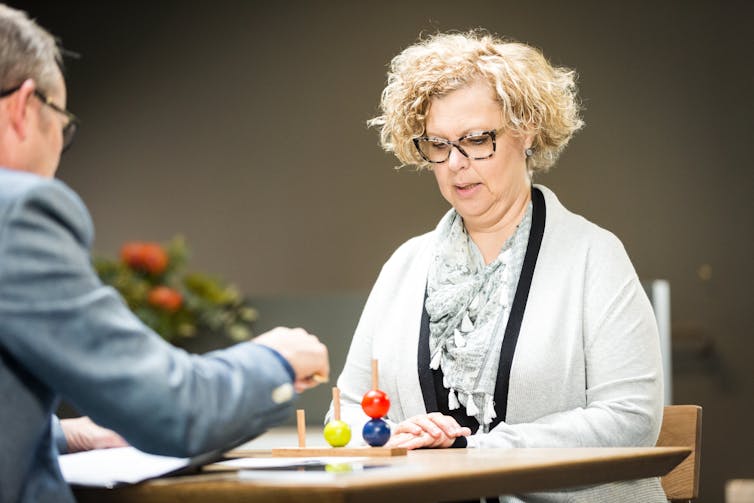 The participants undergo a range of tests to see how they function and perform.
SBS/Blackfella Films
The participants undergo a range of tests to see how they function and perform.
SBS/Blackfella Films
Their performance is observed by a panel of three mental health experts. After each test, the experts have to decide which of the five has a history of a mental illness diagnosis and what that diagnosis might be.
In the British version, the three experts included a psychiatrist, a professor of clinical psychology, and a psychiatric nurse. For the Australian version, the experts are Professor Jayashri Kulkarni, director of Australia’s largest psychiatry research centre; senior psychiatric nurse Jan Macintire; and clinical psychologist Professor Tim Carey.
The proverbial thin line between mental well-being and ill-health is visualised in How ‘Mad’ Are You? when the experts are asked to place photos of the participants on either side of a dividing line between mental health and illness.
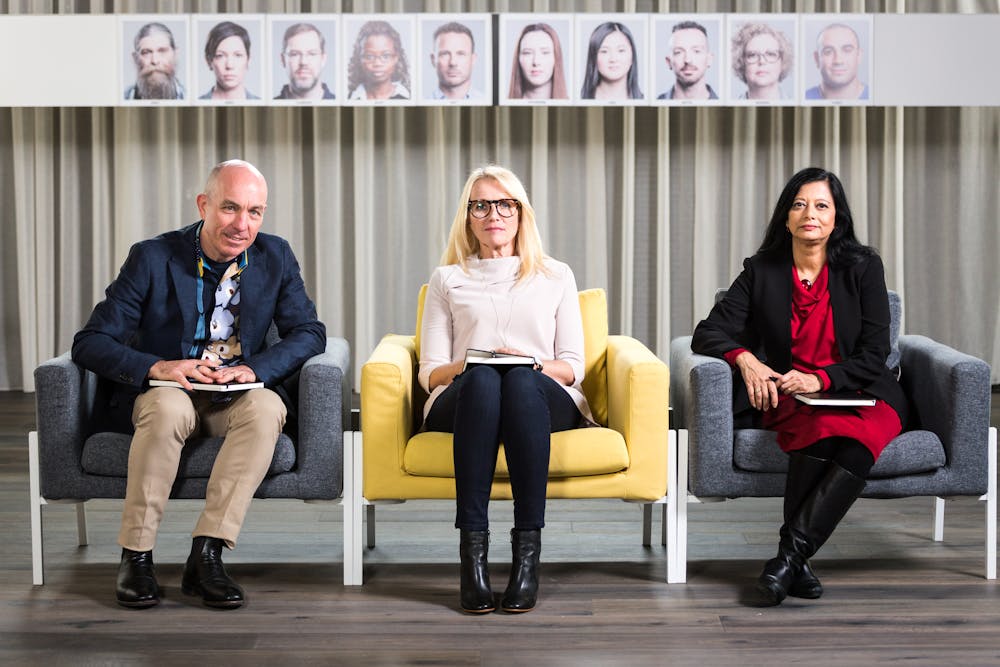 The expert mental health panel try to guess who has been diagnosed with a metal illness in the past – and what type – and who hasn’t.
SBS/Blackfella Films
The expert mental health panel try to guess who has been diagnosed with a metal illness in the past – and what type – and who hasn’t.
SBS/Blackfella Films
This is a crude device, but it serves as the catalyst for reflective conversation between the experts, who become increasingly exasperated with the demands of the task and the scanty evidence on which they have to base their conclusions. “This is not what we normally do!” protests Professor Kulkarni.
Read more: Mental illness on screen – a new world of hopes and aspirations
The task of diagnosing an individual’s mental health solely on the basis of their performance in a series of tests, with both participants and experts being filmed by a camera crew, is unquestionably an artificial abstraction of mental health practice.
But what this experiment reveals is how stereotyping and snap judgements based on appearance and other social cues influence our wider perceptions of mental ill-health. The three experts navigate this minefield with tact and critical self-awareness.
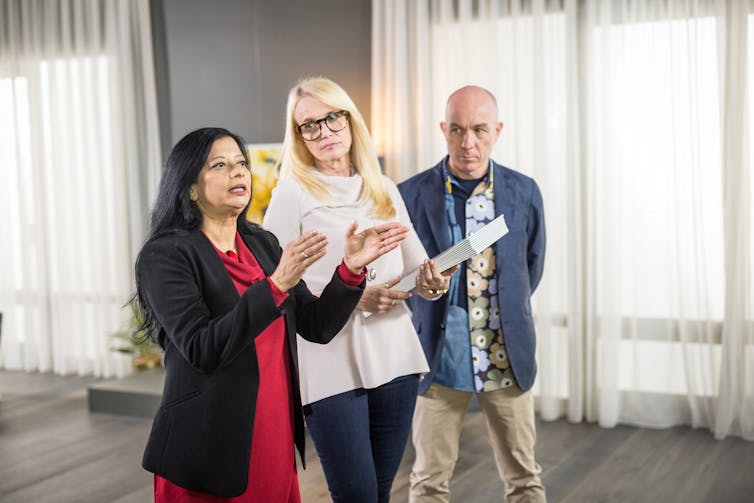 The panellists acknowledge the difficulties of trying to diagnose someone based on observation alone.
SBS/Blackfella Films
The panellists acknowledge the difficulties of trying to diagnose someone based on observation alone.
SBS/Blackfella Films
The series provides insight into the complex decision-making underpinning diagnosis and it is refreshing to see mental health experts willing to admit their uncertainty about the conclusions they are reaching. Their empathy and compassion for the people they have been asked to scrutinise is palpable.
Under the guise of “entertainment” through the reality TV format, How ‘Mad’ Are You? will certainly start conversations about the role of diagnosis in the lived experience of mental ill-health.
While some viewers may object to the show’s central concept, How ‘Mad’ Are You? offers a new way of telling stories about mental health on screen and brings all of us into the conversation.
How ‘Mad’ Are You? is available on SBS On Demand. Part two airs next Thursday October 18 at 8.30pm.
For help or information call Lifeline on 13 11 14 or visit beyondblue.org.au.
Authors: Fincina Hopgood, Lecturer in Screen Studies, University of New England