

Leek orchids are beautiful, endangered and we have no idea how to grow them
- Written by: Marc Freestone, PhD Candidate, Australian National University
Leek orchids don’t have many friends. Maybe it’s because they lack the drop-dead gorgeous looks of many of their fellow family members. Or perhaps it’s because they’re always the first to leave the party: as soon as sheep or weeds encroach on their territory, they’re out of there. Whatever the reason, you don’t see leek orchids around very often.
Read more: Secrets of the orchid mantis revealed – it doesn't mimic an orchid after all
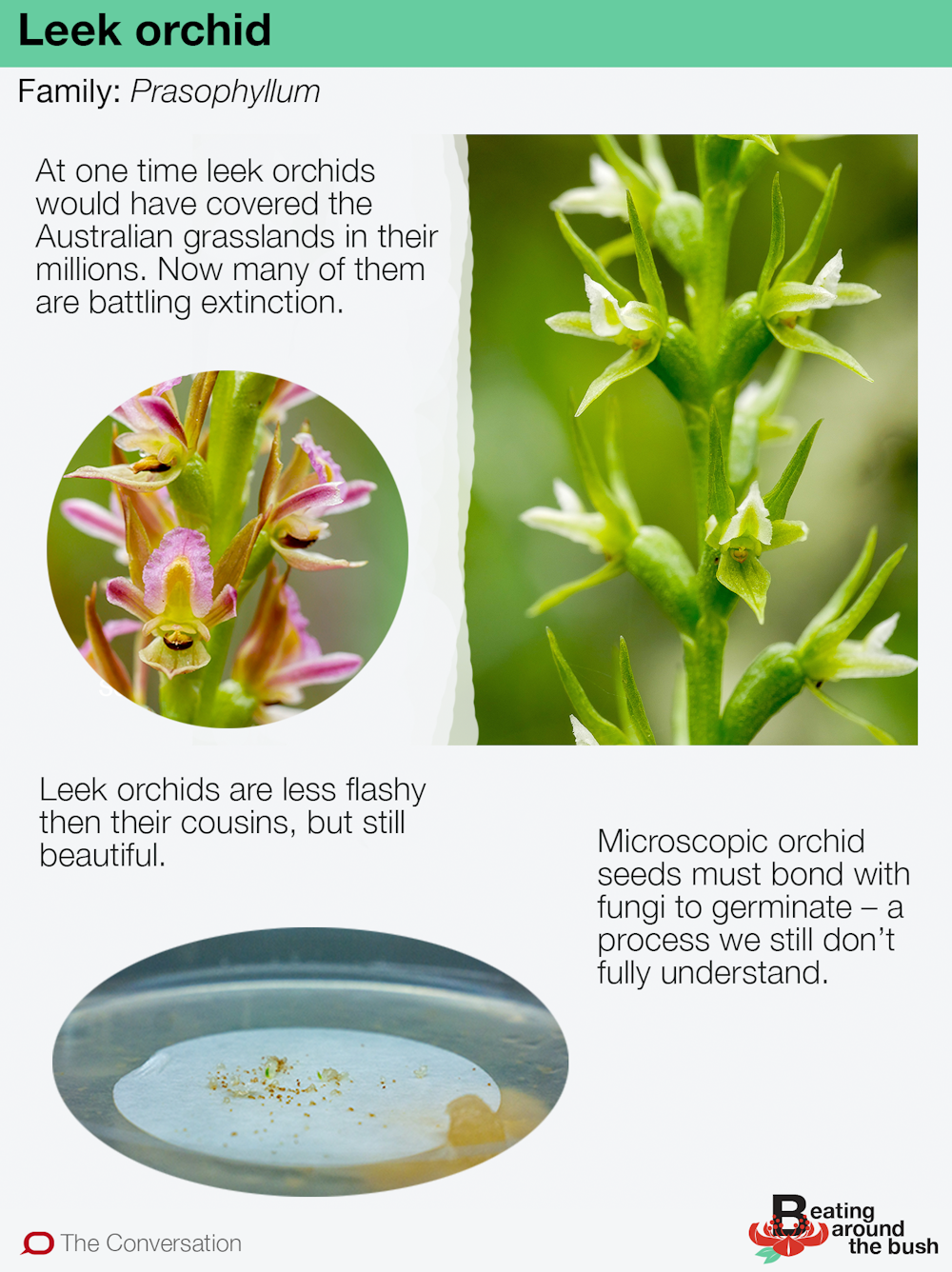
Leek orchids are small, ground-dwelling native Australian orchids, so called for their single spring-onion-like leaf, which shoots up from an underground tuber each autumn. In the spring, if there’s been enough rain, they produce a spike of small brown, green or white flowers.
Like many native orchids, they are battling extinction. My research involves trying to find the secret to propagating them – something we still don’t fully understand.
 Marc Freestone/The Conversation
Extinction
Australia is quite rich in orchids with more than 1,300 native species (by contrast, there are only about 200 species in all of North America). About 140 of these are leek orchids, and most live in bushland remnants across the south of Australia.
With a preference for fertile soils and relatively high rainfall, these little plants suffered severely during the period of agricultural expansion in the southeast of the country during the first half of last century. Rabbits, weeds, inappropriate fire regimes, and declining rainfall patterns continue to plague those that survive, which often hang on in narrow roadsides, beside rail lines or in rural cemeteries – tiny pockets of land that were never ploughed.
Read more:
Bunya pines are ancient, delicious and possibly deadly
Almost one-third of all leek orchid species are at risk of extinction. Some are already extinct, such as the Lilac Leek-orchid (Prasophyllum colemaniae). It once grew in Melbourne’s outer eastern suburbs, but disappeared when an upgrade of a rail line in the 1970s destroyed the last population. Standing half a metre tall, with fragrant purple-white flowers, it was said to be the most beautiful of all leek orchids.
Marc Freestone/The Conversation
Extinction
Australia is quite rich in orchids with more than 1,300 native species (by contrast, there are only about 200 species in all of North America). About 140 of these are leek orchids, and most live in bushland remnants across the south of Australia.
With a preference for fertile soils and relatively high rainfall, these little plants suffered severely during the period of agricultural expansion in the southeast of the country during the first half of last century. Rabbits, weeds, inappropriate fire regimes, and declining rainfall patterns continue to plague those that survive, which often hang on in narrow roadsides, beside rail lines or in rural cemeteries – tiny pockets of land that were never ploughed.
Read more:
Bunya pines are ancient, delicious and possibly deadly
Almost one-third of all leek orchid species are at risk of extinction. Some are already extinct, such as the Lilac Leek-orchid (Prasophyllum colemaniae). It once grew in Melbourne’s outer eastern suburbs, but disappeared when an upgrade of a rail line in the 1970s destroyed the last population. Standing half a metre tall, with fragrant purple-white flowers, it was said to be the most beautiful of all leek orchids.
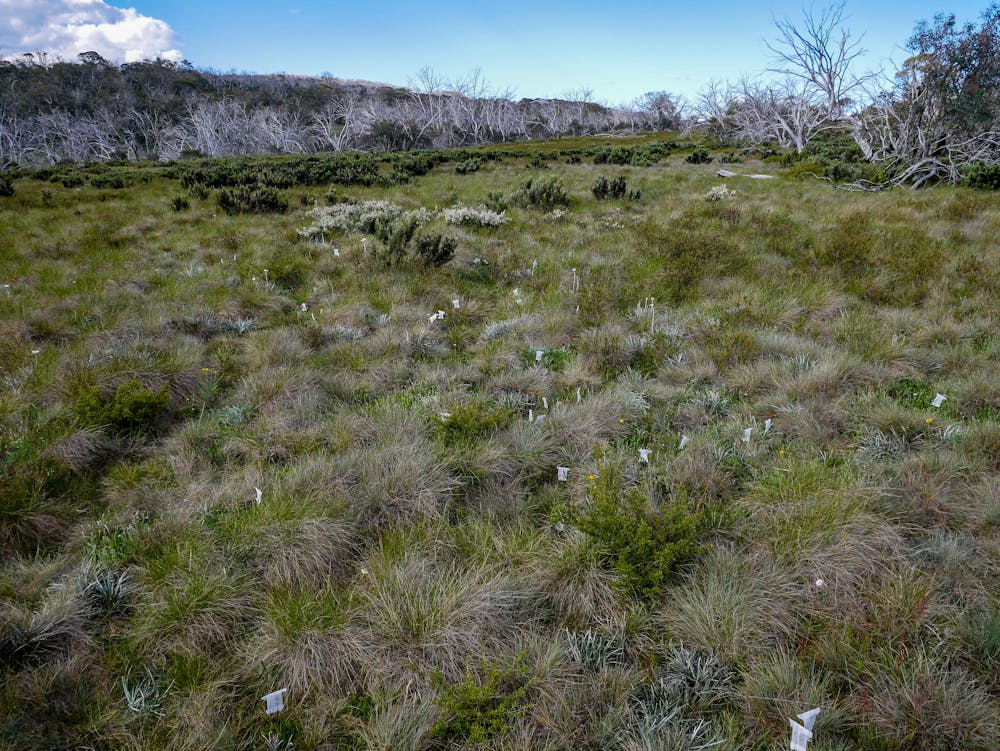 Collecting seed in the Alpine region.
Marc Freestone
Native orchids are rebounding – but not leek orchids
Fast forward to 2018 and things have changed. The Royal Botanic Gardens Victoria now hosts the largest orchid conservation program in the world. Dozens of critically endangered native orchids from the southeast mainland are being brought back from the brink of extinction through propagation and reintroduction programs.
But not leek orchids.
That’s because we still don’t know how to grow leek orchids successfully. In fact, growing any type of orchid is hard work. For a start, orchid seed is microscopic. It is so small it doesn’t contain any food for the germinating orchid seedling.
Instead, all orchids rely on symbiotic fungi that live in their roots and the surrounding soil and are required to inoculate the orchid seed – the fungus literally pumps food into the seeds to get them to germinate. We have no idea why these fungi do this, but we can replicate this scenario in the lab by carefully extracting fungi from the roots of a wild orchid plant, growing the fungi in a petri dish, and sprinkling in the orchid seed. But for some reason, leek orchid seed rarely germinates, and if it does, the young seedlings usually brown off and die.
Collecting seed in the Alpine region.
Marc Freestone
Native orchids are rebounding – but not leek orchids
Fast forward to 2018 and things have changed. The Royal Botanic Gardens Victoria now hosts the largest orchid conservation program in the world. Dozens of critically endangered native orchids from the southeast mainland are being brought back from the brink of extinction through propagation and reintroduction programs.
But not leek orchids.
That’s because we still don’t know how to grow leek orchids successfully. In fact, growing any type of orchid is hard work. For a start, orchid seed is microscopic. It is so small it doesn’t contain any food for the germinating orchid seedling.
Instead, all orchids rely on symbiotic fungi that live in their roots and the surrounding soil and are required to inoculate the orchid seed – the fungus literally pumps food into the seeds to get them to germinate. We have no idea why these fungi do this, but we can replicate this scenario in the lab by carefully extracting fungi from the roots of a wild orchid plant, growing the fungi in a petri dish, and sprinkling in the orchid seed. But for some reason, leek orchid seed rarely germinates, and if it does, the young seedlings usually brown off and die.
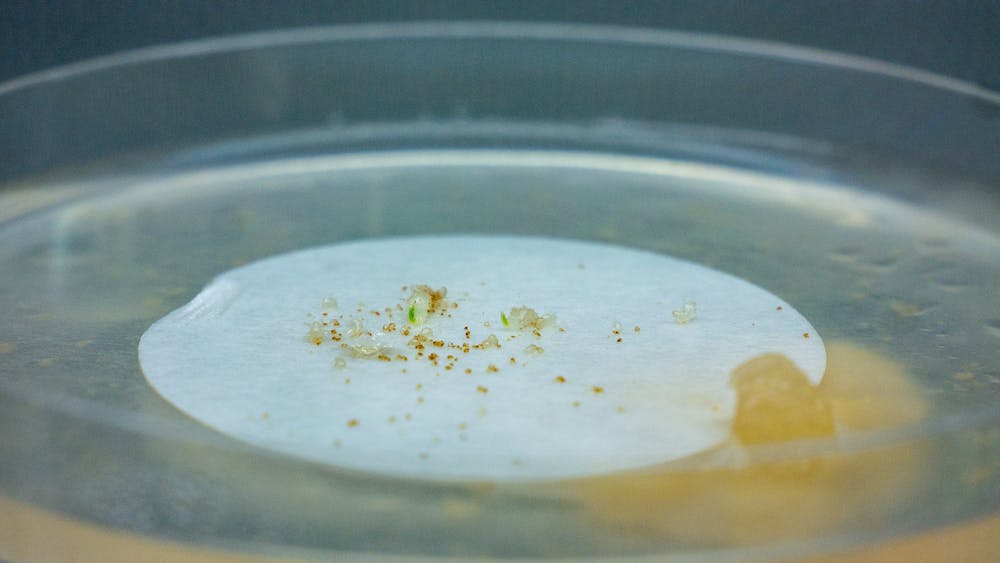 Three month old baby leek orchid seedlings. Of the few seeds that germinate, most won’t survive past this point.
Marc Freestone
How to grow leek orchids is the subject of my PhD project with the Australian National University, based at the Royal Botanic Gardens Victoria. We have many theories about what might be going on and we’re looking at seed viability, growing conditions, and the relationship between leek orchids and their symbiotic fungi.
It’s a race against time to work out how to grow them before more species – like the Shelford Leek-orchid (Prasophyllum fosteri) from western Victoria, which is now down to only a handful of wild plants – go extinct.
Why should we care?
At first glance, leek orchids do not appear to be particularly useful for anything. They can’t cure cancer or be traded for Bitcoin. So who cares if they go extinct?
Three month old baby leek orchid seedlings. Of the few seeds that germinate, most won’t survive past this point.
Marc Freestone
How to grow leek orchids is the subject of my PhD project with the Australian National University, based at the Royal Botanic Gardens Victoria. We have many theories about what might be going on and we’re looking at seed viability, growing conditions, and the relationship between leek orchids and their symbiotic fungi.
It’s a race against time to work out how to grow them before more species – like the Shelford Leek-orchid (Prasophyllum fosteri) from western Victoria, which is now down to only a handful of wild plants – go extinct.
Why should we care?
At first glance, leek orchids do not appear to be particularly useful for anything. They can’t cure cancer or be traded for Bitcoin. So who cares if they go extinct?
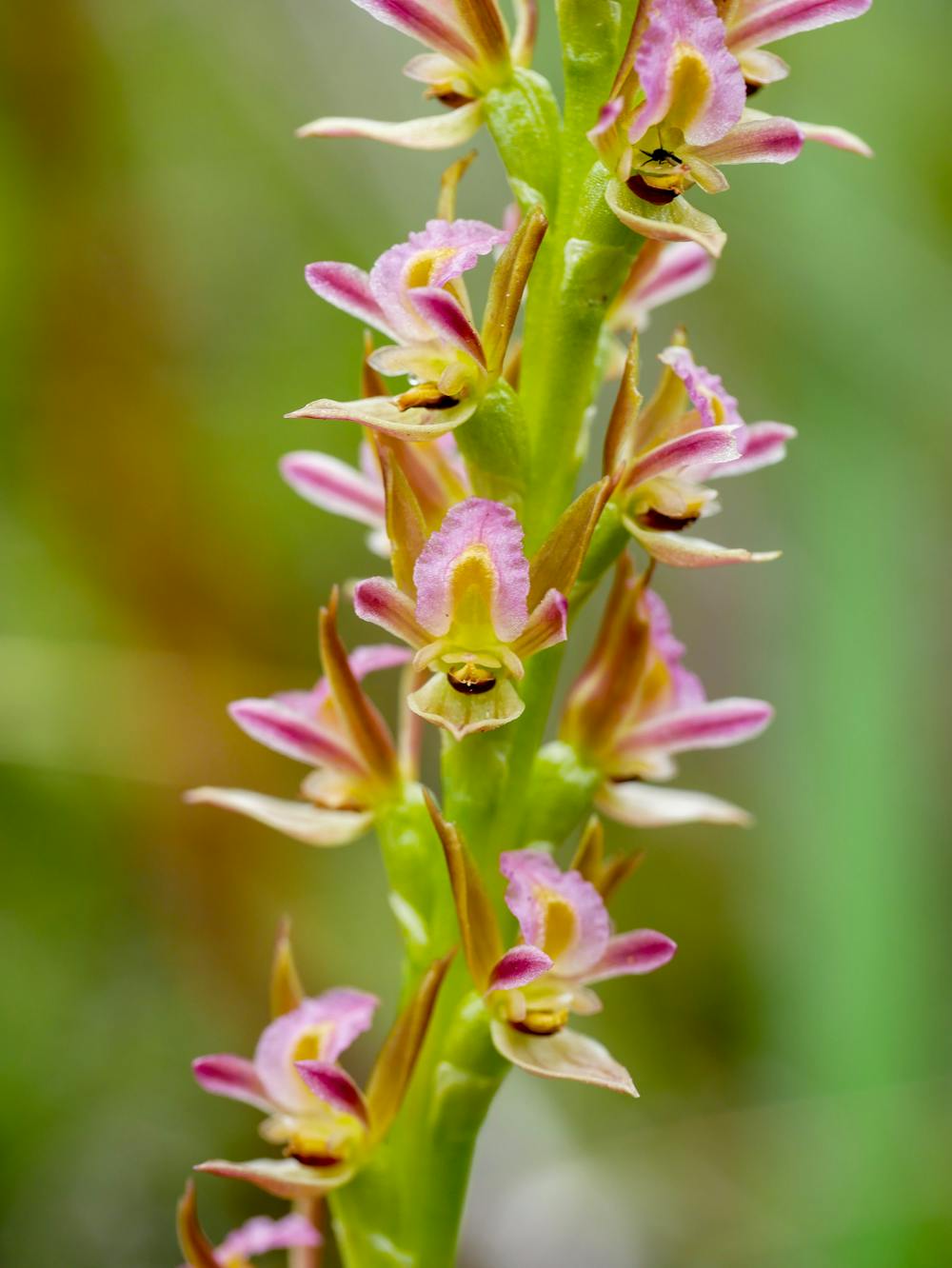 There are only a few hundred coast leek orchids remaining.
Marc Freestone
Well, the first point is we don’t know enough about leek orchids to be able to conclude that they are indeed completely useless to the human race. Second, leek orchids probably used to play an important ecosystem role in the lowland grasslands of southeastern Australia.
Up in the Australian Alps there are several species of leek orchid that are still very common, their flowers providing an important food source for insects. Seeing the massed flowering of the Alpine Leek-orchid (Prasophyllum tadgellianum) in summer really gives you a feel for what the lowland grasslands would have been like once upon a time, when species like the Gaping Leek-orchid (Prasophyllum correctum) would have numbered in the millions. Now there are perhaps 10 plants left.
If it goes extinct, Australia will have lost part of what makes it unique. A small part, perhaps, but when added to all the other threatened species in this country, a significant part.
Read more:
'The worst kind of pain you can imagine' – what it's like to be stung by a stinging tree
Personally, I find leek orchids delicate and utterly defenceless against humans, who have engulfed their world. Ironically, some species are now totally dependent on us for their survival. I feel a great sense of responsibility to help them.
There are only a few hundred coast leek orchids remaining.
Marc Freestone
Well, the first point is we don’t know enough about leek orchids to be able to conclude that they are indeed completely useless to the human race. Second, leek orchids probably used to play an important ecosystem role in the lowland grasslands of southeastern Australia.
Up in the Australian Alps there are several species of leek orchid that are still very common, their flowers providing an important food source for insects. Seeing the massed flowering of the Alpine Leek-orchid (Prasophyllum tadgellianum) in summer really gives you a feel for what the lowland grasslands would have been like once upon a time, when species like the Gaping Leek-orchid (Prasophyllum correctum) would have numbered in the millions. Now there are perhaps 10 plants left.
If it goes extinct, Australia will have lost part of what makes it unique. A small part, perhaps, but when added to all the other threatened species in this country, a significant part.
Read more:
'The worst kind of pain you can imagine' – what it's like to be stung by a stinging tree
Personally, I find leek orchids delicate and utterly defenceless against humans, who have engulfed their world. Ironically, some species are now totally dependent on us for their survival. I feel a great sense of responsibility to help them.
 Sign up to Beating Around the Bush, a series that profiles native plants: part gardening column, part dispatches from country, entirely Australian.
Authors: Marc Freestone, PhD Candidate, Australian National University


















