Everybody has a spider story, but these amazing creatures are often misunderstood
- Written by Andrew Walker, Postdoctoral Research Fellow, Institute for Molecular Bioscience, The University of Queensland
The comedian Jimeoin once wrote a song titled Everybody’s Got a Spider Story (I believe; I can’t find it on YouTube now I am looking), in which each verse tells some alarming story of giant spiders crawling on faces or millions of baby spiders bursting out of someplace unexpected.
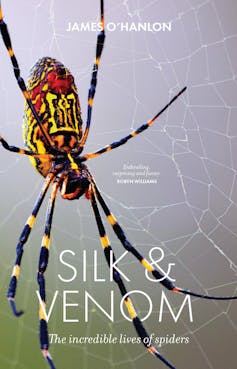
Review: Silk and Venom: The Incredible Lives of Spiders – James O'Hanlon (NewSouth)
James O'Hanlon’s Silk and Venom: The Incredible Lives of Spiders is, at heart, a call for us to start telling better spider stories – stories that celebrate the incredible biology of these creatures, rather than focusing on the surprise, terror and disgust they evoke in some people.
The book begins with an exploration of humankind’s negative feelings towards spiders, before examining a series of fascinating examples of spider biology, following the theory that to remove fear you must supply knowledge.
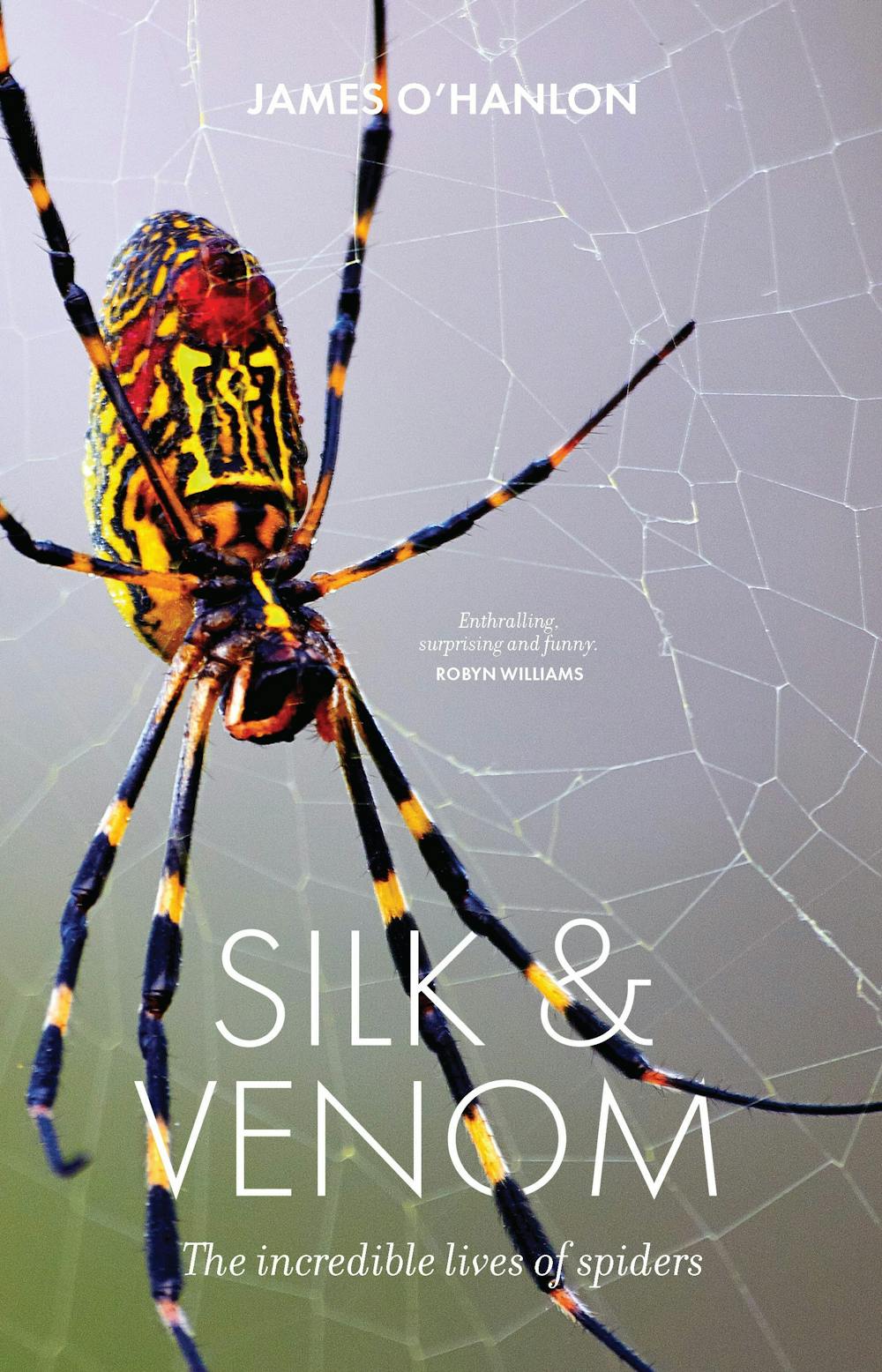
 Myrmarachne smaragdina, or ‘ant-mimicking spider’.
Stuart Harris, courtesy NewSouth.
It’s the examination of some of the more confusing findings about spiders, which would have been easy to ignore for the sake of simplicity, that I really like in this book.
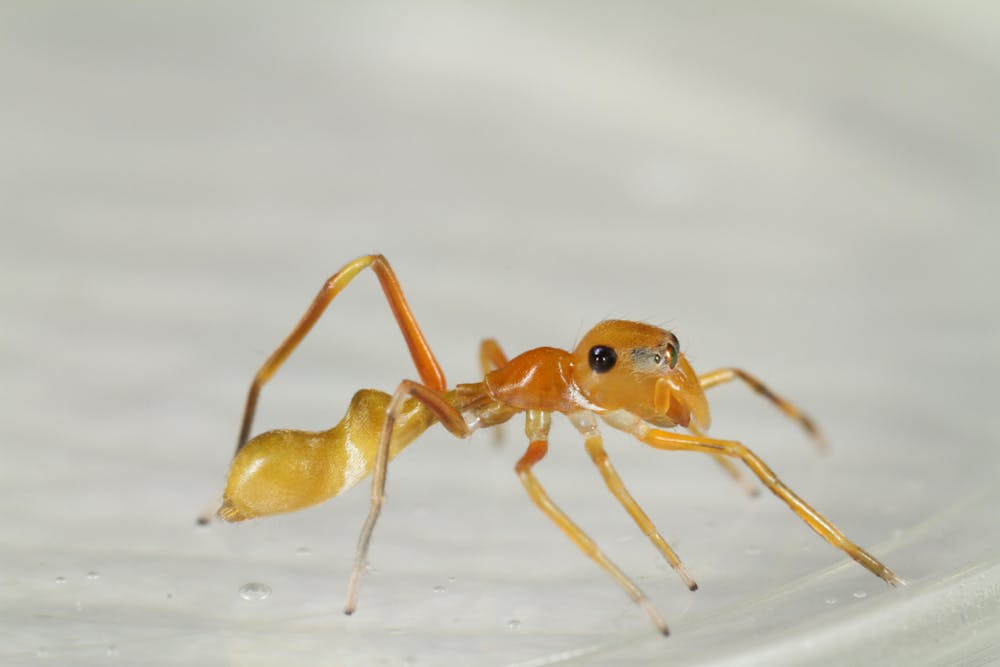
For example, crab spiders are an oft-cited example of perfect camouflage. They appear to blend in perfectly with the flowers on which they wait to ambush bees. However, we learn that crab spiders are not perfectly camouflaged to their bee prey. Bees see in ultraviolet, so we would expect crab spiders to be camouflaged in this visual range too, but the spiders actually show up brilliantly in the ultraviolet.
This turns out to be a kind of visual luring. The bees are more attracted to flowers with spiders than flowers without spiders. A similar process of luring seems to occur with spiders occupying orb webs, and web-markings, such as the X-patterns of the St. Andrews Cross Spider.
Myrmarachne smaragdina, or ‘ant-mimicking spider’.
Stuart Harris, courtesy NewSouth.
It’s the examination of some of the more confusing findings about spiders, which would have been easy to ignore for the sake of simplicity, that I really like in this book.
For example, crab spiders are an oft-cited example of perfect camouflage. They appear to blend in perfectly with the flowers on which they wait to ambush bees. However, we learn that crab spiders are not perfectly camouflaged to their bee prey. Bees see in ultraviolet, so we would expect crab spiders to be camouflaged in this visual range too, but the spiders actually show up brilliantly in the ultraviolet.
This turns out to be a kind of visual luring. The bees are more attracted to flowers with spiders than flowers without spiders. A similar process of luring seems to occur with spiders occupying orb webs, and web-markings, such as the X-patterns of the St. Andrews Cross Spider.
 Crab spiders conceal themselves in flowers and prey on bees.
James O'Hanlon, courtesy NewSouth
The chapter about how spiders capture their prey is where the discussion really gets going. O'Hanlon does a good job of reducing the complexities of how venom works into something both true and readable. He deftly explains some of the other aspects of venom research.
Asking which is the “most venomous spider”, for example, is a question that doesn’t really make sense. This is because venom acts differently on each individual species of animal, including the prey and predators of the spider and others. The actual danger posed by spider venom also depends on how much venom is injected, how likely the spiders are to bite, and so on.
This part of the book deals with which spiders are actually dangerous for humans, going through the handful of species that do actually pose a medical risk. It also delves into the use of spider venom as a biotechnological tool in medicine and agriculture, showcasing some examples where clever humans have repurposed molecules from venom to improve human health or agriculture.
We learn about attempts to use molecules from venom to battle facial tumour disease in Tasmanian devils, and how spider venom toxins are being repurposed into eco-friendly insecticides. This is actually a big field and there are many more examples that could have been included here, but what is included is dealt with well.
Read more:
Don't like spiders? Here are 10 reasons to change your mind
Myths and misconceptions
The myths and misconceptions around spiders are explored, starting with some of the most well-known. No, white-tailed spider bites do not cause tissue necrosis. No, spiders are not accidentally eaten when you sleep.
This section progresses from examining almost-believable urban myths to looking at how the treatment of spiders in mainstream media is almost unbelievably bad.
Some of the better spider stories we could be telling are about silk, the truly amazing material made by many arthropods, which has perhaps been perfected by spiders.
Spiders make multiple types of silk, including the strongest kinds we know of. Via people who have arduously collected and woven spider silks by hand, we learn about another quest in biotechnology: to understand the genetic codes behind spider silk, so that we can transfer those genes into microbes (or even arrange for them to be expressed in goat milk) and produce artificial silk in the lab.
This has been attempted many times with varying degrees of success. Though we are still not wearing shirts made by expressing spider silk genes in bacteria, I enjoyed reading about the individuals and companies who have tried to bring these kinds of silks to market and how far they have got – which is not far, mostly because it is just not profitable.
Crab spiders conceal themselves in flowers and prey on bees.
James O'Hanlon, courtesy NewSouth
The chapter about how spiders capture their prey is where the discussion really gets going. O'Hanlon does a good job of reducing the complexities of how venom works into something both true and readable. He deftly explains some of the other aspects of venom research.
Asking which is the “most venomous spider”, for example, is a question that doesn’t really make sense. This is because venom acts differently on each individual species of animal, including the prey and predators of the spider and others. The actual danger posed by spider venom also depends on how much venom is injected, how likely the spiders are to bite, and so on.
This part of the book deals with which spiders are actually dangerous for humans, going through the handful of species that do actually pose a medical risk. It also delves into the use of spider venom as a biotechnological tool in medicine and agriculture, showcasing some examples where clever humans have repurposed molecules from venom to improve human health or agriculture.
We learn about attempts to use molecules from venom to battle facial tumour disease in Tasmanian devils, and how spider venom toxins are being repurposed into eco-friendly insecticides. This is actually a big field and there are many more examples that could have been included here, but what is included is dealt with well.
Read more:
Don't like spiders? Here are 10 reasons to change your mind
Myths and misconceptions
The myths and misconceptions around spiders are explored, starting with some of the most well-known. No, white-tailed spider bites do not cause tissue necrosis. No, spiders are not accidentally eaten when you sleep.
This section progresses from examining almost-believable urban myths to looking at how the treatment of spiders in mainstream media is almost unbelievably bad.
Some of the better spider stories we could be telling are about silk, the truly amazing material made by many arthropods, which has perhaps been perfected by spiders.
Spiders make multiple types of silk, including the strongest kinds we know of. Via people who have arduously collected and woven spider silks by hand, we learn about another quest in biotechnology: to understand the genetic codes behind spider silk, so that we can transfer those genes into microbes (or even arrange for them to be expressed in goat milk) and produce artificial silk in the lab.
This has been attempted many times with varying degrees of success. Though we are still not wearing shirts made by expressing spider silk genes in bacteria, I enjoyed reading about the individuals and companies who have tried to bring these kinds of silks to market and how far they have got – which is not far, mostly because it is just not profitable.
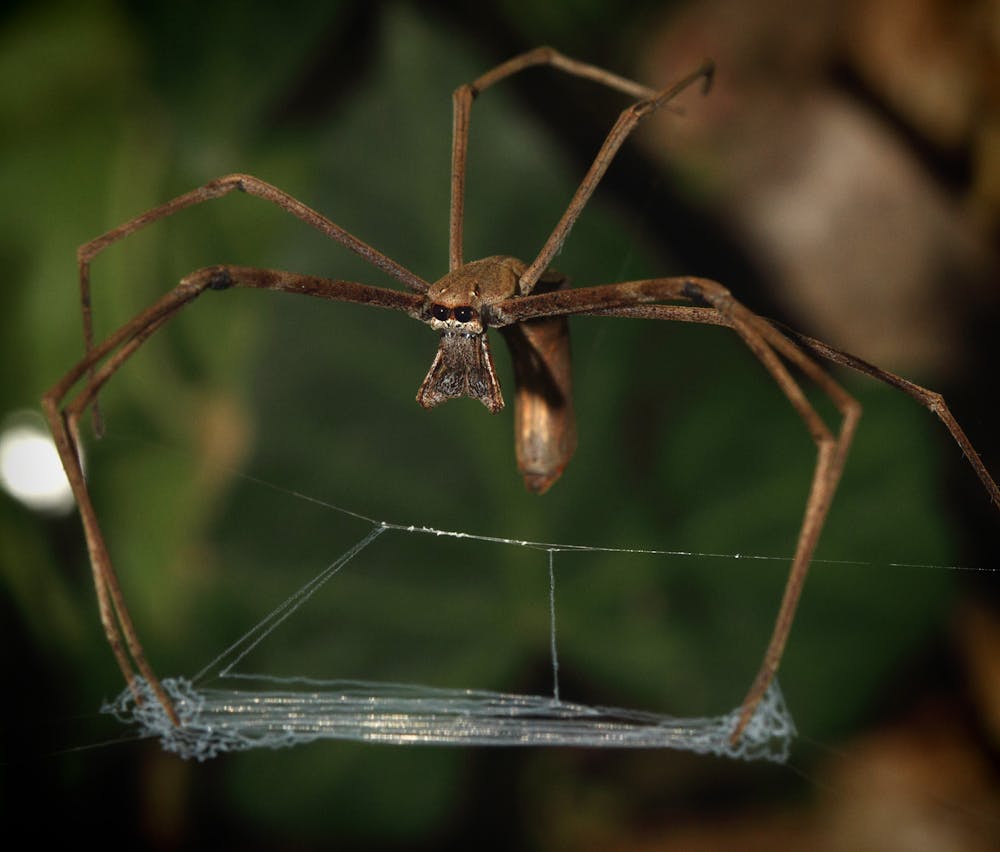 Deinopis or ‘web casting spider’.
Jim McClean, courtesy NewSouth.
Sex and death are topics close to our hearts and O'Hanlon has an amusing chapter that considers spider reproduction and life cycles. He starts by looking at the recent discovery of spiders that lactate to feed their spiderlings, thereby possessing the feature we use to define our own order, the mammals.
The best parts of this chapter are about spider sex and sexual cannibalism, and the many quirks that evolution has delivered, including strategies some males use to avoid being eaten by their partners, and examples of those that seem to offer themselves willingly.
We also learn about spider death and the longest-living spiders. There is very little information about how long spiders live, but did you know that Tasmanian cave spiders can live for 20 years? Or that the oldest tarantula we know of (called #16 instead of something sensible like Methuselah) lived for at least 43 years?
My favourite part of Silk and Venom considers spider ballooning: the phenomenon of airborne spiders, with attached silk, floating or flying to new places. I had not come across the research O'Hanlon presents here, which makes quite a convincing argument that spiders are quasi-magical creatures that can fly.
Spider ballooning, it turns out, does not rely on a good breeze, as I had always imagined. Apparently, it relies primarily on electrostatic forces. The clever spiders can sense electromagnetic fields and tell when conditions are perfect to release a negatively-charged silk web that will be repelled by the ground and attracted to the air.
In experiments in the lab, given the right electrostatic environment, spiders can take off in a completely windless chamber.
Deinopis or ‘web casting spider’.
Jim McClean, courtesy NewSouth.
Sex and death are topics close to our hearts and O'Hanlon has an amusing chapter that considers spider reproduction and life cycles. He starts by looking at the recent discovery of spiders that lactate to feed their spiderlings, thereby possessing the feature we use to define our own order, the mammals.
The best parts of this chapter are about spider sex and sexual cannibalism, and the many quirks that evolution has delivered, including strategies some males use to avoid being eaten by their partners, and examples of those that seem to offer themselves willingly.
We also learn about spider death and the longest-living spiders. There is very little information about how long spiders live, but did you know that Tasmanian cave spiders can live for 20 years? Or that the oldest tarantula we know of (called #16 instead of something sensible like Methuselah) lived for at least 43 years?
My favourite part of Silk and Venom considers spider ballooning: the phenomenon of airborne spiders, with attached silk, floating or flying to new places. I had not come across the research O'Hanlon presents here, which makes quite a convincing argument that spiders are quasi-magical creatures that can fly.
Spider ballooning, it turns out, does not rely on a good breeze, as I had always imagined. Apparently, it relies primarily on electrostatic forces. The clever spiders can sense electromagnetic fields and tell when conditions are perfect to release a negatively-charged silk web that will be repelled by the ground and attracted to the air.
In experiments in the lab, given the right electrostatic environment, spiders can take off in a completely windless chamber.
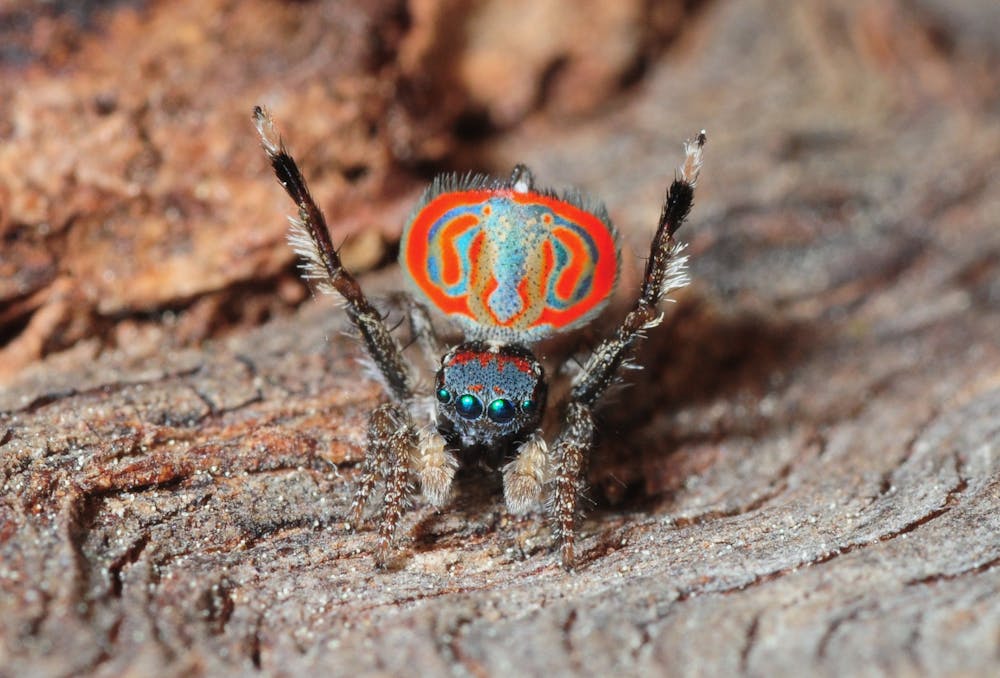 Maratus elephans has a distinctive elephant pattern on its abdomen.
James O'Hanlon, courtesy NewSouth.
Spiders flying is a perfect segue to spiders in space. O'Hanlon reviews this fascinating history. Since 1973, there have been five missions to put spiders in space, the first four focusing on orb-web spiders and web construction in micro-gravity.
The spiders took time to adjust, first spending much time “swimming through space”, before learning to make almost-normal webs. Webs of golden orb weavers are usually slightly asymmetric, with the spider sitting on top facing the ground. In space, they became more symmetric (since there was no down) and the spider was doing its best to act normal by facing away from the light source.
The last mission focused on jumping spiders hunting in space, with the spidernauts again showing a remarkable ability to adapt their understanding of the laws of motion and hunt successfully in micro-gravity.
Read more:
Here are 5 new species of Australian trapdoor spider. It took scientists a century to tell them apart
Better stories
Silk and Venom concludes with two chapters that look at arachnophobia, how it arises and how it can be treated. O'Hanlon expresses his hope for the future of human-spider interactions.
He emphasises reasons why our storytelling about spiders matters, drawing an analogy with the discovery of whales singing and the way the complexity of whalesong had a big effect on how people thought of whales and contributed to their eventual protection from commercial whaling. Conversely, the “Jaws effect” led to worsening perceptions of sharks and the danger they pose, and has contributed to the persecution of sharks.
Silk and Venom was easy and enjoyable to read. O'Hanlon has done a great job of exemplifying how we can tell better stories about our arachnid friends. As well as the main text, the book features a survey, a choose-your-own-adventure section in which you play a jumping spider, and a selection of colour photographs. If you would like to pick up some better spider stories, I suggest you give it a read.
Authors: Andrew Walker, Postdoctoral Research Fellow, Institute for Molecular Bioscience, The University of Queensland
Maratus elephans has a distinctive elephant pattern on its abdomen.
James O'Hanlon, courtesy NewSouth.
Spiders flying is a perfect segue to spiders in space. O'Hanlon reviews this fascinating history. Since 1973, there have been five missions to put spiders in space, the first four focusing on orb-web spiders and web construction in micro-gravity.
The spiders took time to adjust, first spending much time “swimming through space”, before learning to make almost-normal webs. Webs of golden orb weavers are usually slightly asymmetric, with the spider sitting on top facing the ground. In space, they became more symmetric (since there was no down) and the spider was doing its best to act normal by facing away from the light source.
The last mission focused on jumping spiders hunting in space, with the spidernauts again showing a remarkable ability to adapt their understanding of the laws of motion and hunt successfully in micro-gravity.
Read more:
Here are 5 new species of Australian trapdoor spider. It took scientists a century to tell them apart
Better stories
Silk and Venom concludes with two chapters that look at arachnophobia, how it arises and how it can be treated. O'Hanlon expresses his hope for the future of human-spider interactions.
He emphasises reasons why our storytelling about spiders matters, drawing an analogy with the discovery of whales singing and the way the complexity of whalesong had a big effect on how people thought of whales and contributed to their eventual protection from commercial whaling. Conversely, the “Jaws effect” led to worsening perceptions of sharks and the danger they pose, and has contributed to the persecution of sharks.
Silk and Venom was easy and enjoyable to read. O'Hanlon has done a great job of exemplifying how we can tell better stories about our arachnid friends. As well as the main text, the book features a survey, a choose-your-own-adventure section in which you play a jumping spider, and a selection of colour photographs. If you would like to pick up some better spider stories, I suggest you give it a read.
Authors: Andrew Walker, Postdoctoral Research Fellow, Institute for Molecular Bioscience, The University of Queensland