

Earth's frozen zones are in trouble – we're already seeing the consequences
- Written by Timothy Naish, Professor in Earth Sciences, Te Herenga Waka — Victoria University of Wellington
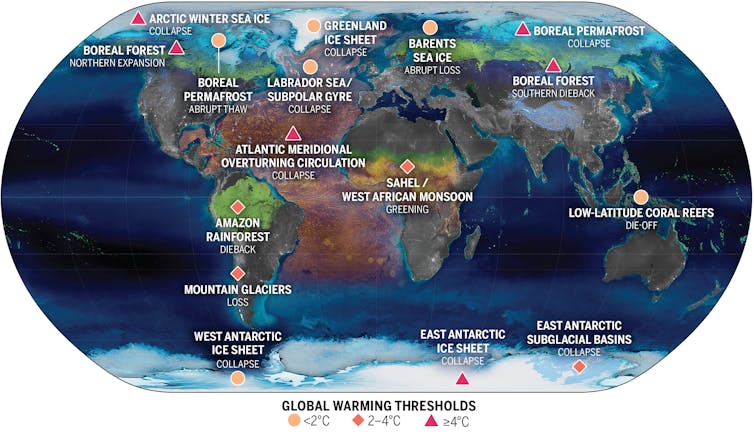
As this year’s UN climate summit (COP28) gets under way in Dubai, scientists studying Earth’s frozen regions have been delivering an urgent call for action to policy makers. But is anyone listening?
Throughout 2023, we have been warning of an impending series of crises occurring in the cryosphere – polar ice sheets, ice shelves, sea ice, mountain glaciers and permafrost.
The Scientific Committee on Antarctic Research (SCAR) released its decadal synopsis on the state of Antarctic climate change and ecosystems. It led the recent Antarctic Treaty meeting to issue the Helsinki Declaration to highlight that significant observed changes in Antarctica influence climate impacts globally.
The World Climate Research Programme (WCRP) has prepared the Kigali Declaration, summarising the latest climate science to highlight the urgency at COP28.
And this month, a State of the Cryosphere 2023 report assessing the most recent science warned that even 2°C of warming would trigger irreversible loss of ice sheets, glaciers, snow, sea ice and permafrost, with disastrous consequences for society and nature.
I have contributed to all three documents. Some of the most dramatic changes are occurring in Antarctica and the Southern Ocean, including extreme heatwaves, record lows in sea ice and the emergence of an amplified warming pattern across the entire Antarctic continent.
These changes are melting Antarctica’s ice sheet and delivering vast quantities of freshwater to the ocean. This in turn drives an accelerating rise in shorelines around the world.
Polar warming is also contributing to drought and wildfires in Australia, floods in New Zealand and extreme weather at every latitude.
Breaching planetary thresholds
In July this year, average monthly global temperatures breached 1.5°C above pre-industrial levels for the first time. With a large El Niño event underway in the Pacific, 2023 is virtually certain to be the hottest year on record.
The World Meteorological Organisation predicts the world is on track to exceed the Paris target to keep warming below 2°C within the next five years, on an annual basis.
Scientific evidence is clear that due to the current trajectory of human-derived greenhouse gas emissions, the polar regions will continue to warm at rates of up to four times the global average.
This is because of self-reinforcing feedbacks, such as those related to retreating sea ice. The more sea ice melts, the more energy the darker ocean surface absorbs, in turn leading to more land ice melting and the potential crossing of tipping points linked to temperature thresholds close to 1.5-2°C of global warming.
There are two key planetary thresholds in the polar regions. Firstly, thawing permafrost in the Arctic has the potential for widespread release of methane and carbon dioxide into the atmosphere, further enhancing global heating.
Secondly, meltdown of up to two-thirds of Antarctica’s ice sheet may become irreversible, locking in multi-metre sea-level rise for generations to come even if the warming were to stop or reverse after peaking before 2100.
Dramatic consequences at all latitudes
The Southern Ocean has taken up most of the heat from global warming (70%). This excess energy will remain in the ocean for centuries and continue melting parts of the coastal fringes of Antarctica from underneath.
The amplified polar warming is accelerating the melting of ice sheets. They are now the largest contributors to rising global sea levels. But they respond slowly, trapping heat and releasing it over long timescales. Sea-level rise will therefore continue for centuries to come, even with net zero emissions.
Projections show substantial differences between low- and high-emissions scenarios, especially after 2050. A high-emissions scenario could result in multi-metre sea-level rise for coming centuries. This includes a “low likelihood, high impact” scenario in which two metres by 2100 cannot be ruled out due to rapid loss of Antarctica’s fringing ice shelves and consequent melting of the ice sheet.
The ice shelves currently stabilise the interior ice sheet and protect it from erosion by encroaching warming ocean waters. Evidence suggests the Paris climate target of limiting heating to 1.5-2C°C is a threshold for widespread ice shelf loss.
The loss of two-thirds of the world’s high mountain glaciers (often referred to as the third pole) is also likely. This will affect two billion people who depend on these frozen water stores for their drinking, power production, agriculture and related ecosystems services.
As glacial lakes fill up, more people will be exposed to hazards such as the recent glacial outburst flood and landslides in Sikkim in India’s northeast.
Intense high-latitude, low-pressure systems – “bomb cyclones” – are now bringing extreme temperatures and precipitation via atmospheric rivers to coastal regions and the interior of Antarctica and Greenland. These extremes cause unseasonal weather not only in polar regions, but also in lower latitudes, including New Zealand.
Changing icescapes
An unprecedented heat wave occurred over East Antarctica in March 2022, peaking at 39°C above the climatological average. It was the largest temperature anomaly ever recorded globally. A local ice shelf, which was in a vulnerable state, collapsed within days.
This demonstrates the potential of future heatwaves over the warmer, lower-elevation West Antarctic Ice Sheet to trigger surface melting and collapse of ice shelves.
During this year’s southern hemisphere winter, Antarctica’s sea ice cover reached a 40-year low. This followed the record low annual sea-ice minimum in early 2023, due to an unseasonably warm Southern Ocean and changed atmospheric circulation patterns that brought warm air south.
These unprecedented changes were well outside the range of natural variability. They coincide with new evidence from a study of ice cores that shows the emergence of an amplified surface-warming pattern over Antarctica.
Decision makers still hold the power
The latest report by the Intergovernmental Panel on Climate Change (IPCC) reinforces that “limiting warming well below 2°C involves rapid, deep and in most cases immediate greenhouse gas emissions reductions”.
However, it is now clearer than ever that policy is not responding at the pace and scale required to avert the impending nexus of global climate, ecological and environmental catastrophes.
Read more: Antarctica's heart of ice has skipped a beat. Time to take our medicine
Every nation’s emissions policy settings are insufficient to achieve the Paris target. New Zealand’s climate policies are assessed as “highly insufficient”, but the country is not alone. The global policy response remains grossly ineffective and has been that way since the IPCC’s first report in 1990.
But the report provides some hope through “multiple feasible and effective, sustainable and equitable options to reduce greenhouse gas emissions and adapt to human caused climate change”.
Scientists made this clear in a policy briefing on sea-level rise to the UN General Assembly, stating:
Ambitious mitigation in line with the Paris Agreement is critical to avoiding thresholds that would yield rapid and irreversible sea-level rise and to enabling successful adaptation.
Authors: Timothy Naish, Professor in Earth Sciences, Te Herenga Waka — Victoria University of Wellington

















