

Australian teenagers record steady results in international tests, but about half are not meeting proficiency standards
- Written by: Lisa De Bortoli, Senior Research Fellow, Australian Council for Educational Research
Australian high school students have achieved steady results in a new round of international tests.
The latest Programme for International Student Assessment (PISA) results, released on Tuesday night, show 15-year-olds have recorded similar results to 2015 and 2018 in mathematics, science and reading.
But when looked at over the past 20 years, Australian students’ performance has dropped significantly. PISA also shows about one in eight Australian students is a “high performer”, while one in every four or five is a “low performer”.
What is PISA?
PISA is an international test of 15-year-olds’ knowledge and skills as they near the end of compulsory education.
It looks at maths, science and reading. In 2022, for the first time, it also assessed creative thinking. The creative thinking results will be released in 2024.
Since 2000, PISA has been conducted every three years but the assessment planned for 2021 was postponed until 2022 because of COVID. About 690,000 students across 81 countries participated in the test. Almost 13,500 students from 743 schools did the test in Australia.
Students complete a computer-based test and a background questionnaire. In the test, students are presented with stimulus material, such as a brief text, sometimes accompanied by a table, graph or diagram, and a series of questions. Students have to select the correct response or provide a written response, ranging from a word or a number, to an explanation.
In the questionnaire, students are asked about their family background, school life and attitudes about learning.
Read more: Australia’s Year 4 students have not lost ground on reading, despite pandemic disruptions
Why is PISA important?
While other national and international assessments (such as NAPLAN) assess what students have learned in school, PISA assesses how students apply what they have learned to real-world situations.
It is also one of three international assessments in which Australia participates, along with the Progress in International Reading Literacy Study (PIRLS), which looks at Year 4 students’ reading comprehension skills, and Trends in International Mathematics and Science Study (TIMSS), which covers maths and science in Year 4 and Year 8.
How did Australia go?
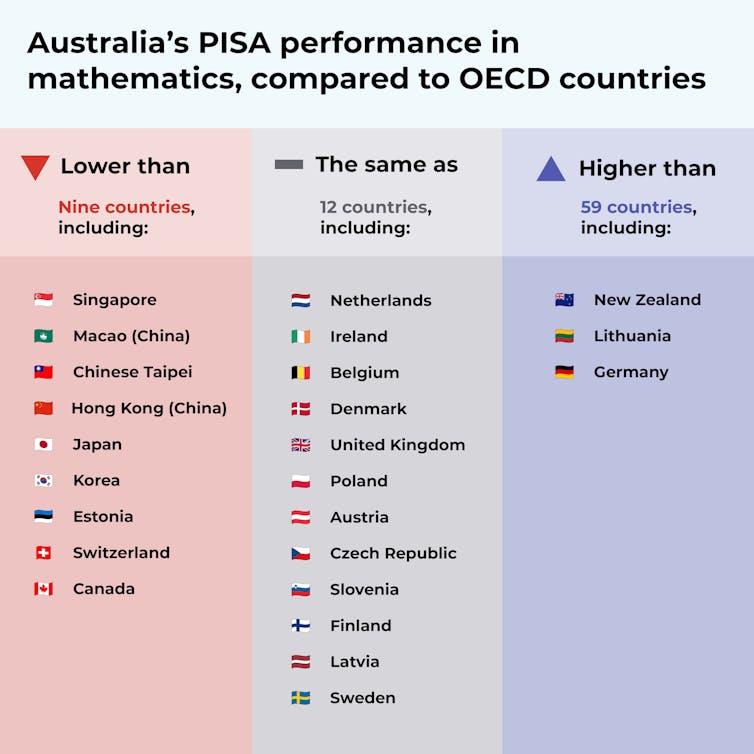
The PISA 2022 results show Australia was equal tenth in maths, and equal ninth in science and reading.
Australian students’ performance in maths and reading has not changed significantly over the past seven years, and their performance in science has not changed significantly over four years.
However, Australian students’ performance has declined significantly since PISA results were first reported. There has been a decrease of 37 points in maths, 20 points in science and 30 points in reading.
The test does not tell us the reasons for this drop. Other countries whose performance in maths, reading and science have also declined significantly include Canada, Finland, Greece, New Zealand and Sweden.
Other countries drop
Australia’s standing compared with other countries has improved since the last PISA test because the performance of other countries has declined.
In maths, 11 countries (Austria, Belgium, Czech Republic, Denmark, Finland, Ireland, the Netherlands, Poland, Slovenia, Sweden and the United Kingdom) that outperformed Australia in 2018 are now on par with Australia. We are now outperforming six countries that were on par with Australia in 2018 (France, Iceland, Italy, New Zealand, Portugal and the Slovak Republic).
In Australia, male students performed significantly higher in maths (with an average score of 493 compared to the female average of 481). Female students performed significantly higher in reading (with an average of 509 compared to the male average of 487). Male and female students performed at similar levels for science.
Students from higher socioeconomic backgrounds performed significantly higher than students from lower socioeconomic backgrounds and students in major cities performed significantly higher than students in regional or remote areas.
What about high and low performers?
About one in every eight Australian students is a “high performer” according to the test. This means they show high levels of skills and knowledge in reading, mathematics and science.
In reading and science, about one in every five of Australian students is a low performer, showing limited skills and knowledge in the relevant subject area, while in maths one in every four students is a low performer.
More than half of Australian students attained the (Australian-set) National Proficient Standard. This meet this, students must “demonstrate more than elementary skills expected at that year level”. In maths, 51% attained the proficient standard, 58% attained it for science and 57% for reading.
Between 2018 and 2022 there was no significant change in the proportion of students who attained the National Proficient Standard. But there has been a significant decline since PISA results were first reported. This includes a 16 percentage point drop in mathematics, nine percentage points in science and 12 percentage points in reading.
Next steps
While it is encouraging to see Australia’s results remain steady, we need to look at the bigger picture.
This includes a long-term decline in results and the reality that a significant proportion of students still aren’t meeting national standards.
Clearly, we are failing some of our 15-year-old students – because they lack basic literacy and numeracy skills and the ability to apply them to real-world situations.
To move forward, we need to ask how our education system can lift their performance. We also cannot forget our high performers – how can our education system support them to extend their learning further?
PISA not only provides us with an opportunity to compare how Australia’s education system fares against other countries. We can also to look at high-performing countries and learn how their curriculum and teaching practices could improve the education of young Australians on the cusp of adulthood.
Authors: Lisa De Bortoli, Senior Research Fellow, Australian Council for Educational Research


















