Australian homes can be made climate-ready, reducing bills and emissions – a new report shows how
- Written by Gill Armstrong, Researcher in architecture and urban planning, Climateworks Centre
Millions of homes were built before Australia introduced housing energy efficiency standards in 2003. They’re leaky. Gaps around windows, doors and between building materials allow air to move in and out. So people tend to compensate, with more heating and cooling. It’s costly and damaging for the environment.
Using a national sample of 102,000 Australian homes across all 69 climate zones, we identified the most common housing types. Then we worked out how to make them “climate ready” and what benefits would flow.
Our new report released today makes a strong case for a renovation wave across Australia.
By combining thermal upgrades with electrifying hot water and cooking appliances, households can shave up to $2,200 a year off their energy bills. And the nation will be closer to reaching net zero emissions by 2050.
Paying for poor performance
Australians are paying for low-performing homes through their energy bills, and the cost extends well beyond the kitchen table.
Low-performing homes draw more energy from the grid as heating and cooling systems work in overdrive to keep indoor temperatures safe or even comfortable.
Home interiors often look stylish, which contributes to making us feel comfortable. But there’s more to it than that.
A home’s performance, and its energy bills, comes down to just a few appliances. That is, those used to heat the hot water, and to heat or cool individual rooms.
In summer, air conditioners need to run for long periods if the ceilings, floors, walls and windows cannot stop the cool from escaping or the Sun’s heat from building up inside.
Multiply poor energy performance across Australia’s housing stock of nearly 11 million homes, and you start to see the scale of inefficiency before us.
We clearly need to improve the energy performance of all low-performing homes.
What’s the solution?
To reach net zero emissions by 2050 or earlier, all sectors of the economy need to rapidly cut emissions. According to the latest Climateworks Centre modelling, decarbonising buildings – responsible for 10% of national emissions – is vital if Australia is to uphold its commitments under the Paris Agreement.
In 2050, most Australians will be living in homes that already exist today, making renovations an essential part of achieving net zero.
We worked together for more than a year to understand Australia’s residential building stock, how these homes perform and what it would take to get them to a zero-carbon standard.
With 69 separate climate zones and millions of homes, Australia’s housing profile looks different depending on the city or town you live in. Townhouses in Brisbane, freestanding houses in Darwin and apartments in Perth can all be made climate-ready, but they can get there in very different ways.
We analysed data from 102,000 homes, examining floor, wall and building materials that are key to energy performance. We found just 16 types of homes make up most Australian housing stock.
The most common “archetypes” can be turned into net zero carbon homes with either a quick fix, modest or full climate-ready upgrade. The Renovation Pathways project allows us to show how 80% of houses and townhouses, and most apartments, across Australia’s climate zones can be made climate-ready.
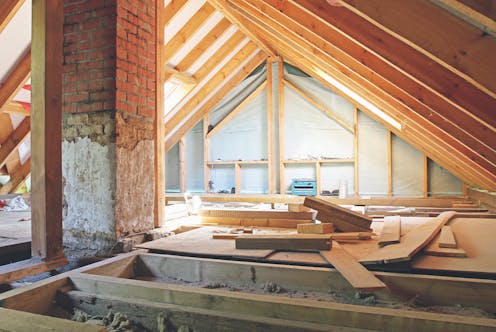
Our analysis shows a “thermal-first” approach – improving air tightness and insulation in roofs, walls and floors – optimises benefits from rooftop solar and electrification.
For example, freestanding houses represent 70% of Australian homes. Houses with lightweight walls such as weatherboard or brick veneer – along with a framed roof and either a concrete slab or suspended timber floor – make up nearly half of the total housing stock and are among the worst performing.
Upgrading the thermal performance of such houses across the country offers the biggest opportunity to reduce emissions, as well as significant household savings.
Show me the money
When combining thermal upgrades with electrifying hot water and cooking appliances, people living in detached houses could save on average between $1,850 and $2,200 a year off their energy bills.
Occupants of townhouses could save between $1,270 and $1,480 a year, and occupants in apartments between $1,030 and $1,200 a year.
As well as much-needed emissions savings for Australia, zero-carbon homes would deliver much-needed savings to residents as living costs continue to rise.
Even low levels of insulation combined with the switch from gas to electric space conditioning can save more than two tonnes a year of CO₂-equivalent per house, compared with a low-performing home built to pre-energy efficiency standards.
Improving home energy performance also has positive effects for Australia’s energy grids. Efficient homes that reduce the need to turn on heating and cooling appliances for long stretches during heatwaves and cold snaps also reduce demand on the energy grid. Each low-performing home upgraded to climate-ready would contribute to reducing peak demand by between 1.4 and 3.5 kilowatts.
Multiple benefits
As more energy sources become electrified under the net zero transition, reducing peak demand will both help to prevent brownouts, blackouts and unexpected power outages, and reduce electricity network costs for consumers.
The catch is that at today’s energy prices, it would takes more for residents to break even on climate-ready upgrades. But it is an area ripe for government support.
Two key planning documents the federal government has committed to releasing – an update to its Trajectory for Low Energy Buildings and a sectoral plan for the built environment – provide the government with the opportunity to embed policy that will support a wave of energy performance upgrades.
If policy supports a “go fast and go all-out” approach to energy performance upgrades in homes, a self-sustaining renovation wave will ensure more and more households live in resilient, climate-ready homes.
Authors: Gill Armstrong, Researcher in architecture and urban planning, Climateworks Centre