The Morrison government's biggest economic problem? Climate change denial
- Written by: Judith Brett, Emeritus Professor of Politics, La Trobe University
Last week Peter Costello accused Malcolm Turnbull of failing to develop an economic narrative to unite the Coalition. Turnbull promised this when he challenged Tony Abbott for the leadership of the Liberal Party, but, said Costello, it never came, and the result is a government struggling to manage deep differences over social issues. There was “jobs and growth”, but this is really just a goal without much of a story about how to get there, except for the company tax cuts.
The big question, though, is why the government does not have a coherent economic narrative.
One possible answer is that it has been too preoccupied with social issues such as religious freedom and before that, same-sex marriage, to give the economy sufficient attention. There is something in that.
But this does not get to the heart of the problem, which is the inability of the Coalition to face the reality of climate change and its stubborn determination to live in a parallel universe of business as usual. It is climate change denial that is preventing the government from developing a coherent economic narrative.
Read more: The pro-coal 'Monash Forum' may do little but blacken the name of a revered Australian
To be sure, those who doubt the seriousness of climate change are now more likely to describe themselves as sceptics rather than outright deniers, but the effects are the same. Doubting the risks of climate change, opposing serious counter measures and believing in coal’s long-term future is an identity issue for many Coalition politicians.
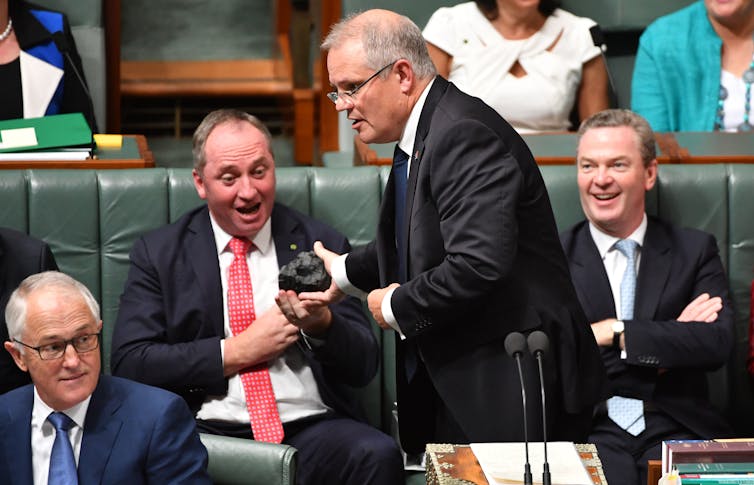 Then-treasurer Scott Morrison brings a lump of coal to question time in February 2017. Climate change denial is holding back the government from a clear economic strategy.
AAP/Mick Tsiakis
Then-treasurer Scott Morrison brings a lump of coal to question time in February 2017. Climate change denial is holding back the government from a clear economic strategy.
AAP/Mick Tsiakis
As an identity issue, it is largely impervious to evidence, as we saw in government ministers’ hasty dismissal of the recent Intergovernmental Panel on Climate Change report – before they had even read it, one suspects. Identity issues are also resistant to the normal processes of bargaining and compromise with which many political conflicts are resolved. The National Energy Guarantee was the last of the government’s energy policies to founder on the suspicion that a market mechanism might damage coal. Chief Scientist Alan Finkel’s Clean Energy Target met the same fate.
So now, some members of the party of private enterprise and the free market, which argued for and oversaw the privatisation of most of Australia’s power utilities, are seriously advocating that the government develop a coal-fired power station. Barnaby Joyce has been at it again in recent weeks.
When AGL announced the planned closure of its ageing Liddell coal-fired power station last year, the government strenuously tried to dissuade it, keep it running for longer or to sell it to rival power company Alinta. The pressure was very public on AGL to “do the right thing”, but also private, with Prime Minister Malcolm Turnbull ringing AGL Chairman Graeme Hunt. It was to no avail, and AGL persisted with its commercially based decision to close the plant and invest instead in the generation of renewable energy, as it had every right to do.
Read more: The true cost of keeping the Liddell power plant open
To state the obvious, the stubborn commitment to coal is pulling the government’s economic policy towards the sort of state socialism it is supposed to abhor. No wonder it is having difficulty developing a coherent economic narrative.
Further, it is alienating the government, and the Liberal Party in particular, from its natural supporters in the business community. With the collapse of the NEG, the government has no energy policy to provide certainty to business and investors. The focus of the new minister for energy, Angus Taylor, has contracted to reducing power prices for consumers. Climate policy has been shifted back into the portfolio of the Minister for the Environment, separating energy from emissions and further demonstrating the identity denialism that distorts the government’s economic narrative. Faced with doubts about Australia’s capacity to meet its agreed to Paris targets, the government blithely says we are “on track”.
Read more: Australia is not on track to reach 2030 Paris target (but the potential is there)
But most big business outside the fossil fuel industries is not in denial about the real risks of climate change, nor the imperatives of international action. Since Turnbull walked away from the NEG in a vain attempt to appease his critics and save his leadership, the Australian Industry Group and the Business Council of Australia have both been discussing ways to “go it alone” on emissions reduction.
Australian Financial Review journalist Phil Coorey last week quoted a member of the Business Council of Australia’s Energy and Climate Change Committee:
Someone has got to do something. This has to be industry-led unless government wants to take over the markets.
Industry needs certainty to invest, and to maintain and create the jobs that are central to the government’s focus on “jobs and growth”. That certainty needs to last beyond the tenure of one government or even two, and have bipartisan support.
Read more: Big firms voice lack of faith in 'cumbersome' and 'impractical' Emissions Reduction Fund
Yet the government is unwilling to provide that certainty. As Angus Taylor told an AFR National Energy Summit last week:
There is no room for bipartisanship when we have a 26% [reduction target] and the other side has 45%.
But because climate policy has become an identity issue for some members of the Coalition, and they fight on it tooth and nail, is has been removed from the normal processes of policy formation.
No wonder the government can’t develop a coherent economic narrative.
Authors: Judith Brett, Emeritus Professor of Politics, La Trobe University