Israel's AI can produce 100 bombing targets a day in Gaza. Is this the future of war?
- Written by Bianca Baggiarini, Lecturer, Australian National University
Last week, reports emerged that the Israel Defense Forces (IDF) are using an artificial intelligence (AI) system called Habsora (Hebrew for “The Gospel”) to select targets in the war on Hamas in Gaza. The system has reportedly been used to find more targets for bombing, to link locations to Hamas operatives, and to estimate likely numbers of civilian deaths in advance.
What does it mean for AI targeting systems like this to be used in conflict? My research into the social, political and ethical implications of military use of remote and autonomous systems shows AI is already altering the character of war.
Militaries use remote and autonomous systems as “force multipliers” to increase the impact of their troops and protect their soldiers’ lives. AI systems can make soldiers more efficient, and are likely to enhance the speed and lethality of warfare – even as humans become less visible on the battlefield, instead gathering intelligence and targeting from afar.
When militaries can kill at will, with little risk to their own soldiers, will the current ethical thinking about war prevail? Or will the increasing use of AI also increase the dehumanisation of adversaries and the disconnect between wars and the societies in whose names they are fought?
AI in war
AI is having an impact at all levels of war, from “intelligence, surveillance and reconnaissance” support, like the IDF’s Habsora system, through to “lethal autonomous weapons systems” that can choose and attack targets without human intervention.
These systems have the potential to reshape the character of war, making it easier to enter into a conflict. As complex and distributed systems, they may also make it more difficult to signal one’s intentions – or interpret those of an adversary – in the context of an escalating conflict.
To this end, AI can contribute to mis- or disinformation, creating and amplifying dangerous misunderstandings in times of war.
AI systems may increase the human tendency to trust suggestions from machines (this is highlighted by the Habsora system, named after the infallible word of God), opening up uncertainty over how far to trust autonomous systems. The boundaries of an AI system that interacts with other technologies and with people may not be clear, and there may be no way to know who or what has “authored” its outputs, no matter how objective and rational they may seem.
High-speed machine learning
Perhaps one of the most basic and important changes we are likely to see driven by AI is an increase in the speed of warfare. This may change how we understand military deterrence, which assumes humans are the primary actors and sources of intelligence and interaction in war.
Militaries and soldiers frame their decision-making through what is called the “OODA loop” (for observe, orient, decide, act). A faster OODA loop can help you outmanoeuvre your enemy. The goal is to avoid slowing down decisions through excessive deliberation, and instead to match the accelerating tempo of war.
So the use of AI is potentially justified on the basis it can interpret and synthesise huge amounts of data, processing it and delivering outputs at rates that far surpass human cognition.
But where is the space for ethical deliberation in an increasingly fast and data-centric OODA loop cycle happening at a safe distance from battle?
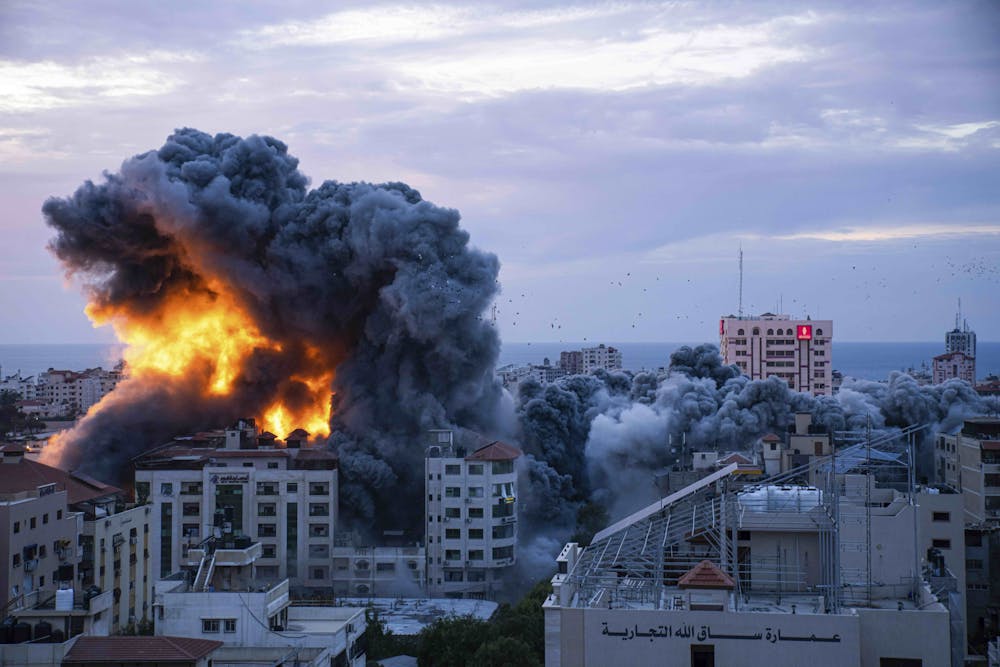
Israel’s targeting software is an example of this acceleration. A former head of the IDF has said that human intelligence analysts might produce 50 bombing targets in Gaza each year, but the Habsora system can produce 100 targets a day, along with real-time recommendations for which ones to attack.
How does the system produce these targets? It does so through probabilistic reasoning offered by machine learning algorithms.
Machine learning algorithms learn through data. They learn by seeking patterns in huge piles of data, and their success is contingent on the data’s quality and quantity. They make recommendations based on probabilities.
The probabilities are based on pattern-matching. If a person has enough similarities to other people labelled as an enemy combatant, they too may be labelled a combatant themselves.
The problem of AI enabled targeting at a distance
Some claim machine learning enables greater precision in targeting, which makes it easier to avoid harming innocent people and using a proportional amount of force. However, the idea of more precise targeting of airstrikes has not been successful in the past, as the high toll of declared and undeclared civilian casualties from the global war on terror shows.
Moreover, the difference between a combatant and a civilian is rarely self-evident. Even humans frequently cannot tell who is and is not a combatant.
Technology does not change this fundamental truth. Often social categories and concepts are not objective, but are contested or specific to time and place. But computer vision together with algorithms are more effective in predictable environments where concepts are objective, reasonably stable, and internally consistent.
Will AI make war worse?
We live in a time of unjust wars and military occupations, egregious violations of the rules of engagement, and an incipient arms race in the face of US–China rivalry. In this context, the inclusion of AI in war may add new complexities that exacerbate, rather than prevent, harm.
AI systems make it easier for actors in war to remain anonymous, and can render invisible the source of violence or the decisions which lead to it. In turn, we may see increasing disconnection between militaries, soldiers, and civilians, and the wars being fought in the name of the nation they serve.
And as AI grows more common in war, militaries will develop countermeasures to undermine it, creating a loop of escalating militarisation.
What now?
Can we control AI systems to head off a future in which warfare is driven by increasing reliance on technology underpinned by learning algorithms? Controlling AI development in any area, particularly via laws and regulations, has proven difficult.
Many suggest we need better laws to account for systems underpinned by machine learning, but even this is not straightforward. Machine learning algorithms are difficult to regulate.
Read more: US military plans to unleash thousands of autonomous war robots over next two years
AI-enabled weapons may program and update themselves, evading legal requirements for certainty. The engineering maxim “software is never done” implies that the law may never match the speed of technological change.
The quantitative act of estimating likely numbers of civilian deaths in advance, which the Habsora system does, does not tell us much about the qualitative dimensions of targeting. Systems like Habsora in isolation cannot really tell us much about whether a strike would be ethical or legal (that is, whether it is proportionate, discriminate and necessary, among other considerations).
AI should support democratic ideals, not undermine them. Trust in governments, institutions, and militaries is eroding and needs to be restored if we plan to apply AI across a range of military practices. We need to deploy critical ethical and political analysis to interrogate emerging technologies and their effects so any form of military violence is considered to be the last resort.
Until then, machine learning algorithms are best kept separate from targeting practices. Unfortunately, the world’s armies are heading in the opposite direction.
Authors: Bianca Baggiarini, Lecturer, Australian National University