

We're all responsible for preventing domestic violence – and men play a crucial role. Tony Birch's new novel makes the case
- Written by: Lynda Ng, Lecturer in World Literature (including Australian literature), The University of Melbourne
One of the most memorable tales from Tony Birch’s 2006 debut collection, Shadowboxing, is The Butcher’s Wife.
In this short story, the titular wife sensationally murders and dismembers her husband after he beats her in full view of everyone in the street. The physical distress of regular beatings is almost to be taken for granted in Birch’s rendition of 1960s Fitzroy. But public humiliation pushes the butcher’s wife past breaking point – and finally demands retaliation.
Birch turns an unsparing eye on domestic violence again in his latest novel, Women and Children, this time shining a spotlight on the societal conditions that enable abusers and entrap women in abusive relationships.
Review: Women and Children by Tony Birch (UQP)

Hypermasculine cowardice
Our introduction to the world of Women and Children comes via 11-year-old Joe Cluny, an inquisitive boy who frequently draws the ire of the nuns at his Catholic school. Joe’s inability to stay out of trouble makes him a strong point of contrast to his older sister, Ruby, who is such an exemplary model of student behaviour that she earns a farm-stay holiday as a reward.
Back in Fitzroy, the nuns’ enthusiasm for corporal punishment seems based on the rationale that misdeeds should be punished by physical blows. Joe is forced to question this moral logic when his aunt Oona shows up at their place one evening with swollen eyes and bruises across her body.
Joe’s mother, Marion, implicitly understands “Oona wouldn’t have turned up at her house that night unless she feared for her safety”. The Cluny family grows increasingly desperate as it becomes clear that without intervention, the escalating violence of Oona’s partner, Ray, can only result in her death.
Women are regarded as the weaker sex in this society and Birch’s emphasis is on the cowardice of a hypermasculine culture that victimises women rather than protects them.
The Cluny sisters never doubt they are on their own: Marion raises two children without help from her shady ex-husband and Oona finds herself rendered a human punching-bag with no recourse. Oona holds no illusions that assistance will be forthcoming – not from neighbours, nor the church, nor society as a whole.
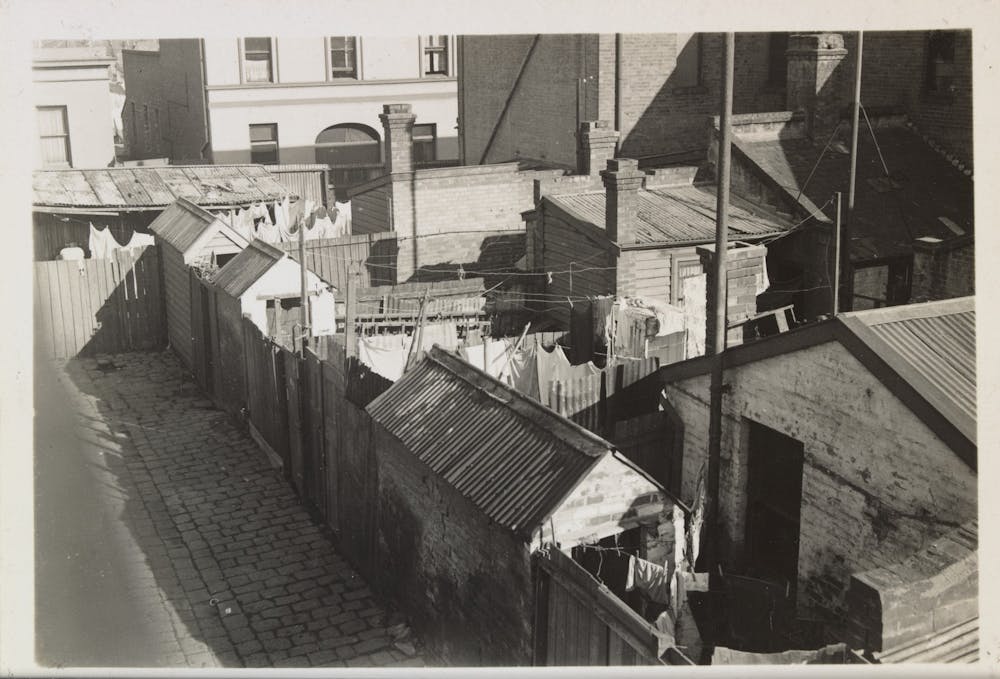 Women and Children is set in Fitzroy (pictured), where Tony Birch grew up.
F. Oswald Barnett Collection State Library of Victoria
Women and Children is set in Fitzroy (pictured), where Tony Birch grew up.
F. Oswald Barnett Collection State Library of Victoria
When the butcher of The Butcher’s Wife chases his wife out into the street, the neighbours hurriedly retreat into their houses to preserve a semblance of privacy.
In Women and Children, people similarly avert their gaze from Oona’s injuries as a sign of respect. Oona herself is reluctant to talk to Marion about her injuries, as to do so would be an admission of personal failure. The shame of being beaten both prevents Oona from seeking help and inhibits people from offering help.
Birch deliberately pierces the tight circle normally drawn around matters of the domestic sphere. By breaking the omerta around domestic violence, he suggests staying silent makes people complicit in the cruelty enacted against some of the most vulnerable people in society.
‘You tell police nothing’
Early on, Joe’s grandfather, Charlie, tells him a parable about a talking dog falsely accused of biting a man. Even though the dog can talk and would be able to give the police an exact description of the animal who was responsible, he stays silent. As a result, the police incarcerate him and eventually, put him down.
The moral of the story, as Charlie emphasises to Joe, is that the dog stays silent: “Because he knew, as everyone in the neighbourhood knows, human and animal both, that you tell police nothing. Not a word”.
This tightly knit community is bound together by its code of silence, a practice that fosters trust and guarantees a certain measure of autonomy in a hostile environment. Yet the silence of the streets also erects barriers that keep Oona dependent on her partner, Ray. She goes back to him, as women in abusive relationships often do, because she cannot see any pathway of escape.
Joe’s grandfather, Charlie, functions as an important counterpart to the women and children of the novel. Charlie has done his best to break the cycle of violence he grew up with and is, by all accounts, a gentle man. Having been a street-sweeper his entire life, he finds joy in salvaging items and provides a loving anchor of stability for his grandson. He retains a playful sensibility well into retirement, at one point even having a go on a swing in a deserted playground.
His ability to hold onto a memory of innocence effectively prevents Charlie from crossing over the threshold of violence that inevitably passes as a mark of manhood. Despite his best efforts to disentangle ideas of masculinity resolutely tied to aggression, at one point all Charlie can say to Marion is: “Men. We’re not much good.” And it is significant that Charlie’s personal refusal of violence is not enough to keep his daughters or grandchildren safe from the brutality of other men.
No nostalgia
Tony Birch has returned in his writing, time and again, to the slums of Fitzroy, where he grew up in the 1960s. There is a tendency to remember the 1960s as an exuberant time of social change. It was a tumultuous decade, where the rise of second-wave feminism and landmark progress made by Aboriginal activists arguably gave birth to the modern Australian nation.
 However, the types of stories Birch tells make it clear that the impulse to return does not stem from any nostalgia for the Australia of his childhood. It was only in 1965 that women won the right to drink in public bars, and in 1966 that they were no longer made to give up their jobs in the Commonwealth public service on getting married. (The right to equal pay came even later, in 1972.)
By the same token, it wasn’t until 1962 that all Aboriginal Australians had the right to vote in federal elections – and Queensland became the last state extend to voting rights to all Aboriginal and Torres Strait Islander people in the middle of the decade, in 1965.
At a time when Aboriginal communities are demonised for having a culture of violence and specifically targeted for state intervention, Birch’s carefully observed domestic scenes remind us of the constrained conditions women across Australia once operated within.
Misogyny and domestic violence are distasteful elements of the broader Australian culture that we would, by and large, prefer not to talk about.
Read more:
Damned Whores and God’s Police is still relevant to Australia 40 years on – more's the pity
A collective duty to act
Towards the end of Birch’s novel, the women are compelled to seize control of their own fates. Marion’s daughter, Ruby, returns from her farm-stay equipped with new skills to defend herself (and her younger brother Joe) from the bullying of local boys.
Her fearlessness and defiant nature seem to anticipate the wave of feminism that would seize hold of Australia in the 1970s – and the way boundaries between the private and public sphere would eventually collapse. Marion finally takes action to save her sister when no man seems willing to defend her.
Although these climactic moments involve women standing up to the bullying and intimidation of men, Birch does not allow us to forget the crucial role men play in the advance of feminism. Marion is only at liberty to deal with Ray because her caregiving duties have been taken over by Charlie. Having Joe out of the house and shielded from scenes of assault is an important step in breaking a cycle of normalised male violence.
Elsewhere, Birch has said:
We use that term (domestic violence) […] because it’s a crime committed overwhelmingly by men against women and children. Some of those children are male children.
Charlie’s willingness to provide safety and shelter to his grandson points the way forward to a world where caring for others is no longer considered a gender-specific role, but widespread and shared equally across the community. On this matter, Birch is unequivocal: when everyone knows someone is in trouble, there is a collective duty to do something about it.
Authors: Lynda Ng, Lecturer in World Literature (including Australian literature), The University of Melbourne
However, the types of stories Birch tells make it clear that the impulse to return does not stem from any nostalgia for the Australia of his childhood. It was only in 1965 that women won the right to drink in public bars, and in 1966 that they were no longer made to give up their jobs in the Commonwealth public service on getting married. (The right to equal pay came even later, in 1972.)
By the same token, it wasn’t until 1962 that all Aboriginal Australians had the right to vote in federal elections – and Queensland became the last state extend to voting rights to all Aboriginal and Torres Strait Islander people in the middle of the decade, in 1965.
At a time when Aboriginal communities are demonised for having a culture of violence and specifically targeted for state intervention, Birch’s carefully observed domestic scenes remind us of the constrained conditions women across Australia once operated within.
Misogyny and domestic violence are distasteful elements of the broader Australian culture that we would, by and large, prefer not to talk about.
Read more:
Damned Whores and God’s Police is still relevant to Australia 40 years on – more's the pity
A collective duty to act
Towards the end of Birch’s novel, the women are compelled to seize control of their own fates. Marion’s daughter, Ruby, returns from her farm-stay equipped with new skills to defend herself (and her younger brother Joe) from the bullying of local boys.
Her fearlessness and defiant nature seem to anticipate the wave of feminism that would seize hold of Australia in the 1970s – and the way boundaries between the private and public sphere would eventually collapse. Marion finally takes action to save her sister when no man seems willing to defend her.
Although these climactic moments involve women standing up to the bullying and intimidation of men, Birch does not allow us to forget the crucial role men play in the advance of feminism. Marion is only at liberty to deal with Ray because her caregiving duties have been taken over by Charlie. Having Joe out of the house and shielded from scenes of assault is an important step in breaking a cycle of normalised male violence.
Elsewhere, Birch has said:
We use that term (domestic violence) […] because it’s a crime committed overwhelmingly by men against women and children. Some of those children are male children.
Charlie’s willingness to provide safety and shelter to his grandson points the way forward to a world where caring for others is no longer considered a gender-specific role, but widespread and shared equally across the community. On this matter, Birch is unequivocal: when everyone knows someone is in trouble, there is a collective duty to do something about it.
Authors: Lynda Ng, Lecturer in World Literature (including Australian literature), The University of Melbourne 

















