

The first-ever survey on Australian attitudes towards space is out. So, what do we think?
- Written by: Tristan Moss, Senior lecturer, UNSW Sydney
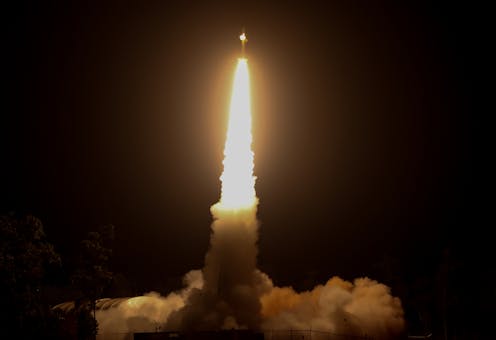
If someone were to ask you how space technologies impact your daily life, or how much Australia should invest in space, would you have an immediate answer or would you wonder why these questions were even being asked?
Understanding what the average Australian thinks about space is essential – voters and taxpayers will only encourage governments to fund space activities if they feel it is important.
Yet until now there was no comprehensive survey of Australian opinions about space in the 66 years since humans launched their first satellite in 1957.
Our new report shows what the Australian public thinks about Australia’s investment and activities in space and the results are eye opening.
Space tech is everywhere
You’ve probably used space technologies many times today without thinking about it. This includes navigation apps on your phone, paying for your coffee, checking the weather, high-speed internet and maybe even remote health services.
Data and services from satellites underpin activities vital to our national economy. Space helps farmers predict when to harvest their crops and GPS ensures ships, planes and trucks reach their destinations.
Information from space also lets us investigate climate change, assists in predicting bushfires and helps emergency services respond to floods. Pictures from space contribute to Indigenous land and water management and protecting cultural heritage.
What do Australians think about space?
To understand what the public thinks about space today, the Australian Centre for Space Governance commissioned a study, co-funded by UNSW Canberra, which polled a nationally representative sample of more than 1,500 members of the Australian public. Our report is the first of its kind.
Our results showed the Australian community is interested in space but is unsure about what Australia does there. One third of Australians agreed space affected their everyday life and 44% were neutral. Around half of those surveyed are interested in Australian space activities but only a quarter said they were knowledgeable of global space events.
Similarly, the number of Australians who follow the activities of the Australian Space Agency, established in 2018, was only around one fifth and an equal number had never heard of it.
Australia has a long history of space activities, usually in cooperation with international partners. Australia has tested rockets at Woomera in South Australia and supported US Moon landings. This included providing broadcast images to the world of the Apollo 11 Moon landing in 1967.
But when asked to choose from a list including tracking stations and Australian-born astronauts, more Australians remembered the 2001 comedy The Dish than any of Australia’s historic space activities.
In addition, only 16% of Australians were aware of the country’s first (and only) locally launched satellite, WRESAT, lofted into orbit on an American rocket from Woomera in 1967.
How much should Australia spend on space?
Space has also been a vital part of the country’s defence forces and a range of government functions that support Australia’s security and resilience. Around 50% of Australians felt the Australian Defence Force should prioritise space alongside other areas of defence interest.
Many people are aware of important applications of Earth observation satellites, like weather forecasting, mapping, disaster response and climate data. However, less than a quarter disagreed with the cancellation of the A$1.2 billion National Space Mission for Earth Observation, a proposed ongoing Earth observation satellite program. Of those surveyed, 45% were neutral and less than a quarter felt the mission should not have been cancelled.
Space missions also allow us to understand the universe. If you’ve ever looked at a picture sent back from a NASA probe, it’s highly likely the image was received at the tracking station just outside of Canberra, managed by CSIRO. Nearly 55% of Australians think it is important to invest in space science, even if there is no immediate social or economic benefit.
Overall, Australians are split about whether the country is spending the right amount on space. While 20% felt too little was spent on space technologies, 31% believed the amount was about right.
But the highest proportion, 36%, did not know. This is important, suggesting there isn’t sufficient information provided to the public.
What do these results mean for Australia’s space future?
Australians appear to be uncertain about the country’s space trajectory. But there were some clues about what direction the public feels Australia should take. Communication satellite technology and Earth observation were identified as the most important of the Australian Space Agency’s seven priorities.
Australians also saw building satellite capability as an important focus. But developing local launch capabilities was rated as the lowest priority, despite this often being the focus of media reporting.
Importantly, respondents saw space as a useful way to encourage study and work in the sciences. They also believed space activities should include a diverse representation of the community.
The clearest insight from this report is Australians are interested in space but are not very aware of what we do in space and why. This reflects longstanding national debates about government spending on space technologies.
There is an opportunity to address this. Clear messaging of how space services contribute to individual lives, national needs and government priorities, will help inform decision making.
It will also ensure those decisions align with what the public wants and values.
Authors: Tristan Moss, Senior lecturer, UNSW Sydney


















